North America Anti-Aging products Market Size, Share, and COVID-19 Impact Analysis, By Product Type (Facial Serum, Moisturizers, Creams & Lotions, Eye Care Products, Facial Cleanser & Exfoliators, Facial Masks & Peels, Sunscreen & Sun Protection, and Others), By Distribution Channel (Supermarkets & Hypermarkets, Pharmacy/Drugstores, Speciality Beauty Stores, Online/E-Commerce and Others), and North America Anti-Aging products Market Insights, Industry Trend, Forecasts to 2035
Industry: Healthcare
North America Anti-Aging products Market Insights Forecasts to 2035
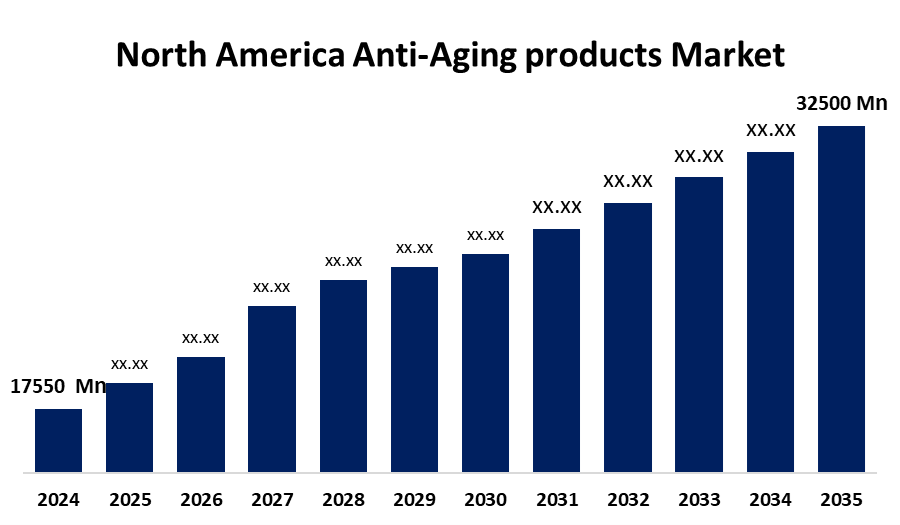
- The North America Anti-Aging products Market Size Was Estimated at USD 17,550 Million in 2024
- The Market Size is Expected to Grow at a CAGR of Around 5.76% from 2025 to 2035
- The North America Anti-Aging products Market Size is Expected to Reach USD 32,500 Million by 2035
Get more details on this report -
According to a research report published by Spherical Insights & Consulting, the North America Anti-aging products market size is anticipated to reach USD 32,500 million by 2035, growing at a CAGR of 5.76% from 2025 to 2035. The anti-aging products market in North America is driven by rising income of Millennials, increased self-consciousness and importance of grooming, and self-care and technological innovations such as skin 3.0 technologies, biotechnology-derived actives such as peptide complexes and microbiome-friendly ingredients, moving from clinical settings to over-the-counter anti-aging products.
Market Overview
The North America anti-aging products market refers to topical and clinical solutions that mitigate physiological aging signs like wrinkles and loss of elasticity, and is currently dominated by a sophisticated mix of product categories. These include high-potency facial serums, moisturizers, creams and lotions, eye care products, facial cleansers and exfoliators, facial masks and peels, and daily sunscreen and sun protection.
Innovation is currently driven by Skin 3.0 technologies, such as AI-powered diagnostic apps. This research-intensive landscape is bolstered by government support in the form of R&D tax credits in the U.S. and Canada, which incentivize the development of advanced molecular delivery systems. Key driving factors include the massive aging boomer demographic, rising disposable income, and the skinimalism trend, where consumers prioritize a few high-quality, clinically proven products over complex routines. Consequently, the market is evolving toward multifunctional, bio-compatible formulas that offer visible results without the need for invasive surgery.
Report Coverage
This research report categorizes the market for the North America anti-aging products based on various segments and regions, and forecasts revenue growth and analyses trends in each submarket. The report analyses the key growth drivers, opportunities, and challenges influencing the North America anti-aging products market. Recent market developments and competitive strategies, such as expansion, product launch, development, partnership, merger, and acquisition, have been included to draw the competitive landscape in the market. The report strategically identifies and profiles the key market players and analyses their core competencies in each sub-segment of the North America anti-aging products market.
North America Anti-Aging products Market Report Coverage
| Report Coverage | Details |
|---|---|
| Base Year: | 2024 |
| Market Size in 2024: | USD 17550 Million |
| Forecast Period: | 2025-2035 |
| Forecast Period CAGR 2025-2035 : | 5.76% |
| 2035 Value Projection: | USD 32500 Million |
| Historical Data for: | 2020-2023 |
| No. of Pages: | 2,011 |
| Tables, Charts & Figures: | 102 |
| Segments covered: | By Product Type, By Distribution Channel |
| Companies covered:: | Loreal, The Estée Lauder Companies, Procter & Gamble, Unilever, Johnson & Johnson, Shiseido, Beiersdorf, Galderma, Pierre Fabre, Coty, Revlon, Nu Skin, Mary Kay, Avon, Neutrogena, Others, and |
| Pitfalls & Challenges: | COVID-19 Empact, Challenge, Future, Growth, & Analysis |
Get more details on this report -
Driving Factors
The anti-aging products market in North America is driven by the convergence of demographic shifts and skin 3.0 technological breakthroughs. dual demand from the aging Baby Boomer and Gen X cohorts, who possess high disposable income, alongside the rise of prejuvenation among Millennials and Gen Z. These younger consumers are adopting preventative routines earlier, heavily influenced by social media and digital diagnostic tools.
Technological sophistication further fuels growth, with innovations in biotechnology-derived actives, such as peptide complexes and microbiome-friendly ingredients, moving from clinical settings to over-the-counter serums. Additionally, the normalization of male grooming has significantly widened the consumer base, as men increasingly seek targeted anti-aging solutions. The market is also being reshaped by skinimalism, where consumers prioritize high-potency, multifunctional products that address the exposome external stressors like UV and pollution, reflecting a broader cultural shift toward proactive, science-backed skin health.
Restraining Factors
The North America anti-aging products market is constrained by factors such as the high cost of premium clinical formulations, stringent regulatory oversight by the FDA and Health Canada regarding drug-like efficacy claims, which complicates product launches and marketing strategies and increasing consumer scepticism toward synthetic preservatives and misleading clean beauty labels creates a barrier to brand trust.
Market Segmentation
The North America anti-aging products market share is classified into product type and distribution channel.
- The moisturizers, creams & lotions segment accounted for the largest revenue market share in 2024 and is expected to grow at a significant CAGR during the forecast period.
The North America Anti-aging products market is segmented by product type into facial serum, moisturizers, creams & lotions, eye care products, facial cleanser & exfoliators, facial masks & peels, sunscreen & sun protection, and others. Among these, the moisturiser, creams & lotions segment accounted for the largest revenue market share in 2024 and is expected to grow at a significant CAGR during the forecast period. This is due to moisturisers, creams & lotions being viewed as a non-negotiable daily essential for all skin types. Market growth is sustained by the integration of active hero ingredients such as retinol, hyaluronic acid, and ceramides directly into daily creams. This allows consumers to address hydration and aging simultaneously, fulfilling the demand for high-value, multifunctional products.
- The supermarkets & hyper markets segment dominated the share in 2024 and is anticipated to grow at a remarkable CAGR during the forecast period.
Based on the distribution channel The North America anti-aging products market is segmented into supermarkets & hypermarkets, pharmacy/drugstores, speciality beauty stores, online/e-commerce and others. Among these, the supermarkets & hypermarkets segment dominated the share in 2024 and is anticipated to grow at a remarkable CAGR during the forecast period. Because of convenience and a broad pricing spectrum that appeals to both mass-market and mass-prestige consumers. These outlets provide immediate physical gratification and the ability to compare brands side-by-side, which remains the primary driver for routine skincare replenishment.
Competitive Analysis:
The report offers the appropriate analysis of the key organisations/companies involved within the North America anti-aging products market, along with a comparative evaluation primarily based on their product offering, business overviews, geographic presence, enterprise strategies, segment market share, and SWOT analysis. The report also provides an elaborate analysis focusing on the current news and developments of the companies, which includes product development, innovations, joint ventures, partnerships, mergers & acquisitions, strategic alliances, and others. This allows for the evaluation of the overall competition within the market.
List of Key Companies
- Loreal
- The Estée Lauder Companies
- Procter & Gamble
- Unilever
- Johnson & Johnson
- Shiseido
- Beiersdorf
- Galderma
- Pierre Fabre
- Coty
- Revlon
- Nu Skin
- Mary Kay
- Avon
- Neutrogena
- Others
Key Target Audience
- Market Players
- Investors
- End-users
- Government Authorities
- Consulting and Research Firm
- Venture capitalists
- Value-Added Resellers (VARs)
Recent Developments:
- In August 2024, Neutrogena launched the Visible Repair range in North America, specifically targeting the early aging concerns of younger Millennial and Gen Z consumers, emphasizing retinol and hyaluronic acid for preventative care.
Market Segment
This study forecasts revenue at the North America, regional, and country levels from 2020 to 2035. Spherical Insights has segmented the North America anti-aging products market based on the below-mentioned segments:
North America Anti-Aging products Market, By Product Type
- Facial Serum
- Moisturizers, Creams & Lotions
- Eye Care Products
- Facial Cleanser & Exfoliators
- Facial Masks & Peels
- Sunscreen & Sun Protection
- Others
North America Anti-Aging products Market, Distribution Channel
- Supermarkets & Hypermarkets
- Pharmacy/Drugstores
- Speciality Beauty Stores
- Online/E-Commerce
- Others
Need help to buy this report?