China Contraceptive Devices Market Size, Share, By Product Type (Male Contraceptive Devices, Female Contraceptive Devices), By Technology (Hormonal, Non-Hormonal), By Distribution Channel (Hospital Pharmacy, Retail Pharmacy, Online Channels, Clinics), By End Use (Hospitals, Homecare, Clinics), China Contraceptive Devices Market Insights, Industry Trend, Forecasts to 2035
Industry: Healthcare
China Contraceptive Devices Market Size Insights Forecasts to 2035
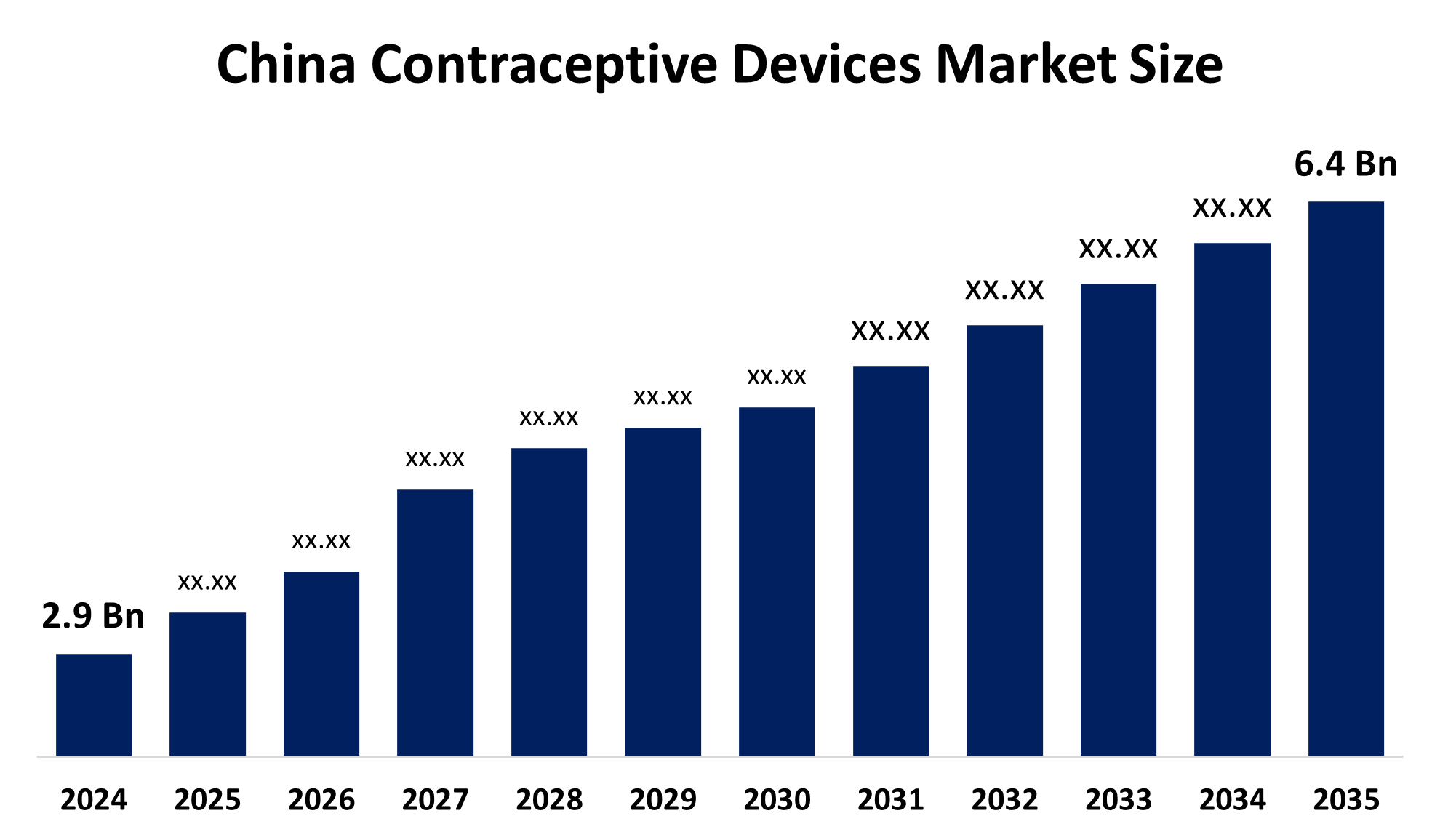
- China Contraceptive Devices Market Size 2024: USD 2.9 Billion
- China Contraceptive Devices Market Size 2035: USD 6.4 Billion
- China Contraceptive Devices Market CAGR 2024: 7.46%
- China Contraceptive Devices Market Segments: Product Type, Technology, Distribution Channel, and End Use.
Get more details on this report -
The China Contraceptive Devices Market comprises a wide range of products which serve the purpose of preventing unintended pregnancies while managing population growth through its distribution of condoms, intrauterine devices, contraceptive implants, diaphragms and vaginal rings. The devices provide their services to hospitals and clinics and pharmacies, and homecare settings which operate in both urban and rural areas. The market experiences growth because people become more knowledgeable about reproductive health, urban areas continue to develop, e-commerce services expand their reach and the government implements initiatives that support family planning and maternal health. The market adoption receives support from two developments, which include better safety features of hormonal and non-hormonal devices and the ability to safely access products through online platforms. Social attitudes about family planning have changed, while people spend more on healthcare services, which increases the demand for modern contraceptive solutions in China.
Government-supported public health campaigns together with national healthcare programs that provide contraceptive services have improved public access to these services. The government now directs its population control efforts toward reproductive health management because it has changed its approach to population control since the one-child policy ended. Women who work and study at higher education institutions now require dependable long-acting reversible contraceptives which has increased demand for these products. Future advances will happen because companies develop new biodegradable materials and create less intrusive delivery methods and implement digital health systems for fertility progress monitoring and establish partnerships with international healthcare organizations.
Market Dynamics of the China Contraceptive Devices Market:
The driving forces behind this market include family planning requirements, unintended pregnancy prevention efforts, and STD control programs. The Chinese government provides substantial support through its national health campaigns and contraceptive subsidy programs, which serve as essential drivers of the market. Modern reproductive health solutions and population control methods progress through technological advancements, including new hormonal devices and barrier systems, digital tracking applications, and biodegradable materials.
The market encounters multiple difficulties, including ethical concerns, stringent safety requirements for products, research and development expenses, and limitations on how certain devices can be used. The system encounters problems because of technical difficulties, challenges involved in expanding distribution capacity, and the requirement for specialized knowledge.
The future prospects for the contraceptive devices market in China are encouraging, and these include applications in the field of women's health, STD prevention, family planning, public health programs, and innovative, eco-friendly products. The increase in awareness campaigns, together with health organization investments and favourable regulatory policies has led to this situation.
Market Segmentation
The China contraceptive devices market share is classified into product type, technology, distribution channel, and end use.
By Product Type:
The China Contraceptive Devices Market is divided by product type into male contraceptive devices and female contraceptive devices. Among these, female contraceptive devices dominated the share in 2024 and are anticipated to grow at a remarkable CAGR during the forecast period. This dominance is attributed to the widespread adoption of intrauterine devices and contraceptive implants supported by hospital-based insertion procedures and government programs. Male contraceptive devices, particularly condoms, continue to hold a substantial share due to easy availability, affordability, and increasing awareness campaigns promoting safe sexual practices.
By Technology:
The market is divided by technology into hormonal and non-hormonal contraceptive devices. Among these, hormonal devices dominated in 2024 and are anticipated to grow at a remarkable CAGR during the forecast period. Hormonal intrauterine systems and implants offer long-term effectiveness, reduced failure rates, and convenience, making them preferred choices among urban women. However, non-hormonal devices such as copper IUDs and barrier methods maintain significant demand due to fewer systemic side effects and suitability for women with contraindications to hormonal therapies.
By Distribution Channel:
The market is divided by distribution channel into hospital pharmacy, retail pharmacy, online channels, and clinics. Among these, hospital pharmacies dominated in 2024 and are anticipated to grow at a remarkable CAGR during the forecast period. Hospitals remain primary centers for insertion of long-acting reversible contraceptives and professional counseling. However, online channels are witnessing rapid growth due to increased smartphone penetration, privacy advantages, and convenience in ordering products such as condoms and emergency contraceptive devices, especially among younger populations.
By End Use:
The market is divided by end use into hospitals, homecare, and clinics. Among these, hospitals dominated the share in 2024 and are anticipated to grow at a remarkable CAGR during the forecast period. Hospitals play a critical role in procedural contraceptive services, follow-up care, and management of side effects. Clinics also contribute significantly by offering accessible reproductive health consultations in urban and semi-urban areas. Homecare settings are expanding steadily due to the growing use of over-the-counter contraceptive products and telehealth support.
Competitive Analysis:
The report offers the appropriate analysis of the key organisations/companies involved within the China Contraceptive Devices Market, along with a comparative evaluation primarily based on their product offering, business overviews, geographic presence, enterprise strategies, segment market share, and SWOT analysis. The report also provides an elaborative analysis focusing on the current news and developments of the companies, which includes product development, innovations, joint ventures, partnerships, mergers & acquisitions, strategic alliances, and others. This allows for the evaluation of the overall competition within the market.
Top Key Companies in China Contraceptive Devices Market:
- Bayer AG
- Reckitt Benckiser Group plc
- Okamoto Industries, Inc.
- Humanwell Healthcare (Group) Co., Ltd.
- Church & Dwight Co., Inc.
- CooperSurgical, Inc.
- Fuji Latex Co., Ltd.
- Shanghai Dahua Pharmaceutical Co., Ltd.
- DKT International
- Pfizer Inc.
- Teva Pharmaceutical Industries Ltd.
- AbbVie Inc.
- Shandong Ming Yuan Latex Co. Ltd
Recent Developments in China Contraceptive Devices Market:
- In March 2025, Reckitt Benckiser Group plc expanded its Durex product portfolio in China with the launch of a next-generation ultra-thin condom range designed specifically for the Asian consumer base. The launch was supported by an integrated e-commerce and digital marketing collaboration with leading Chinese online retail platforms to strengthen brand penetration among younger demographics.
- In January 2025, Bayer AG announced the expansion of its women’s health division in China through enhanced hospital partnerships to promote its long-acting reversible contraceptive solutions, including hormonal intrauterine systems. The initiative focused on physician training programs and clinical awareness campaigns to increase adoption across Tier-1 and Tier-2 cities.
- In November 2024, Okamoto Industries, Inc. introduced a premium condom line in the Chinese market featuring improved elasticity and enhanced comfort technology. The product launch was accompanied by strategic retail collaborations to strengthen offline pharmacy distribution channels.
Key Target Audience
- Market Players
- Investors
- End-users
- Government Authorities
- Consulting and Research Firm
- Venture capitalists
- Value-Added Resellers (VARs)
Market Segment
This study forecasts revenue at the China, regional, and country levels from 2020 to 2035. Spherical Insights has segmented the China Contraceptive Devices Market based on the below-mentioned segments:
China Contraceptive Devices Market, By Product Type
- Male Contraceptive Devices
- Female Contraceptive Devices
China Contraceptive Devices Market, By Technology
- Hormonal
- Non-Hormonal
China Contraceptive Devices Market, By Distribution Channel
- Hospital Pharmacy
- Retail Pharmacy
- Online Channels
- Clinics
China Contraceptive Devices Market, By End Use
- Hospitals
- Homecare
- Clinics
Need help to buy this report?