Global Cell Surface Marker Detection Market Size, and Share, By Product (Flow Cytometry, Hematology Analyzers, and Reagents & Kits), By Application (Disease Diagnosis & Identification, Research & Drug Discovery, and Others), and By Region (North America, Europe, Asia-Pacific, Latin America, Middle East, and Africa), Analysis and Forecast 2026 - 2035.
Industry: Healthcare
Global Cell Surface Marker Detection Market Insights Forecasts to 2035
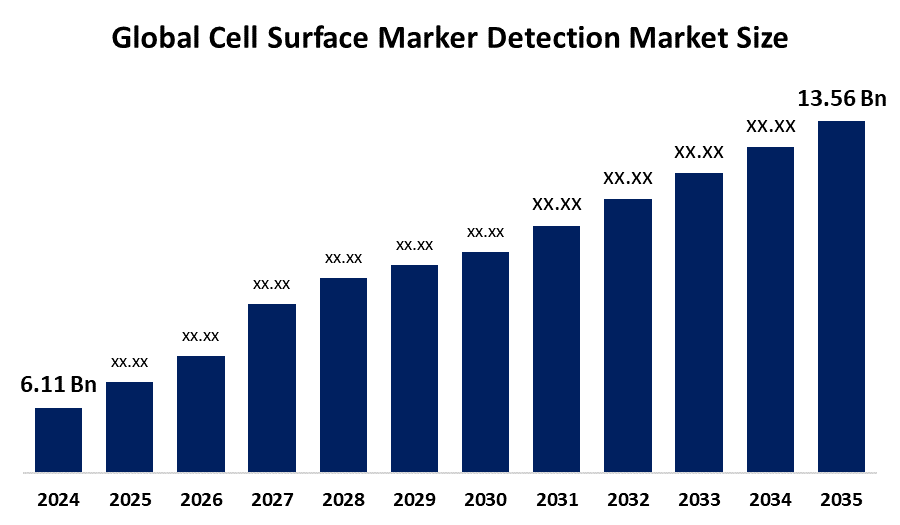
- The Global Cell Surface Marker Detection Market Size Was Estimated at USD 6.11 Billion in 2025
- The Market Size is Expected to Grow at a CAGR of around 8.3% from 2026 to 2035
- The Worldwide Cell Surface Marker Detection Market Size is Expected to Reach USD 13.56 Billion by 2035
- Asia Pacific is expected to grow the fastest during the forecast period.
Get more details on this report -
According to a research report published by Spherical Insights and Consulting, the global cell surface marker detection market size was worth around USD 6.11 billion in 2025 and is predicted to grow to around USD 13.56 billion by 2035 with a compound annual growth rate (CAGR) of 8.3% from 2026 to 2035. The market for cell surface marker detection is experiencing rapid growth because of increased needs for precision medicine and rising cancer rates, and improvements in flow cytometry and imaging technologies. The market expansion is driven by increased utilization of targeted therapies and companion diagnostics and increased funding for biomarker research.
Cell Surface Marker Detection Market Key Takeaways
- North America dominated the market with the largest share of 40% in 2025.
- Asia Pacific is expected to grow at the fastest CAGR during the forecast period.
- By product, the reagents and kits segment held a dominant share of the market in 2025, with an approximate 64% share.
- By product, the hematology analyzers segment is expected to grow at the fastest CAGR in the market between 2026 and 2035.
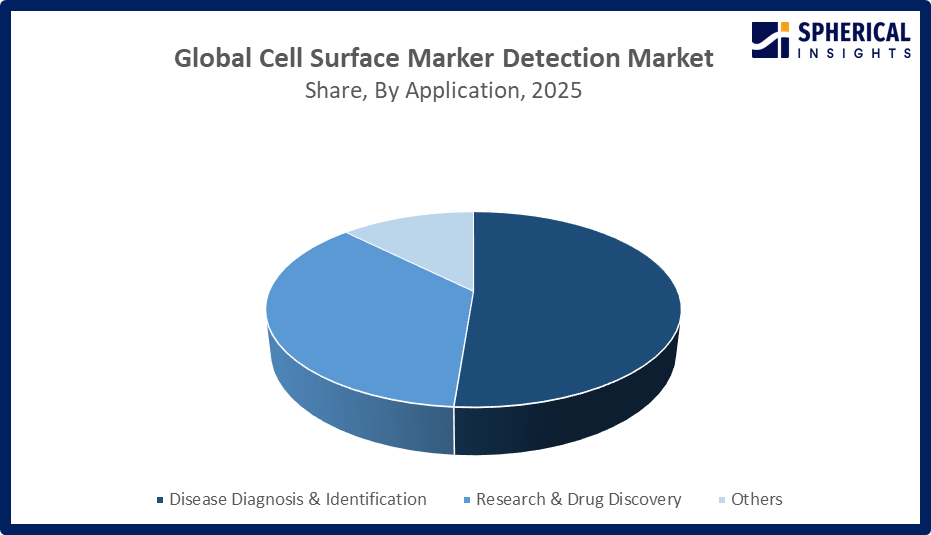
- By application, the disease diagnosis and identification segment led the global market in 2025, with an approximate 51% share.
- By application, the research and drug discovery segment is expected to grow with the highest CAGR in the market during the studied years.
Market Overview
The market for global cell surface marker detection technologies includes systems that identify and analyze proteins found on cell membranes because these technologies serve crucial functions in disease diagnosis, immunophenotyping and therapeutic research. The markers find extensive application in oncology and immunology and stem cell research because they enable the detection of cancer cells and immune system monitoring, and precise treatment selection. The market expansion occurs because cancer cases are increasing, which results in almost 10 million deaths each year, and people need more personalized medical treatment. The industry benefits from improvements in flow cytometry systems, PCR technology and next-generation sequencing platforms, which enable their use.
The rising financial backing for biotech and pharmaceutical research leads to increased research and development expenditures, which surpass $200 billion each year, and this trend fosters technological progress. Emerging markets and biomarker-based drug development present prospects because rising healthcare costs and increasing clinical research activities will drive demand for efficient solutions that enable accurate and fast detection of cell surface markers. In March 2025, the National Cancer Institute updated NIH funding opportunity PAR-25-074 to support validation of molecular and cellular biomarkers for cancer detection. The UH2/UH3 program funds two-year analytical and three-year clinical validation of assays, including pharmacodynamic and immune monitoring markers for clinical trials.
Cell Surface Marker Detection Market Trends
- Advancements in flow cytometry and imaging technologies: Modern tools like high-parameter flow cytometry and imaging cytometry enable simultaneous detection of multiple markers at single-cell resolution. This improves diagnostic accuracy and supports complex research in immunology and oncology.
- Growing adoption of single-cell analysis: Single-cell technologies are increasingly used to study cellular heterogeneity, especially in cancer. They allow precise identification of rare cell populations, driving demand for advanced marker detection solutions.
- Rising demand for precision medicine: Healthcare is shifting toward personalized treatments based on biomarkers. Cell surface marker detection plays a crucial role in selecting targeted therapies and companion diagnostics, boosting its clinical adoption.
Report Coverage
This research report categorizes the cell surface marker detection market based on various segments and regions, forecasts revenue growth, and analyzes trends in each submarket. The report analyses the key growth drivers, opportunities, and challenges influencing the cell surface marker detection market. Recent market developments and competitive strategies, such as expansion, type launch, development, partnership, merger, and acquisition, have been included to draw the competitive landscape in the market. The report strategically identifies and profiles the key market players and analyses their core competencies in each sub-segment of the cell surface marker detection market.
Global Cell Surface Marker Detection Market Report Coverage
| Report Coverage | Details |
|---|---|
| Base Year: | 2025 |
| Market Size in 2025: | USD 6.11 billion |
| Forecast Period: | 2025-2035 |
| Forecast Period CAGR 2025-2035 : | CAGR of 8.3% |
| 2035 Value Projection: | USD 13.56 billion |
| Historical Data for: | 2020-2024 |
| No. of Pages: | 187 |
| Tables, Charts & Figures: | 121 |
| Segments covered: | By Product,By Application |
| Companies covered:: | Becton, Dickinson and Company, Bio-Rad Laboratories Inc., Thermo Fisher Scientific Inc., Merck KGaA, F. Hoffmann-La Roche Ltd, Danaher Corporation, Miltenyi Biotec, Sysmex Corporation, Agilent Technologies Inc., Qiagen N.V., Siemens Healthineers, Abcam plc, Diasorin SpA, Nihon Kohden Corporation and other key players |
| Pitfalls & Challenges: | COVID-19 Empact, Challenge, Future, Growth, & Analysis |
Get more details on this report -
Driving Factors
Key drivers of the global cell surface marker detection market include the rising prevalence of cancer and chronic diseases, with cancer causing nearly 10 million deaths in 2022, fueling demand for precise diagnostic tools. The increasing adoption of flow cytometry and advanced technologies supports rapid, high-throughput analysis. The market expansion receives acceleration from biotechnology research investments, which will reach $300 billion by 2028, and the development of personalized medicine and immunotherapy treatments. The growth of companion diagnostics and drug discovery research, which shows a 7.5% annual rise in R&D investment, creates an increased need for cell surface marker detection in both clinical and research environments.
Restraining Factors
The major factors that restrict the market include expensive equipment, which makes flow cytometers inaccessible to low-income areas because their prices start at $50,000 and reach $200,000. The global workforce shortage of trained professionals, which stands at 30%, hampers precise data evaluation. The market faces difficulties because of slow regulatory processes and unstable reimbursement systems, which create problems for businesses operating in developing markets that lack proper healthcare systems.
Market Segmentation
Product Insights
Why do the reagents & kits hold the largest share in the cell surface marker detection industry?
The reagents & kits segment led the market, holding a major 64% share in 2025. Market growth is driven by increasing adoption of in vitro diagnostics, rapid advancements in diagnostic technologies, and rising use of consumables in techniques like Western blotting, immunohistochemistry, and flow cytometry. The non-reusable nature of kits and reagents leads to frequent repurchasing. Additionally, growing chronic disease prevalence and emphasis on precision medicine boost demand for accurate diagnostic solutions.
The hematology analyzers segment is expected to show the fastest growth over the forecast period. The segment growth is due to technological advancements in analyzers, including improved accuracy and automation, enhancing clinical efficiency. The rising prevalence of chronic and blood-related diseases increases demand for advanced diagnostics, while the growing adoption of precision medicine relies heavily on accurate blood analysis.
Application Insights
How has disease diagnosis & identification emerged as the dominant segment globally?
The disease diagnosis & identification segment held the 51% market share in 2025. The segment dominance is attributed to the rising prevalence of chronic diseases, including autoimmune disorders and cancer, requiring early and accurate diagnosis. Advancements in automation and high-throughput diagnostic technologies enhance detection efficiency and reliability. Cell surface markers enable precise identification of specific cell types, making them essential in clinical practice, while increasing focus on precision medicine further boosts demand.
The research & drug discovery segment is expected to gain the highest market share between 2025 and 2035. Segment growth is fueled by advancements in cell surface marker detection technologies, including automation and high-throughput screening. Rising focus on precision medicine, increased research–pharma collaborations, and growing prevalence of chronic diseases are further expanding applications and driving market demand.
Get more details on this report -
Regional Segment Analysis of the Cell Surface Marker Detection Market
- North America (U.S., Canada, Mexico)
- Europe (Germany, France, U.K., Italy, Spain, Rest of Europe)
- Asia-Pacific (China, Japan, India, Rest of APAC)
- South America (Brazil and the Rest of South America)
- The Middle East and Africa (UAE, South Africa, Rest of MEA)
What factors have led to North America's dominance in the cell surface marker detection market?
North America dominated the cell surface marker detection market by holding the largest share of 40% in 2025. The region is the leading market due to advanced healthcare infrastructure, high adoption of cutting-edge technologies, and strong presence of leading biotechnology and pharmaceutical companies such as Thermo Fisher Scientific and Danaher Corporation. Significant R&D investments and favorable government funding from agencies like the National Institutes of Health support innovation. Additionally, the high prevalence of cancer and chronic diseases, along with growing demand for precision medicine and early diagnosis, further strengthens regional market leadership. In April 2025, the Workshop on Recent Issues in Bioanalysis (19th WRIB) released a global white paper outlining recommendations on high-dimensional cytometry and single-cell imaging. The guidance supports evolving regulatory and industry standards, advancing technologies used in cell surface marker detection and bioanalytical research worldwide.
U.S. Cell Surface Marker Detection Market Trends
The U.S. cell surface marker detection market is growing due to rising cancer prevalence, increasing adoption of precision medicine, and strong funding from agencies like the National Institutes of Health. Advancements in flow cytometry and single-cell analysis, along with expanding biopharmaceutical research, further drive market expansion. In August 2025, researcher Lei Wang received a $673,600 NIH Trailblazer Award to develop programmable RNA-based sensors for in situ cell detection. The project uses Boolean logic to combine RNA signals, enabling precise identification and targeted treatment of diseased cells while sparing healthy tissue.
Why is Asia Pacific the fastest-growing region in the cell surface marker detection market?
Asia Pacific is expected to experience the fastest growth over the forecast period, with an approximate 18% market share. The region's growth is owing to expanding healthcare infrastructure, rising investments in biotechnology, and increasing government support for research and diagnostics. Countries like China and India are witnessing rapid growth in pharmaceutical and clinical research activities. Additionally, the rising prevalence of chronic diseases, growing awareness of early diagnosis, and increasing adoption of advanced technologies are accelerating demand for cell surface marker detection solutions across the region. In September 2025, the National Medical Products Administration issued clinical evaluation guidelines for cancer screening IVDs. The framework requires strong clinical evidence, population-based validation, and rigorous trials, ensuring screening tools meet performance, safety, and risk–benefit standards while supporting effective public health outcomes.
India Cell Surface Marker Detection Market Trends
India’s cell surface marker detection market is expanding due to rising cancer and autoimmune disease cases, increasing adoption of advanced diagnostics, and growing investment in biotechnology research. Government initiatives and expanding healthcare infrastructure, along with rising demand for precision medicine and early disease detection, are further accelerating market growth.
How is the opportunistic rise of Europe in the cell surface marker detection market?
Europe’s cell surface marker detection market is experiencing opportunistic growth driven by strong research funding, supportive regulatory frameworks, and increasing focus on precision medicine. Programs led by organizations like European Commission boost innovation. Rising cancer prevalence, expanding biopharmaceutical R&D, and adoption of advanced technologies such as flow cytometry and single-cell analysis further accelerate regional market expansion.
Competitive Analysis:
The report offers the appropriate analysis of the key organizations/companies involved within the cell surface marker detection market, along with a comparative evaluation primarily based on their type of offering, business overviews, geographic presence, enterprise strategies, segment market share, and SWOT analysis. The report also provides an elaborative analysis focusing on the current news and developments of the companies, which includes type development, innovations, joint ventures, partnerships, mergers & acquisitions, strategic alliances, and others. This allows for the evaluation of the overall competition within the market.
List of Key Companies
- Becton, Dickinson and Company
- Bio-Rad Laboratories Inc.
- Thermo Fisher Scientific Inc.
- Merck KGaA
- F. Hoffmann-La Roche Ltd
- Danaher Corporation
- Miltenyi Biotec
- Sysmex Corporation
- Agilent Technologies Inc.
- Qiagen N.V.
- Siemens Healthineers
- Abcam plc
- Diasorin SpA
- Nihon Kohden Corporation
- Others
Key Target Audience
- Market Players
- Investors
- End-users
- Government Authorities
- Consulting and Research Firm
- Venture capitalists
- Value-Added Resellers (VARs)
Recent Development
- In March 2026, Siemens Healthineers expanded brain health research offerings with Atellica IM pTau217 and BDTau assays. These blood-based tests enable less-invasive Alzheimer’s biomarker detection, addressing a disease affecting 60-70% of dementia cases globally and improving research and diagnostic capabilities.
- In December 2025, BD (Becton, Dickinson and Company) announced the global launch of new BD FACSDiscover A8 Cell Analyzer configurations. Featuring SpectralFX and CellView technologies, these systems enable analysis of 50+ cell characteristics with real-time imaging, enhancing research capabilities across immunology, cancer immunotherapy, and cell biology.
- In April 2024, Merck launched the Aptegra CHO genetic stability assay, an all-in-one solution using next-generation sequencing. Replacing multiple traditional tests, it reduces testing time by 66% and costs by 43%, accelerating biosafety validation and supporting faster biopharmaceutical production.
- In March 2024, Bio-Rad Laboratories launched validated antibodies for rare cell and circulating tumor cell detection. Compatible with Celselect kits and the Genesis Cell Isolation System, the solution enables sensitive identification, capture, and analysis of tumor cells, supporting research on tumor heterogeneity and disease progression.
- In May 2023, Sysmex Corporation launched the XF-1600 flow cytometer, PS-10 sample preparation system, and reagents in Japan. The integrated system automates flow cytometry testing, improving efficiency, accuracy, and standardization in diagnosing hematological diseases such as leukemia and lymphoma while reducing manual workload.
Market Segment
This study forecasts revenue at global, regional, and country levels from 2020 to 2035. Spherical Insights has segmented the cell surface marker detection market based on the below-mentioned segments:
Global Cell Surface Marker Detection Market, By Product
- Flow Cytometry
- Hematology Analyzers
- Reagents & Kits
Global Cell Surface Marker Detection Market, By Application
- Disease Diagnosis & Identification
- Research & Drug Discovery
- Others
Global Cell Surface Marker Detection Market, By Regional Analysis
- North America
- US
- Canada
- Mexico
- Europe
- Germany
- UK
- France
- Italy
- Spain
- Russia
- Rest of Europe
- Asia Pacific
- China
- Japan
- India
- South Korea
- Australia
- Rest of Asia Pacific
- South America
- Brazil
- Argentina
- Rest of South America
- Middle East & Africa
- UAE
- Saudi Arabia
- Qatar
- South Africa
- Rest of the Middle East & Africa
Need help to buy this report?