Global Biodegradable Water Bottles Market Size, Share, and COVID-19 Impact Analysis, By Capacity (500 ml and Below, 500 ml -1,000 ml, and 1,000 ml and Above), By Material (Plant-Based Plastics, Cellulose, and Paper & Cardboard), and By Region (North America, Europe, Asia-Pacific, Latin America, Middle East, and Africa), Analysis and Forecast 2025 - 2035.
Industry: Consumer Goods
Global Biodegradable Water Bottles Market Insights Forecasts to 2035
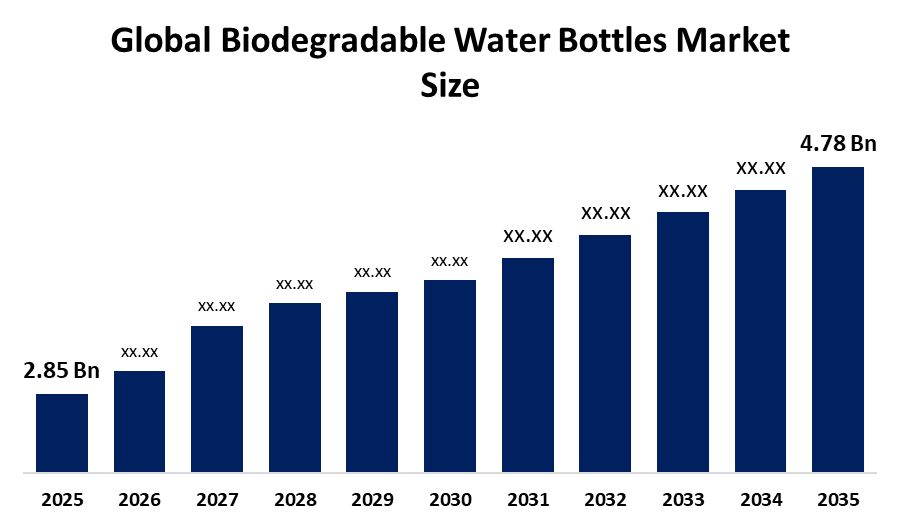
- The Global Biodegradable Water Bottles Market Size Was Estimated at USD 2.85 Billion in 2025
- The Market Size is Expected to Grow at a CAGR of around 5.31% from 2026 to 2035
- The Worldwide Biodegradable Water Bottles Market Size is Expected to Reach USD 4.78 Billion by 2035
Get more details on this report -
Key Takeaways -
- North America dominated the market with the largest share in 2025.
- Asia Pacific is expected to grow the fastest during the forecast period.
- By capacity, the 500 ml -1,000 ml segment dominates the market with the largest share, while the 1,000 ml and above segment is the rapidly growing segment in the market.
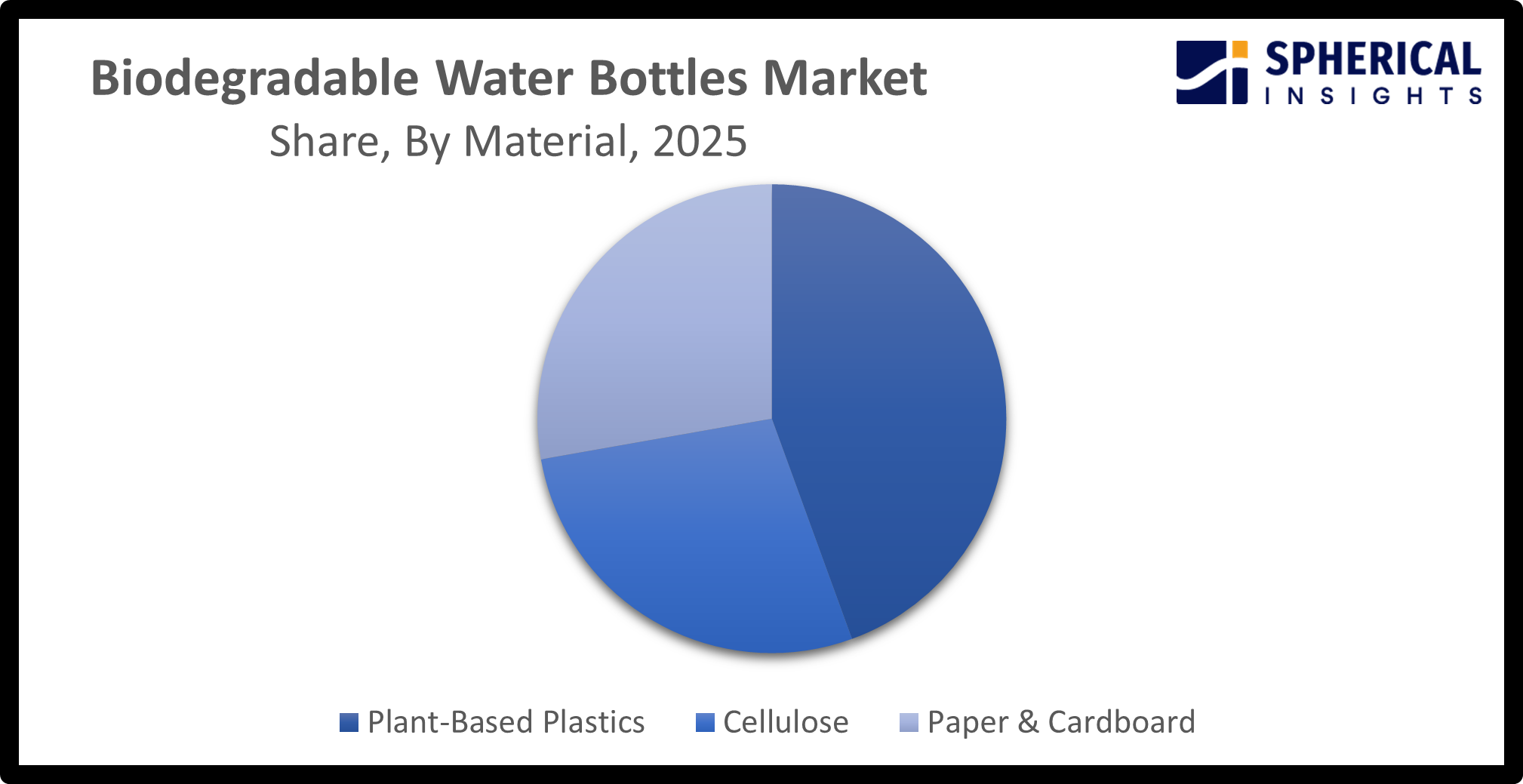
- By material, the plant-based plastics segment is anticipated to hold the dominant share, on the other hand, the cellulose segment is emerging in the biodegradable water bottles market.
According to a research report published by Spherical Insights and Consulting, the Global Biodegradable Water Bottles Market size was worth around USD 2.85 Billion in 2025 and is predicted to grow to around USD 4.78 Billion by 2035 with a compound annual growth rate (CAGR) of 5.31% from 2026 and 2035. The market for biodegradable water bottles has a number of opportunities to grow due to the emergence of algae-based options, with high profit margins in paper-based alternatives.
Key Trends in Biodegradable Water Bottles Market –
- Adoption of plant-based materials such as PLA and algae
- Increased investment in R&D and strategic acquisition for enhancing production
- Inclination towards circular economy models
Market Overview
The global biodegradable water bottles industry is the market providing eco-friendly packaging alternatives made from materials such as polylactic acid (PLA, derived from corn/sugarcane), plant-based plastics, algae, and paper, designed to decompose in 180 days or less. Plastic pollution concerns, government bans, and demand for sustainability are rapidly escalating the biodegradable water bottles market. Unlike traditional plastic bottles, which have persisted for centuries, these eco-friendly alternatives decompose into natural compounds that the ecosystem can safely absorb.
Innovation and market expansion are anticipated as a result of major players' growing R&D expenditures and expanding partnerships. For instance, in November 2022, Kygo, Diplo, and More invested in Cove, the World’s first biodegradable water bottle. The ongoing initiative to make single-use plastics a thing of the past has broken new ground with Cove, the world’s first biodegradable water bottle.
Report Coverage
This research report categorizes the biodegradable water bottles market based on various segments and regions, forecasts revenue growth, and analyzes trends in each submarket. The report analyses the key growth drivers, opportunities, and challenges influencing the biodegradable water bottles market. Recent market developments and competitive strategies such as expansion, type launch, development, partnership, merger, and acquisition have been included to draw the competitive landscape in the market. The report strategically identifies and profiles the key market players and analyses their core competencies in each sub-segment of the biodegradable water bottles market.
Driving Factors
Growing inclination towards sustainable products
Consumer increased awareness about sustainability, regulatory changes enabling reduced plastic usage, and enhancement of product durability and usability due to technological advancements in materials are contributing to driving the biodegradable water bottles market. For instance, Vietnamese consumers demand sustainable convenience in packaging. Consumers are increasingly on the go, juggling work and personal commitments, which has led to a surge in demand for grab-and-go food and drink.
Stricter government regulations on plastics
With a population of over 1.3 million people, India is one of the largest producers of plastic waste and faces considerable challenges in managing the generated waste efficiently. The Plastic Waste Management Rules, 2024, aim to address the management issue through stricter regulations for biodegradables and microplastics. The rules in India also serve as a foundational step through the introduction of extended producer responsibility (EPR). An exponential increase in plastic waste is driving the need for stringent regulation and transition toward a circular economy, which is contributing to propel the market growth.
Restraining Factors
Increased production costs, limited material availability, inferior barrier properties for long-term storage, and misconceptions about durability are hindering its adoption, thereby challenging the biodegradable water bottles market.
Market Segmentation
The Biodegradable Water Bottles Market share is classified into capacity and material.
- The 500 ml -1,000 ml segment dominated the market with the largest share in 2025 and is projected to grow at a substantial CAGR during the forecast period.
Based on the capacity, the biodegradable water bottles market is divided into 500 ml and below, 500 ml –1,000 ml, and 1,000 ml and above. Among these, the 500 ml -1,000 ml segment dominated the market with the largest share in 2025 and is projected to grow at a substantial CAGR during the forecast period.This is due to its use on a standard and daily basis. The 500 – 1,000 ml range bottles strikes balance between convenience and consumer usability, appealing to a wide array of customers from casual users to those with on-the-go hydration needs. While the 1,000 ml and above segment is the emerging segment in the biodegradable water bottles market, due to its use at residential or bulk scale.
- The plant-based plastics segment accounted for the largest market share in 2025 and is projected to grow at a substantial CAGR during the forecast period.
Based on the material, the biodegradable water bottles market is divided into plant-based plastics, cellulose, and paper & cardboard. Among these, the plant-based plastics segment accounted for the largest market share in 2025 and is projected to grow at a substantial CAGR during the forecast period. Plant-based plastic bottles are often made from polylactic acid (PLA) derived from cornstarch or sugarcane. The growing demand for sustainable, biodegradable alternatives to petroleum-based PET, especially in the beverage and cosmetic sectors, contributes to driving the segmental market growth. Further, the cellulose segment is a growing segment driven by demand for sustainable materials, often using cellulose derived from wood pulp, bamboo, or agricultural waste.
Get more details on this report -
Regional Segment Analysis of the Biodegradable Water Bottles Market
- North America (U.S., Canada, Mexico)
- Europe (Germany, France, U.K., Italy, Spain, Rest of Europe)
- Asia-Pacific (China, Japan, India, Rest of APAC)
- South America (Brazil and the Rest of South America)
- The Middle East and Africa (UAE, South Africa, Rest of MEA)
North America is anticipated to hold the largest share of the biodegradable water bottles market over the predicted timeframe.
North America is anticipated to hold the largest share of about 45.0% in the biodegradable water bottles market over the predicted timeframe. The market ecosystem in North America is strong, due to brands like Los Angeles-based Cove, which produces the first PHA-based, marine-degradable bottle. Further, an increasing consumer need for sustainable alternatives, stringent government regulations against single-use plastics and increased environmental awareness are propelling the biodegradable water bottles market. The U.S. is leading the North America biodegradable water bottles market, due to inclination towards sustainable alternatives, along with the stringent regulations on single-use plastics.

Get more details on this report -
Asia Pacific is expected to grow at a rapid CAGR in the biodegradable water bottles market during the forecast period, holding about 26.0% share in 2025. The Asia Pacific area has a thriving market for biodegradable water bottles due to the growing environmental awareness and high-growth, urbanization-heavy markets like India, China, and Japan. Due to their governments’ increased adoption of biodegradable water bottles through stringent regulations and sustainability mandates, the market is expected to grow. Regional policies like the ASEAN Regional Action Plan are driving waste management reform. China is the leading country in the region’s market, owing to the presence of key players like GracePack that produce compostable, plant-based, and PLA-based alternatives, providing solutions to conventional plastic pollution.
Competitive Analysis:
The report offers the appropriate analysis of the key organizations/companies involved within the biodegradable water bottles market, along with a comparative evaluation primarily based on their type of offering, business overviews, geographic presence, enterprise strategies, segment market share, and SWOT analysis. The report also provides an elaborative analysis focusing on the current news and developments of the companies, which includes type development, innovations, joint ventures, partnerships, mergers & acquisitions, strategic alliances, and others. This allows for the evaluation of the overall competition within the market.
List of Key Companies
- Lyspackaging
- Mitsubishi Chemicals (MCPP)
- Cove
- Montana Private Reserve
- TSL Plastics Ltd.
- Paper Water Bottle
- TotalEnergies Corbion
- Ecologic Brands Inc.
- Just Water
- Raepack Ltd.
- Others
Key Target Audience
- Market Players
- Investors
- End-users
- Government Authorities
- Consulting And Research Firm
- Venture capitalists
- Value-Added Resellers (VARs)
Recent Development
- In February 2026, Hilly Aqua, Kerala’s public-sector packaged drinking water, launched biodegradable bottles. As part of a pilot project, the biodegradable option would initially be available in 300 ml bottles.
- In November 2025, World Aquatics seeks partners for sustainable feeding bottles in open water swimming. Yet despite increasing innovation in sustainable materials, few solutions currently meet the specific performance and safety needs of elite open water competition.
- In May 2025, Kerala-based startup Green Bio developed a range of fully biodegradable water bottles that mimic the appearance and function of plastic but break down completely within 180 days. The bottles are produced using polylactide (PLA), a bioplastic derived from renewable resources such as corn and sugarcane.
- In April 2025, the State govt launched eco-friendly water bottles at ‘Vrithi 2025’ Green Kerala Conclave. The initiative, led by Kerala Irrigation Infrastructure Development Corporation (KIIDC) under the department of irrigation, introduced drinking water packaged in compostable bottles under state’s ‘Hilly Aqua’ brand. These green bottles, while similar in appearance to plastic, are 100% biodegradable and compostable through natural processes.
- In January 2024, in a major step towards reducing plastic pollution, the Defence Food Research Laboratory (DFRL) in Mysuru, part of the Defence Research and Development Organisation (DRDO), introduced a groundbreaking product: India's first biodegradable water bottle.
- In September 2023, Mysuru-based Defence Food Research Laboratory developed biodegradable water bottles. The eco-friendly innovation is seen as a remedy to rampant plastic pollution; the bottle is compostable as per ISO 17088-2021 and IS 17899 T:2022 Standards.
Market Segment
This study forecasts revenue at global, regional, and country levels from 2020 to 2035. Spherical Insights has segmented the Biodegradable Water Bottles Market based on the below-mentioned segments:
Global Biodegradable Water Bottles Market, By Capacity
- 500 ml and Below
- 500 ml –1,000 ml
- 1,000 ml and Above
Global Biodegradable Water Bottles Market, By Material
- Plant-Based Plastics
- Cellulose
- Paper & Cardboard
Global Biodegradable Water Bottles Market, By Regional Analysis
- North America
- US
- Canada
- Mexico
- Europe
- Germany
- UK
- France
- Italy
- Spain
- Russia
- Rest of Europe
- Asia Pacific
- China
- Japan
- India
- South Korea
- Australia
- Rest of Asia Pacific
- South America
- Brazil
- Argentina
- Rest of South America
- Middle East & Africa
- UAE
- Saudi Arabia
- Qatar
- South Africa
- Rest of the Middle East & Africa
Need help to buy this report?