Global Autonomous Rail Bolt Tightening Market Size, Share, and COVID-19 Impact Analysis, By Product (Autonomous Bolt Tightening Systems, Semi-autonomous Bolt Tightening Tools, and Manual/Assisted Bolt Tightening Tools), By Application (Rail Installation & Assembly, Maintenance & Repair Operations, and Inspection-Led Remediation), By End-User (Rail Infrastructure Contractors, Rail Operators/Maintenance Teams, and OEMs and Service Providers), and By Region (North America, Europe, Asia-Pacific, Latin America, Middle East, and Africa), Analysis and Forecast 2025 - 2035

Industry: Construction & Manufacturing

RELEASE DATE Feb 2026
REPORT ID SI18698
PAGES 195
REPORT FORMAT PathSoft

Global Autonomous Rail Bolt Tightening Market Size Insights Forecasts to 2035

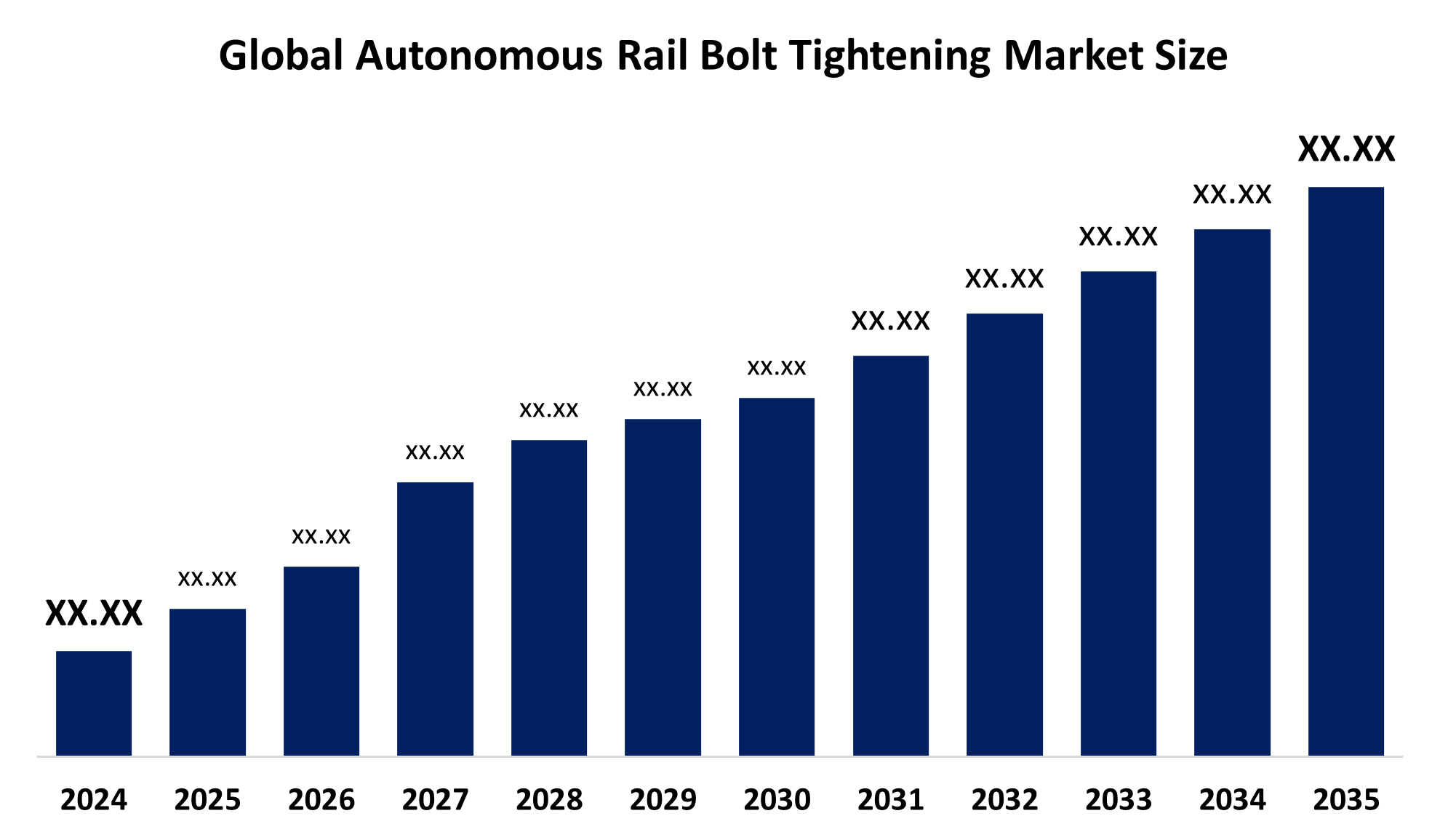
  • The Market Size is Expected to Grow at a CAGR of around 13% from 2025 to 2035
  • The Worldwide Autonomous Rail Bolt Tightening Market Size is expected to hold a significant share by 2035
  • North America is expected to grow the fastest during the forecast period.
Get more details on this report -

Request Free Sample PDF

According to a research report published by Spherical Insights and Consulting, The Global Autonomous Rail Bolt Tightening Market Size is Expected to hold a significant share by 2035, at a CAGR of 13% during the forecast period 2025-2035. The global autonomous rail bolt tightening market is growing due to rising rail infrastructure investments, the demand for maintenance efficiency, and the adoption of automation. Digital inspection, together with robotics technology, enables safe operations that reduce system downtime, thereby driving the deployment of autonomous tightening systems across expanding passenger and freight transportation networks.


Market Overview

The Global Autonomous Rail Bolt Tightening Market comprises AI-powered robotic systems designed to independently navigate railway tracks, detect fasteners through computer vision and sensors, locate bolts or nuts, and apply precise torque, which typically ranges between 100 and 1,900 Nm, through a fully automated cycle that requires no manual work. These machines primarily perform preventive and corrective track maintenance work on high-speed rail, metro, and conventional lines to ensure secure fastener connections, which protect against derailments while minimizing track downtime. The market experiences growth because rail infrastructure spending and automation technology are becoming more widespread. The rapid growth of the rail industry results from China's high-speed rail network expansion, which covers 45000 kilometres, and its maintenance labor shortages, safety requirements and its increased train operation needs, which demand ongoing predictive maintenance.


The opportunities of IoT-integrated systems together with 5G-enabled remote monitoring systems create an opportunity to decrease maintenance downtime by 20 to 30%. The need to update old rail infrastructure throughout North America and developing countries creates a strong growth market for autonomous bolt tightening solutions. The Prime Minister of India, Narendra Modi, inaugurated a rail project which costs Rs.7,200 crore in East Champaran, Bihar on July 2025 to support the development of smart railway systems. The system optimizes operational efficiency through its AI-based signaling system, IIoT-controlled control rooms, robotics technology, predictive maintenance systems, and autonomous inspection equipment, which together maintain advanced Vande Bharat maintenance operations.


Report Coverage

This research report categorizes the Global Autonomous Rail Bolt Tightening Market based on various segments and regions, forecasts revenue growth, and analyzes trends in each submarket. The report analyses the key growth drivers, opportunities, and challenges influencing the autonomous rail bolt tightening market. Recent market developments and competitive strategies, such as expansion, type launch, development, partnership, merger, and acquisition, have been included to draw the competitive landscape in the market. The report strategically identifies and profiles the key market players and analyses their core competencies in each sub-segment of the autonomous rail bolt tightening market.  


Global Autonomous Rail Bolt Tightening Market Report Coverage

Report CoverageDetails
Base Year:2024
Forecast Period:2025-2035
Forecast Period CAGR 2025-2035 :13%
Historical Data for:2020-2023
No. of Pages:195
Tables, Charts & Figures:102
Segments covered:By Product, By Application
Companies covered::Pujara Engineers, Hitachi Rail, Bosch Rexroth, CRRC Corporation Limited, Kawasaki Heavy Industries, Desoutter, ASG Jergens, Delta Regis, Cleco, Atlas Copco, Nitto Kohki, ITH Bolting Technology, Desoutter, Kolver and Other Key Players
Pitfalls & Challenges:and COVID-19 Impact Analysis

Get more details on this report -

Request Free Sample PDF
 

Driving Factors

The Global Autonomous Rail Bolt Tightening Market is expanding due to rising demand for automation that enhances safety and operational efficiency. The lengthy manual process of rail inspections, together with maintenance work, leads operators to use robotic systems. Autonomous systems produce reliable fastening results, which decrease downtime throughout extended rail systems. The implementation of rail infrastructure development and modernization projects by governments boosts adoption rates throughout the industry. Advanced rail inspection robots can reduce inspection time by up to 50%, while AI-enabled maintenance systems lower maintenance costs by nearly 30%. The market growth potential receives a boost from ongoing progress in artificial intelligence, smart sensor technology, and machine learning systems.


Restraining Factors

The Global Autonomous Rail Bolt Tightening Market faces two major obstacles, which include the expensive initial investment needed to acquire advanced robots and sensors and the costs of integrating those systems into existing rail networks. The process of adopting new technologies faces delays because organizations deal with three main issues, which include the requirement to integrate their systems with old infrastructure, the need for workforce training and the need to obtain regulatory certifications.


Market Segmentation

The autonomous rail bolt tightening market share is classified into product, application, and end-user.  


  • The autonomous bolt tightening systems segment dominated the market in 2024, approximately 50% and is projected to grow at a substantial CAGR during the forecast period.

Based on the product, the Global Autonomous Rail Bolt Tightening Market is divided into autonomous bolt tightening systems, semi-autonomous bolt tightening tools, and manual/assisted bolt tightening tools. Among these, the autonomous bolt tightening systems segment dominated the market in 2024, approximately 50% and is projected to grow at a substantial CAGR during the forecast period. The market expansion of autonomous bolt tightening systems results from their ability to achieve high-precision (±1% torque accuracy) performance, their compatibility with Industry 4.0 technologies, and their use in electric vehicle and aerospace production, which requires faultless component assembly. The systems enable organizations to collect real-time information while using predictive maintenance capabilities, and their operational speed increases by 20-30%, which results in wider acceptance in the automotive and rail industries.


Get more details on this report -

Request Free Sample PDF
  • The maintenance & repair operations segment accounted for the largest share in 2024, approximately 55% and is anticipated to grow at a significant CAGR during the forecast period.

Based on the application, the Global Autonomous Rail Bolt Tightening Market is divided into rail installation & assembly, maintenance & repair operations, and inspection-led remediation. Among these, the maintenance & repair operations segment accounted for the largest share in 2024, approximately 50% and is projected to grow at a substantial CAGR during the forecast period. The maintenance & repair operations segment market growth is due to aging rail infrastructure in North America and Europe requiring continuous upkeep and frequent bolt retightening from vibration and traffic loads. The segment guarantees track safety and operational reliability because 55% of global rail maintenance spending goes towards renewal activities.


  • The rail operators/maintenance teams segment accounted for the highest market revenue in 2024, approximately 43% and is anticipated to grow at a significant CAGR during the forecast period.

Based on the end-user, the Global Autonomous Rail Bolt Tightening Market is divided into rail infrastructure contractors, rail operators/maintenance teams, and OEMs & service providers. Among these, the rail operators/maintenance teams segment accounted for the highest market revenue in 2024, approximately 43% and is anticipated to grow at a significant CAGR during the forecast period. The rail operators/maintenance teams segment market growth is due to the responsibility for continuous track maintenance across existing networks, requiring regular bolt tightening and inspection. Operators need to spend 111.42 billion in 2023 for global rail infrastructure maintenance, which contractors will not manage because they only deal with specific construction tasks.


Regional Segment Analysis of the Autonomous Rail Bolt Tightening Market

  • North America (U.S., Canada, Mexico) 
  • Europe (Germany, France, U.K., Italy, Spain, Rest of Europe)
  • Asia-Pacific (China, Japan, India, Rest of APAC)
  • South America (Brazil and the Rest of South America) 
  • The Middle East and Africa (UAE, South Africa, Rest of MEA)


Asia Pacific is anticipated to hold the largest share of the autonomous rail bolt tightening market over the predicted timeframe.


Get more details on this report -

Request Free Sample PDF

Asia Pacific is anticipated to hold the largest share of the autonomous rail bolt tightening market over the predicted timeframe. The autonomous rail bolt tightening market is dominated with 41% share by the Asia Pacific region because China, India, Japan and South Korea are currently expanding their rail systems while making significant investments in automation. China operates the largest high-speed rail network in the world, which extends over 45000 kilometers thus creating a strong need for advanced maintenance solutions. India is making major financial commitments toward developing freight corridors, expanding metro systems and upgrading existing infrastructure. The Indian railway modernization program, which costs 30 billion, began its mechanized track equipment acquisition process in January 2026. The regional market dominance is supported by the increasing use of predictive maintenance and smart rail technologies, which show statistical evidence of market control.


North America is expected to grow at a rapid CAGR in the autonomous rail bolt tightening market during the forecast period. The North American market for autonomous rail bolt tightening is experiencing fast growth with an approximate 25% share because infrastructure modernisation, freight network improvements, and increased automation investments drive demand. The United States and Canada are increasing their use of AI-based inspection systems and robotic maintenance solutions to improve operational safety and reduce equipment downtime. The Federal Railroad Administration announced a 2.4 billion funding program in December 2024 to support rail safety and modernization projects, which include automated track inspection systems and autonomous bolt tightening equipment.


In Europe, the autonomous rail bolt tightening rail market is expanding due to modernization of aging networks, strict safety regulations, and ongoing digitalization initiatives. Germany, France, and the United Kingdom lead investments in advanced robotic maintenance technologies. The EU’s sustainability and interoperability goals further accelerate the adoption of autonomous solutions. In July 2024, the European Union Agency for Railways released reports highlighting safety, interoperability, and environmental priorities shaping Europe’s rail future.


Competitive Analysis:

The report offers the appropriate analysis of the key organizations/companies involved within the Global Autonomous Rail Bolt Tightening Market, along with a comparative evaluation primarily based on their type of offering, business overviews, geographic presence, enterprise strategies, segment market share, and SWOT analysis. The report also provides an elaborative analysis focusing on the current news and developments of the companies, which includes type development, innovations, joint ventures, partnerships, mergers & acquisitions, strategic alliances, and others. This allows for the evaluation of the overall competition within the market.


List of Key Companies

  • Pujara Engineers
  • Hitachi Rail
  • Bosch Rexroth
  • CRRC Corporation Limited
  • Kawasaki Heavy Industries
  • Desoutter
  • ASG Jergens
  • Delta Regis
  • Cleco
  • Atlas Copco
  • Nitto Kohki
  • ITH Bolting Technology
  • Desoutter
  • Kolver
  • Others


Key Target Audience

  • Market Players
  • Investors
  • End-users
  • Government Authorities 
  • Consulting and Research Firm
  • Venture capitalists
  • Value-Added Resellers (VARs) 


Recent Development


  • In December 2025, Hitachi Rail expanded its partnership with Google Cloud to deploy advanced AI and cybersecurity solutions, accelerating autonomous and sustainable rail innovation. Building on their October 2025 alliance, the collaboration integrates HMAX, GlobalLogic’s digital engineering expertise, and generative and agentic AI technologies.


  • In October 2025, Hitachi Rail became the first transport firm to integrate NVIDIA’s IGX Thor AI platform into its HMAX system. The upgrade delivers 8x AI compute power and real-time edge processing, transforming rail decision-making and accelerating maintenance analytics.


  • In March 2025, Kolver highlighted torque optimization with its CBS880 and K-DUCER systems, emphasizing controlled speed for precision fastening. Addressing hard joint challenges, K-DUCER’s downshift function enhances torque accuracy, preventing over-tightening, component damage, and inconsistent clamping in industrial assembly applications.


  • In October 2024, the Federal Railroad Administration announced over $2.4 billion under the Bipartisan Infrastructure Law for 122 rail projects across 41 states and Washington, D.C. Through the CRISI Program, funding supports track upgrades, bridge rehabilitation, port connectivity expansion, modern locomotives, and short line railroad improvements nationwide.


  • In January 2021, ITH Bolting Technology launched IHF Fastener Systems for bolts up to M80, tailored for onshore and offshore wind turbines. The solution integrates digital management software, delivering ±2% pre-tension accuracy and cloud-based data tracking for enhanced precision and traceability.


Market Segment

This study forecasts revenue at global, regional, and country levels from 2020 to 2035. Spherical Insights has segmented the Global Autonomous Rail Bolt Tightening Market based on the below-mentioned segments:  


Global Autonomous Rail Bolt Tightening Market, By Product

  • Autonomous Bolt Tightening Systems
  • Semi-autonomous Bolt Tightening Tools
  • Manual/Assisted Bolt Tightening Tools


Global Autonomous Rail Bolt Tightening Market, By Application

  • Rail Installation & Assembly
  • Maintenance & Repair Operations
  • Inspection-Led Remediation


Global Autonomous Rail Bolt Tightening Market, By End-User

  • Rail Infrastructure Contractors
  • Rail Operators/Maintenance Teams
  • OEMs & Service Providers


Global Autonomous Rail Bolt Tightening Market, By Regional Analysis

  • North America
    • US
    • Canada
    • Mexico


  • Europe
    • Germany
    • UK
    • France
    • Italy
    • Spain
    • Russia
    • Rest of Europe


  • Asia Pacific
    • China
    • Japan
    • India
    • South Korea
    • Australia
    • Rest of Asia Pacific


  • South America
    • Brazil
    • Argentina
    • Rest of South America


  • Middle East & Africa
    • UAE
    • Saudi Arabia
    • Qatar
    • South Africa
    • Rest of the Middle East & Africa


Frequently Asked Questions (FAQ)

  • 1.What role do autonomous bolt tightening systems play in high-speed rail network safety?
    Autonomous bolt tightening systems ensure precise torque control (within ±1%) on rail fasteners, preventing loosening from high-speed vibrations. This eliminates derailment risks caused by loose bolts, maintaining track integrity and passenger safety on high-speed rail networks.
  • 2.How is increasing investment in smart railway infrastructure influencing demand for autonomous bolt tightening systems?
    Increasing smart railway investments boosts autonomous bolt tightening demand; global rail automation spending is projected to exceed $30 billion by 2030, driving adoption of precise, AI-enabled maintenance systems that cut downtime and reduce manual labor needs.
  • 3.What advancements in computer vision technology are improving bolt detection accuracy in autonomous systems?
    Advancements like deep learning-based object detection and high-resolution 3D vision sensors have improved bolt detection accuracy to over 95%, enabling precise identification and alignment even under dirt and shadow conditions.
  • 4.How is IoT integration with torque sensors enabling predictive maintenance in rail bolt tightening systems?
    IoT-linked torque sensors collect real-time tightening data, enabling analytics that predict bolt loosening trends. This predictive maintenance approach can reduce unplanned repairs by up to 25–30 %, improving reliability and lowering lifecycle costs across rail networks.
  • 5.How does real-time data analytics improve bolt tightening precision and lifecycle performance?
    Real-time data analytics optimizes torque application accuracy to ±1-2% precision, reducing over- or under-tightening risks. Continuous performance monitoring can extend the fastener lifecycle by 15-20% and lower maintenance costs by nearly 25% through data-driven predictive adjustments.
  • 6.What is the impact of safety regulations on automated rail maintenance investments?
    Stringent safety regulations have boosted automated rail maintenance investments by over 20 % annually, as operators adopt advanced systems to meet compliance, reduce human error, and lower derailment risks across national networks.
  • 7.How do public-private partnerships in rail infrastructure projects drive the adoption of robotic maintenance technologies?
    Public-private partnerships accelerate robotic maintenance adoption by combining funding and expertise, increasing automation project deployment by over 30 %, and enabling scaled integration of advanced systems like autonomous bolt tightening within rail upgrades.

Need help to buy this report?

Inquiry Before Buy
We'll use cookies to improve and customize your experience if you continue to browse. Is it OK if we also use cookies to show you personalized ads?
Learn more and manage your cookies
Yes, Accept Cookies