Global Automotive Weather Strip Market Size, Share, By Product Type (Door Weather Strips, Window Weather Strips, Hood Weather Strips, and Trunk Weather Strips), By Material Type (Rubber, PVC, Silicone, EPDM, and Polyurethane), By Application (Passenger Vehicles, Commercial Vehicles, Electric Vehicles, Two-Wheelers, and Others), and By Region (North America, Europe, Asia-Pacific, Latin America, Middle East, and Africa), Analysis and Forecast 2025 - 2035.
Industry: Automotive & Transportation
Global Automotive Weather Strip Market Insights Forecasts to 2035
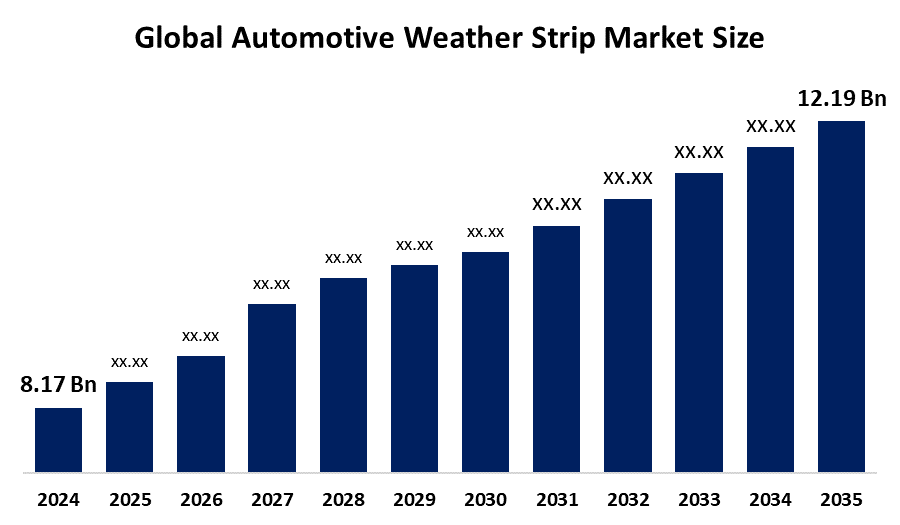
- The Global Automotive Weather Strip Market Size Was Estimated at USD 8.17 Billion in 2024
- The Market Size is Expected to Grow at a CAGR of around 3.7% from 2025 to 2035.
- The Worldwide Automotive Weather Strip Market Size is Expected to Reach USD 12.19 Billion by 2035.
- North America is expected to grow the fastest during the forecast period.
Get more details on this report -
According to a research report published by Spherical Insights and Consulting, the global automotive weather strip market size was worth around USD 8.17 billion in 2024 and is predicted to grow to around USD 12.19 billion by 2035 with a compound annual growth rate (CAGR) of 3.7% from 2025 to 2035. Global advances in materials science, integration of smart technologies, innovations in automated manufacturing and precision extrusion techniques, and growing demand for energy-efficient, quieter, and more comfortable vehicles are all driving opportunities in the automotive weather strip market.
Market Overview
The automotive weather strip market refers to the industry involved in manufacturing and supplying sealing components such as door seals, window seals, trunk seals, and roof seals that prevent water, dust, noise, and air leakage in vehicles, enhancing comfort, safety, and energy efficiency. The product range includes items created from EPDM, rubber, thermoplastic elastomers, and polyurethane foams, which manufacturers use in passenger cars, commercial vehicles, and electric vehicles. The market expansion requires businesses to develop high-durability materials, noise and vibration reduction technologies, and smart sensor systems for airtightness monitoring and lightweight products that improve fuel efficiency.
Government bodies worldwide support the market through regulations and incentives focused on vehicle safety, emission reduction, and energy efficiency, which encourage automakers to adopt advanced weather stripping solutions to meet environmental and safety standards. For instance, in July 2025, the PLI scheme of India provides financial support to the automotive industry and its associated component manufacturing sector through its auto and auto components PLI program that attracted INR 29500 crore in committed investments, which will generate approximately 45000 new employment opportunities by early 2025, according to India's manufacturing expansion efforts.
In 2024, the U.S. BLS reports that more than 520000 employees worked in motor vehicle parts manufacturing, which includes the production of components used in vehicle assembly, strengthening the automotive weather strips market growth.
Report Coverage
This research report categorizes the automotive weather strip market based on various segments and regions, forecasts revenue growth, and analyzes trends in each submarket. The report analyses the key growth drivers, opportunities, and challenges influencing the automotive weather strip market. Recent market developments and competitive strategies, such as expansion, product launch, development, partnership, merger, and acquisition, have been included to draw the competitive landscape in the market. The report strategically identifies and profiles the key market players and analyses their core competencies in each sub-segment of the automotive weather strip market.
Global Automotive Weather Strip Market Report Coverage
| Report Coverage | Details |
|---|---|
| Base Year: | 2024 |
| Market Size in 2024: | USD 8.17 billion |
| Forecast Period: | 2025-2035 |
| Forecast Period CAGR 2025-2035 : | CAGR of 3.7% |
| 2035 Value Projection: | USD 12.19 billion |
| Historical Data for: | 2020-2023 |
| No. of Pages: | 222 |
| Tables, Charts & Figures: | 121 |
| Segments covered: | By Product Type,By Material Type,By Application,By Region |
| Companies covered:: | Cooper-Standard Automotive Inc., Toyoda Gosei Co., Ltd., Hutchinson S.A., Henniges Automotive Holdings, Inc., Nishikawa Rubber Co., Ltd., SaarGummi Group, Standard Profil A.S., Hwaseung Industries Co., Ltd., Kinugawa Rubber Industrial Co., Ltd., Rehau Group, Magna International Inc., PPAP Automotive Limited, Jiangyin Haida Rubber and Plastic Co., Ltd., Zhejiang Xiantong Rubber and Plastic Co., Ltd., Hebei Shida Seal Group Co., Ltd.,and Other key players |
| Pitfalls & Challenges: | COVID-19 Empact, Challenge, Future, Growth, & Analysis |
Get more details on this report -
Driving Factors
Rapid technological innovation is one of the main drivers of the automotive weather strip market's growth. Rising demand for enhanced vehicle safety, noise reduction, and improved cabin comfort, which is the main factor driving the market for automotive weatherstrips. The industry experiences innovation and investment through EPDM and TPE and hybrid polymer materials together with precision extrusion and molding techniques, rising production of electric and hybrid vehicles, increasing automotive manufacturing output, growing demand for aftermarket replacements, the implementation of stricter emission and safety regulations, and the industry-wide focus on energy efficiency standards. Additionally government initiatives and incentives in major regions supply chain support policies are strengthening domestic parts production and supply chain resilience.
In November 2024, the U.S. State Partnership and Supplier Support Funding provides automotive suppliers with USD 70.8 million to achieve plant modernization and manufacturing capacity enhancement. Their efforts to develop electrified vehicle components and various parts production processes will create advantages for the entire automotive components ecosystem, which includes weather strip manufacturing companies.
Restraining Factors
High development and deployment costs, highly price sensitive and competitive, supply chain disruptions, trade barriers, economic slowdowns, extreme weather durability, material degradation, and performance consistency challenges are the main factors restricting the automotive weather strip market.
Market Segmentation
The automotive weather strip market share is classified into product type, material type, and application.
- The door weather strips segment dominated the market in 2024, approximately 50%, and is projected to grow at a substantial CAGR during the forecast period.
Based on the product type, the automotive weather strip market is divided into door weather strips, window weather strips, hood weather strips, and trunk weather strips. Among these, the door weather strips segment dominated the market in 2024, approximately 50%, and is projected to grow at a substantial CAGR during the forecast period. The growing need for highly durable and effective sealing solutions, most frequently used and exposed parts of a vehicle, preventing water, dust, and noise intrusion, and higher wear and tear function is driving the door weather strips industry.
- The rubber segment accounted for the largest share in 2024, approximately 55%, and is anticipated to grow at a significant CAGR during the forecast period.
Based on the material type, the automotive weather strip market is divided into rubber, PVC, silicone, EPDM, and polyurethane. Among these, the rubber segment accounted for the largest share in 2024, approximately 55%, and is anticipated to grow at a significant CAGR during the forecast period. Excellent sealing performance, offering flexibility, cost-effectiveness, and strong resistance to extreme temperatures, UV radiation, moisture, and ozone, and provides effective noise, vibration, and air insulation is driving the rubber industry.
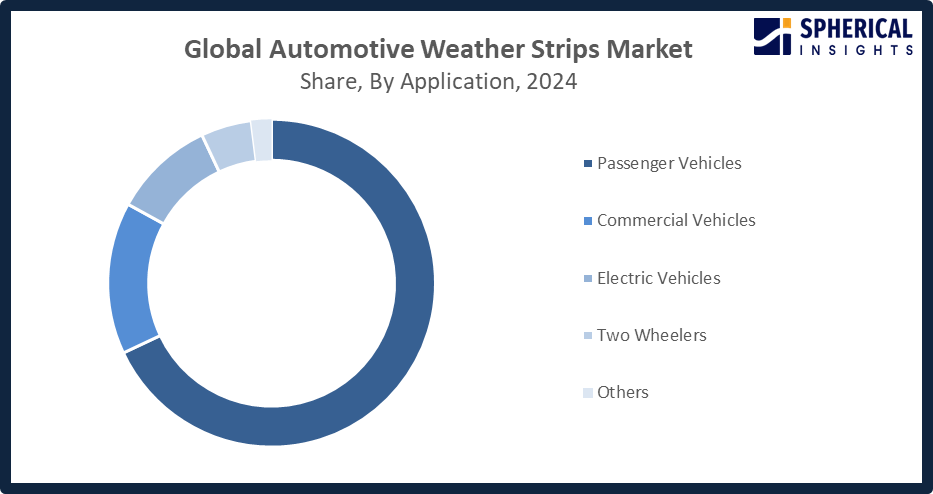
- The passenger vehicles segment accounted for the highest market revenue in 2024, approximately 70%, and is anticipated to grow at a significant CAGR during the forecast period.
Based on the application, the automotive weather strip market is divided into passenger vehicles, commercial vehicles, electric vehicles, two-wheelers, and others. Among these, the passenger vehicles segment accounted for the highest market revenue in 2024, approximately 70%, and is anticipated to grow at a significant CAGR during the forecast period. Increased global production and sales volume of passenger cars, rising consumer demand for comfort, noise reduction, and improved cabin insulation, and growing middle-class population is bolstering passenger vehicles market.
Get more details on this report -
Regional Segment Analysis of the Automotive Weather Strip Market
- North America (U.S., Canada, Mexico)
- Europe (Germany, France, U.K., Italy, Spain, Rest of Europe)
- Asia-Pacific (China, Japan, India, Rest of APAC)
- South America (Brazil and the Rest of South America)
- The Middle East and Africa (UAE, South Africa, Rest of MEA)
Asia Pacific is anticipated to hold the largest share of the automotive weather strip market over the predicted timeframe.
Asia Pacific is anticipated to hold the largest share of the automotive weather strip market over the predicted timeframe. Strong government backing for vehicle comfort, noise reduction, and energy efficiency, along with the accelerating shift toward electric vehicles, are what propel Asia Pacific. The region not only leads in vehicle production and exports but also serves as a global automotive component manufacturing center because of its established supply chains and access to raw materials. The existence of multiple OEMs and tier-1 suppliers in countries like China, India, Japan and South Korea creates increased demand for weather strips at both OEM and aftermarket levels.
Government launches include Japan, METI's ongoing programs support automotive supply chains and digital transformation efforts and green growth initiatives through their Green Growth Strategy, which creates investment opportunities and decarbonization pathways and strengthens manufacturing resilience and China’s MIIT-led Automotive Industry Stable Growth Work Plan, September 2025 strengthens production capabilities, supply chain operations and parts manufacturing processes throughout the automotive industry including automotive weather strips market.
North America is expected to grow at a rapid CAGR in the automotive weather strip market during the forecast period. The United States, Canada, and Mexico make substantial investments in advanced sealing technologies so that they can achieve energy efficiency, noise reduction, and water resistance, which results in increased requirements for high-quality weather strips. The rising consumer preference for luxury vehicles with exceptional comfort, quick expansion of electric vehicles, enforcement of strict safety and emission standards, and strong demand for replacement parts from the aftermarket create conditions that drive faster industry growth.
Government initiatives include the Mexican government announced new support measures for the country's motor transport industry, which included tax incentives and direct investment on March 2026, Canada’s FedDev Ontario announced a financial commitment exceeding USD 1.6 million to assist automotive parts suppliers in implementing advanced technologies on March 2026 , and introduced its national automotive strategy in February 2026 including funding of up to USD 3 billion from the SRF and USD 100 million from the RTR Initiative to support vehicle and parts production.
Competitive Analysis:
The report offers the appropriate analysis of the key organizations/companies involved within the automotive weather strip market, along with a comparative evaluation primarily based on their product of offering, business overviews, geographic presence, enterprise strategies, segment market share, and SWOT analysis. The report also provides an elaborative analysis focusing on the current news and developments of the companies, which includes product development, innovations, joint ventures, partnerships, mergers & acquisitions, strategic alliances, and others. This allows for the evaluation of the overall competition within the market.
List of Key Companies
- Cooper-Standard Automotive Inc.
- Toyoda Gosei Co., Ltd.
- Hutchinson S.A.
- Henniges Automotive Holdings, Inc.
- Nishikawa Rubber Co., Ltd.
- SaarGummi Group
- Standard Profil A.S.
- Hwaseung Industries Co., Ltd.
- Kinugawa Rubber Industrial Co., Ltd.
- Rehau Group
- Magna International Inc.
- PPAP Automotive Limited
- Jiangyin Haida Rubber and Plastic Co., Ltd.
- Zhejiang Xiantong Rubber and Plastic Co., Ltd.
- Hebei Shida Seal Group Co., Ltd.
- Others
Key Target Audience
- Market Players
- Investors
- End-users
- Government Authorities
- Consulting and Research Firm
- Venture capitalists
- Value-Added Resellers (VARs)
Recent Development
- In December 2025, Toyoda Gosei developed commercial automotive weather strip components which contain a higher percentage of recycled rubber than their previous products. These components were first used on the Toyota RAV4. The company developed these products to achieve their sustainability goals and reduce carbon emissions for their sealing components.
- In July 2025, The Cooper Standard and Renault partnership demonstrated a complete recyclable thermoplastic body seal together with their new FlushSeal technology through their demonstration of the Embleme prototype vehicle.
- In April 2024, Cooper Standard demonstrated continuous development of its FlushSeal sealing system which serves as an innovative weather sealing solution that combines better door design compatibility with enhanced soundproofing and operational efficiency.
Market Segment
This study forecasts revenue at global, regional, and country levels from 2020 to 2035. Spherical Insights has segmented the automotive weather strip market based on the below-mentioned segments:
Global Automotive Weather Strip Market, By Product Type
- Door Weather Strips
- Window Weather Strips
- Hood Weather Strips
- Trunk Weather Strips
Global Automotive Weather Strip Market, By Material Type
- Rubber
- PVC
- Silicone
- EPDM
- Polyurethane
Global Automotive Weather Strip Market, By Application
- Passenger Vehicles
- Commercial Vehicles
- Electric Vehicles
- Two Wheelers
- Others
Global Automotive Weather Strip Market, By Regional Analysis
- North America
- US
- Canada
- Mexico
- Europe
- Germany
- UK
- France
- Italy
- Spain
- Russia
- Rest of Europe
- Asia Pacific
- China
- Japan
- India
- South Korea
- Australia
- Rest of Asia Pacific
- South America
- Brazil
- Argentina
- Rest of South America
- Middle East & Africa
- UAE
- Saudi Arabia
- Qatar
- South Africa
- Rest of the Middle East & Africa
Need help to buy this report?