Global Automotive Testing and Proving Grounds Market Size, Share, and COVID-19 Impact Analysis, By Vehicle Type (Passenger Cars, Commercial Vehicles, Electric Vehicles, Hybrid Vehicles, and Two-Wheelers), By Testing Type (Prototypes, Pre-Production, Series Production, Post-Production, and Field Testing), By End-User (Automobile Manufacturers, Automotive Suppliers, Research Institutions, Government Agencies, and Consulting Firms), and By Region (North America, Europe, Asia-Pacific, Latin America, Middle East, and Africa), Analysis and Forecast 2025 - 2035.
Industry: Automotive & Transportation
Global Automotive Testing and Proving Grounds Market Insights Forecasts to 2035
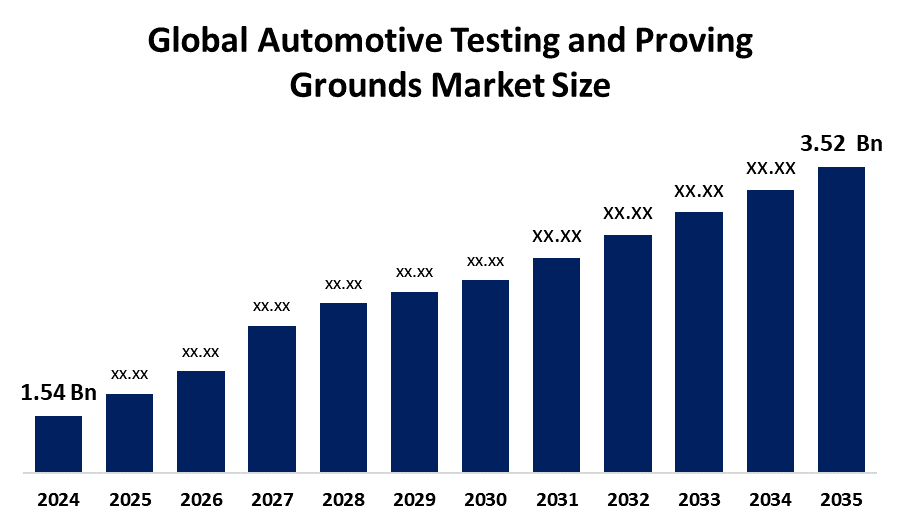
- The Global Automotive Testing and Proving Grounds Market Size Was Estimated at USD 1.54 Billion in 2024
- The Market Size is Expected to Grow at a CAGR of around 7.8% from 2025 to 2035
- The Worldwide Automotive Testing and Proving Grounds Market Size is Expected to Reach USD 3.52 Billion by 2035
- Asia Pacific is expected to grow the fastest during the forecast period.
Get more details on this report -
According to a research report published by Spherical Insights and Consulting, the global automotive testing and proving grounds market size was worth around USD 1.54 billion in 2024 and is predicted to grow to around USD 3.52 billion by 2035 with a compound annual growth rate (CAGR) of 7.8% from 2025 to 2035. The worldwide market for automotive testing and proving grounds is expanding because electric and autonomous vehicle production increases, safety and emissions regulations become stricter and research and development funding rises, and advanced testing facilities are needed to validate new technologies that shorten vehicle development cycles.
Automotive Testing and Proving Grounds Market Key Takeaways
- North America led the global automotive testing and proving grounds market with the largest market share of 38% in 2024.
- Asia Pacific is estimated to observe the fastest expansion during the forecast period.
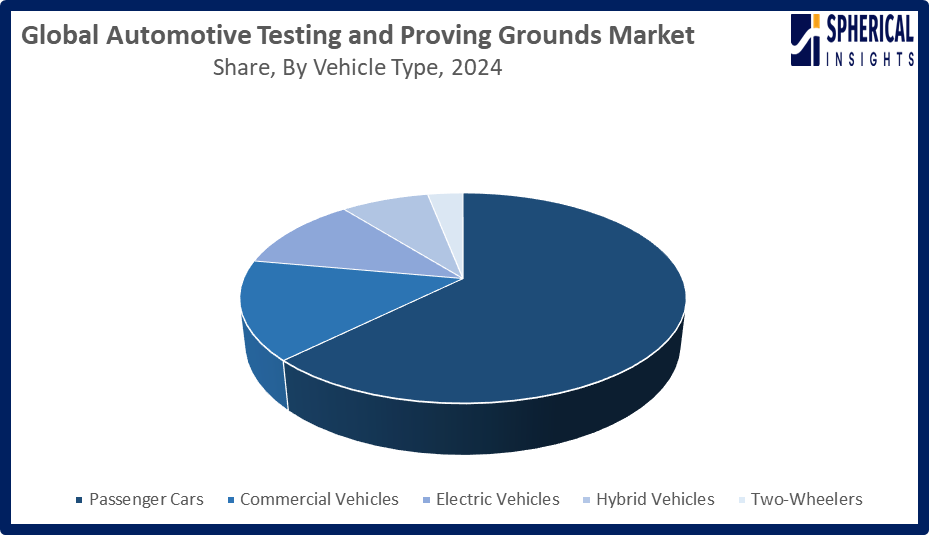
- By vehicle type, the passenger cars segment held the major market share of 63% in 2024.
- By vehicle type, the electric vehicles segment is the fastest growing segment projected to expand at the highest CAGR.
- By testing type, the field testing segment dominated the market, accounting for the 42% revenue share in 2024.
- By testing type, the prototypes segment is the fastest growing segment with a notable CAGR from 2024 to 2035.
- By end-user, the automobile manufacturers segment dominated the market with the 40% market share in 2024.
- By end-user, the automotive suppliers segment is the fastest growing segment, projected to expand at the highest CAGR.
Market Overview
The global automotive testing and proving grounds market includes outdoor and indoor testing facilities, which have high-speed tracks, durability test roads, climate chambers, crash test areas and ADAS/autonomous simulation platforms for conducting thorough vehicle assessments in real-world situations and controlled environments. The proving grounds serve as testing grounds for OEMs and Tier-1 suppliers and R&D organizations to assess performance and evaluate durability, verify emissions compliance and achieve safety certification, conduct electric vehicle battery assessments and test advanced driver-assistance systems and autonomous vehicle systems. In October 2025, the E-Mobility Business Support Centre and Electric Vehicle Battery Safety Evaluation Center opened in Hoengseong through a funding partnership between the two organizations which dedicated 48 billion won and 9.143 billion won, respectively, for the development of EMC and battery testing facilities, a real-vehicle proving ground and a total performance evaluation centre. The building will include an autonomous driving centre, which will have a driving test system that uses artificial intelligence to assess drivers.
Key growth drivers include the increasing adoption of electric vehicles (EVs), which now represent 42% of testing demand, requiring advanced battery and powertrain validation. Stricter safety regulations are also significant, as over 58% of global automotive recalls involve software or safety issues, motivating manufacturers to implement thorough verification. Opportunities exist in developing specialized EV battery testing protocols and AI-driven simulation platforms, with 52% of validation labs providing comprehensive EV testing. In April 2025, Shanghai’s Jiading district launched 15 industrial application scenarios covering automotive electrification, AI, and integrated circuits. The upgraded Shanghai International Proving Ground offers autonomous driving simulations, smart cockpit testing, and export certification, while SMVIC plans a 10-billion-yuan hub, drone and robotics testing, and public cultural events to encourage industry collaboration.
Automotive Testing and Proving Grounds Market Growth Factors
• Rising R&D spending by OEMs: Automotive manufacturers are significantly increasing research and development investments to innovate and validate new vehicle technologies. Global automotive R&D expenditure reached approximately USD 135 billion in 2023, driving demand for advanced testing infrastructure capable of handling new powertrains and systems.
• Connected vehicle & V2X technology adoption: The growing integration of connected technologies such as V2X communication, IoT, and cybersecurity systems necessitates extensive testing for interoperability and safety. This trend has led to increased investment in proving grounds equipped with high-bandwidth networks and advanced simulation facilities.
• Stringent global safety & emissions regulations: Evolving international safety and environmental standards are compelling manufacturers to conduct comprehensive compliance testing at specialized proving grounds. A significant share of vehicle recalls in 2023 was linked to electronic system failures, further emphasizing the need for rigorous testing.
Report Coverage
This research report categorizes the automotive testing and proving grounds market based on various segments and regions, forecasts revenue growth, and analyzes trends in each submarket. The report analyses the key growth drivers, opportunities, and challenges influencing the automotive testing and proving grounds market. Recent market developments and competitive strategies, such as expansion, type launch, development, partnership, merger, and acquisition, have been included to draw the competitive landscape in the market. The report strategically identifies and profiles the key market players and analyses their core competencies in each sub-segment of the automotive testing and proving grounds market.
Global Automotive Testing and Proving Grounds Market Report Coverage
| Report Coverage | Details |
|---|---|
| Base Year: | 2024 |
| Market Size in 2024: | USD 1.54 billion |
| Forecast Period: | 2025-2035 |
| Forecast Period CAGR 2025-2035 : | CAGR of 7.8% |
| 2035 Value Projection: | USD 3.52 billion |
| Historical Data for: | 2020-2023 |
| No. of Pages: | 210 |
| Tables, Charts & Figures: | 143 |
| Segments covered: | By Vehicle Type,By Testing Type,By End-User,By Region |
| Companies covered:: | SGS Group, AVL List GmbH, Bureau Veritas, Millbrook Proving Ground, Applus+ IDIADA, Horiba, Ltd., UTAC, Intertek Group plc, DEKRA, Siemens AG, TUV SUD Group, Robert Bosch GmbH, Continental AG, Vector Informatik GmbH, TUV Rheinland Group, China Automotive Research Institute (CARIT),and Other key players |
| Pitfalls & Challenges: | COVID-19 Empact, Challenge, Future, Growth, & Analysis |
Get more details on this report -
Driving Factors
The global automotive testing and proving grounds market exists because electric vehicles (EVs) and autonomous vehicles (AVs) expand their testing requirements, which need specialized evaluation methods for battery performance, ADAS validation and self-driving technologies. The testing facilities will see increased demand because global electric vehicle sales are expected to surpass 20 million units each year by 2025. Comprehensive crash testing, emissions testing and system compliance testing become essential because safety regulations and environmental regulations demand complete safety testing. The worldwide expansion of proving grounds happens because original equipment manufacturers (OEMs) increase their research and development spending and embrace artificial intelligence, Internet of Things, and digital twin technologies, and require faster vehicle development times. In July 2025, the Flanders-Netherlands region launched the CCAM Proving Region (CPR), a cross-border test zone for connected and automated mobility. Offering simulation, controlled track tests, and public road trials, it serves as a living lab, providing comprehensive environments to develop and validate advanced automation technologies across both countries.
Restraining Factors
The global automotive testing and proving grounds market faces restraints from high costs and financial constraints, which are major barriers, with 49% of small to mid-sized automotive startups facing financial limitations in multi-stage testing. The 31% of companies that need to meet certification standards face certification delays, according to their reports. The testing standard fragmentation creates an operational problem because 27% of manufacturers face difficulties with vehicle technology compatibility across different vehicle systems.
Market Segmentation
Vehicle Type Insights
The passenger cars dominated the automotive testing and proving grounds market with the 63% market share, because of high global production volumes and rapid technological progress in electric vehicles, ADAS, and connected systems. Growing safety regulations and consumer demand for advanced features require extensive durability, crash, and performance testing, increasing the use of proving grounds for passenger vehicle validation worldwide.
The electric vehicles segment is the fastest growing segment with a significant CAGR during the forecast period, as rising global EV adoption, strict emission regulations, and supportive government incentives. Extensive testing is needed for battery safety, thermal management, charging systems, and powertrain efficiency, boosting demand for specialized EV testing infrastructure and proving grounds worldwide.
Get more details on this report -
Testing Type Insights
The field testing dominated the market with the 42% market share, attributing to the increasing need for real-world validation of autonomous driving systems, ADAS technologies, and connected vehicle functions. Automakers depend on large-scale road testing to evaluate vehicle performance, safety, and reliability across various traffic, weather, and road conditions before commercial deployment.
The prototypes segment is the fastest growing segment with a significant CAGR during the forecast period, due to rising vehicle innovation, rapid EV development, and advancements in autonomous technologies. Automakers perform extensive early-stage testing to assess new designs, powertrains, software systems, and safety features before progressing to pre-production and mass manufacturing stages.
End-User Insights
The automobile manufacturers segment dominated the market with the 40% market share, because of increasing investments in vehicle development, electrification, and autonomous technologies. OEMs conduct extensive safety, durability, and performance testing to meet regulatory standards and minimize product failures, strengthening their reliance on advanced proving grounds and testing infrastructure globally.
The automotive suppliers segment is the fastest growing segment for the foreseen period, owing to the increasing development of advanced components such as ADAS sensors, EV batteries, power electronics, and software systems. Suppliers require extensive validation and certification testing to ensure component reliability, safety compliance, and seamless integration with next-generation vehicles.
Regional Segment Analysis of the Automotive Testing and Proving Grounds Market
- North America (U.S., Canada, Mexico)
- Europe (Germany, France, U.K., Italy, Spain, Rest of Europe)
- Asia-Pacific (China, Japan, India, Rest of APAC)
- South America (Brazil and the Rest of South America)
- The Middle East and Africa (UAE, South Africa, Rest of MEA)
North America Market Trends
North America dominated the automotive testing and proving grounds market, accounting for a 38% market share, driven by an advanced automotive R&D ecosystem, a strong regulatory framework, and rapid adoption of autonomous and electric vehicle technologies. The region hosts major automakers and technology developers that are investing heavily in vehicle validation facilities and simulation platforms.
Strict safety regulations enforced by organizations such as the National Highway Traffic Safety Administration require extensive crash, durability, and software testing before commercialization. In addition, the growing development of connected and autonomous vehicles in the United States and Canada is driving demand for sophisticated proving grounds and real-world testing environments to ensure performance, safety, and regulatory compliance.
In November 2024, Ontario’s Ministry of Transportation proposed a 10-year pilot program for Automated Commercial Motor Vehicles (ACMV) on public roads. Targeting commercial vehicles over 4,500 kg, the program supports the safe adoption of autonomous vehicles, with two testing streams: SAE Level 3 requiring a driver, and Levels 4–5 enabling driverless operation under oversight. The proposal also invited stakeholder feedback by November 14.
U.S. Automotive Testing and Proving Grounds Market Trends
The U.S. automotive testing and proving grounds market is growing due to increasing development of electric vehicles, autonomous driving technologies, and ADAS systems. Rising R&D investments and strict safety regulations are boosting demand for advanced testing of batteries, connectivity, and cybersecurity. In October 2024, MITRE and the University of Michigan’s Mcity launched a virtual-physical AV testing platform combining simulation, a 32-acre test site, and standardized reporting to support safer autonomous vehicle validation.
Asia Pacific Market Trends
Asia Pacific is the fastest growing market for automotive testing and proving grounds, with an approximate 29% share, as rapid automotive production, expanding electric vehicle development, and increasing investments in testing infrastructure. Countries such as China, India, Japan, and South Korea are heavily investing in EV and autonomous vehicle technologies, requiring advanced validation facilities. China alone produced over 30 million vehicles in 2023, creating strong demand for safety, performance, and emissions testing. In India, government initiatives supporting EV adoption and upgrading national testing agencies are further accelerating growth. Additionally, rising R&D spending by automakers and the expansion of connected vehicle technologies are increasing the need for modern proving grounds across the region.
China Automotive Testing and Proving Grounds Market Trends
The China automotive testing and proving grounds market is growing quickly, supported by the rapid expansion of electric vehicles and autonomous driving technologies. Government programs promoting smart mobility and NEVs are increasing the need for advanced proving grounds. In June 2024, the Ministry of Industry and Information Technology announced plans to lead global automotive standardization, including nearly 20 international standards for EV testing, collision safety terminology, autonomous driving regulations, and battery durability evaluation.
Europe Automotive Testing and Proving Grounds Market Trends
The Europe automotive testing and proving grounds market is expanding due to stringent vehicle safety and emissions regulations, along with significant investments in electric and autonomous vehicle technologies. Countries such as Germany, France, and the United Kingdom host advanced facilities for EV battery testing, ADAS development, and connected vehicle trials. Rising automotive R&D investments and regulatory compliance requirements are increasing the demand for advanced proving grounds and simulation technologies. In March 2025, the European Commission introduced an action plan to standardize autonomous vehicle testing across member states and establish regulatory sandboxes for safe real-world trials. The initiative also includes the creation of a European Connected and Autonomous Vehicle Alliance and allocates €350 million (2025-2027) to support next-generation battery development.
U.K. Automotive Testing and Proving Grounds Market Trends
The U.K. automotive testing and proving grounds market is expanding due to increasing investments in electric and autonomous vehicle technologies. Government policies supporting zero-emission mobility and advanced R&D infrastructure are encouraging extensive vehicle validation. The growing development of ADAS, connected vehicles, and battery technologies is boosting demand for advanced proving grounds and real-world testing facilities. In December 2025, the UK Government approved the DRIVE35 programme, a USD 2.5 billion initiative aimed at strengthening zero-emission vehicle manufacturing and supply chains while attracting USD 6.6 billion in private investment and supporting over 50,000 jobs.
Competitive Analysis:
The report offers the appropriate analysis of the key organizations/companies involved within the automotive testing and proving grounds market, along with a comparative evaluation primarily based on their type of offering, business overviews, geographic presence, enterprise strategies, segment market share, and SWOT analysis. The report also provides an elaborative analysis focusing on the current news and developments of the companies, which includes type development, innovations, joint ventures, partnerships, mergers & acquisitions, strategic alliances, and others. This allows for the evaluation of the overall competition within the market.
List of Key Companies
- SGS Group
- AVL List GmbH
- Bureau Veritas
- Millbrook Proving Ground
- Applus+ IDIADA
- Horiba, Ltd.
- UTAC
- Intertek Group plc
- DEKRA
- Siemens AG
- TUV SUD Group
- Robert Bosch GmbH
- Continental AG
- Vector Informatik GmbH
- TUV Rheinland Group
- China Automotive Research Institute (CARIT)
- Others
Key Target Audience
- Market Players
- Investors
- End-users
- Government Authorities
- Consulting and Research Firm
- Venture capitalists
- Value-Added Resellers (VARs)
Recent Development
- In March 2026, UTAC announced a major expansion in China with a new high-tech proving ground in Huainan, Anhui. The facility offers advanced testing, homologation, and labs for new-energy vehicles, supporting global standards and serving as UTAC’s strategic operational hub in China’s leading automotive province.
- In February 2026, the UNECE released a proposed global regulation to support safe self-driving vehicles. The Global Technical Regulation on Automated Driving Systems (ADS), adopted by the GRVA in January, sets uniform safety standards and a harmonized validation methodology for deploying fully autonomous vehicles without on-board drivers.
- In November 2025, China launched its first state-level automotive chip testing platform in Shenzhen, jointly operated by China Reform Holdings and CATARC. The facility, with 13 laboratories and 80+ test systems, streamlines chip validation, strengthens quality oversight, and supports semiconductor self-reliance for safety-critical automotive electronics.
- In June 2025, Applus+ IDIADA announced a major expansion of its ADAS/CAV testing infrastructure at its Spain Proving Ground. Launching in November 2025, the new 1,000-meter, four-lane track enhances high-speed ADAS testing, supporting autonomous driving development and reinforcing IDIADA’s Euro NCAP-accredited leadership in advanced mobility validation.
- In April 2025, TUV SUD signed an MoU with India’s NATRAX, enabling EMI/EMC testing for vehicles and components at its Bengaluru facility. Test results will support Type Approval and Conformity of Production certifications under India’s Central Motor Vehicle Rules, expanding opportunities for manufacturers nationwide.
Market Segment
This study forecasts revenue at global, regional, and country levels from 2020 to 2035. Spherical Insights has segmented the automotive testing and proving grounds market based on the below-mentioned segments:
Global Automotive Testing and Proving Grounds Market, By Vehicle Type
- Passenger Cars
- Commercial Vehicles
- Electric Vehicles
- Hybrid Vehicles
- Two-Wheelers
Global Automotive Testing and Proving Grounds Market, By Testing Type
- Prototypes
- Pre-Production
- Series Production
- Post-Production
- Field Testing
Global Automotive Testing and Proving Grounds Market, By End-User
- Automobile Manufacturers
- Automotive Suppliers
- Research Institutions
- Government Agencies
- Consulting Firms
Global Automotive Testing and Proving Grounds Market, By Regional Analysis
- North America
- US
- Canada
- Mexico
- Europe
- Germany
- UK
- France
- Italy
- Spain
- Russia
- Rest of Europe
- Asia Pacific
- China
- Japan
- India
- South Korea
- Australia
- Rest of Asia Pacific
- South America
- Brazil
- Argentina
- Rest of South America
- Middle East & Africa
- UAE
- Saudi Arabia
- Qatar
- South Africa
- Rest of the Middle East & Africa
Need help to buy this report?