Australia Exoskeleton Market Size, Share, and COVID-19 Impact Analysis, By Technology (Powered, and Non-powered), By End Use (Healthcare, Military, and Industry), and Australia Exoskeleton Market Insights, Industry Trend, Forecasts to 2035
Industry: Healthcare
Australia Exoskeleton Market Insights Forecasts to 2035
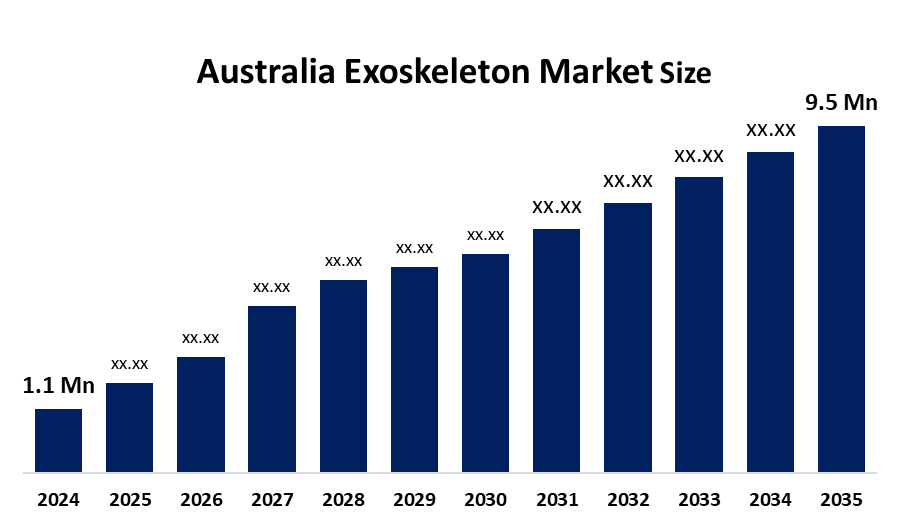
- The Australia Exoskeleton Market Size Was Estimated at USD 1.1 Million in 2024
- The Market Size is Expected to Grow at a CAGR of Around 5.38% from 2025 to 2035
- The Australia Exoskeleton Market Size is Expected to Reach USD 9.5 Million by 2035
Get more details on this report -
According to a research report published by Spherical Insights & Consulting, the Australia exoskeleton market size is anticipated to reach USD 9.5 million by 2035, growing at a CAGR of 5.38% from 2025 to 2035. The exoskeleton market in Australia is driven by increased efforts to prevent workplace injuries, increased use in rehabilitation and senior care, increased defense modernization programs, wearable robotics technology advancements, and government support for assistive mobility and occupational safety.
Market Overview
The exoskeleton market in Australia involves the creation and manufacturing of wearable robotic systems that provide users with increased strength and endurance and enhanced mobility capabilities. Powered and passive systems function as rehabilitation tools and mobility aids within healthcare settings, while they serve industrial purposes to prevent work-related injuries and provide defence forces with load-bearing capabilities. The applications seek to enhance safety, productivity, and quality of life for people who work in medical fields and occupational environments.
In Australia, there is the National Reconstruction Fund, a $15 billion fund set up by the government to help with the development of exoskeletons; of this, $1 billion is earmarked for critical technology and advanced manufacturing. In addition, the government provides funding through the National Disability Insurance Scheme (NDIS) for the purchase of assistive devices, including medical exoskeletal systems. Also, all devices must be approved by the Therapeutic Goods Administration (TGA), which also assess the clinical safety of the product and provides clinical guidance on its adoption.
Local research development in wearable robotics for medical rehabilitation and industrial support sectors is driving progress in the Australian exoskeleton market. Australian companies work together with research institutions to develop and market their lightweight adaptive technology products. The upcoming possibilities include developing solutions for elderly citizens' workplace safety programs, defence technologies, and creating personalized motion support systems that use artificial intelligence to boost human performance.
Report Coverage
This research report categorizes the market for the Australia exoskeleton market based on various segments and regions, and forecasts revenue growth and analyses trends in each submarket. The report analyses the key growth drivers, opportunities, and challenges influencing the Australia exoskeleton market. Recent market developments and competitive strategies, such as expansion, product launch, development, partnership, merger, and acquisition, have been included to draw the competitive landscape in the market. The report strategically identifies and profiles the key market players and analyses their core competencies in each sub-segment of the Australia exoskeleton market.
Australia Exoskeleton Market Report Coverage
| Report Coverage | Details |
|---|---|
| Base Year: | 2024 |
| Market Size in 2024: | USD 1.1 Million |
| Forecast Period: | 2025-2035 |
| Forecast Period CAGR 2025-2035 : | 5.38% |
| 2035 Value Projection: | USD 9.5 Million |
| Historical Data for: | 2020-2023 |
| No. of Pages: | 208 |
| Tables, Charts & Figures: | 120 |
| Segments covered: | By Technology , By End Use |
| Companies covered:: | Exo Suits Australia, Bunjil Composites / ULS Robotics partners, Exxovantage Pty Ltd, Royal Rehab, maxon motor Australia Pty Ltd, Australian university research labs, Workplace robotics innovators, Others |
| Pitfalls & Challenges: | COVID-19 Empact, Challenge, Future, Growth, & Analysis |
Get more details on this report -
Driving Factors
The exoskeleton market in Australia is driven by the workplaces increase their efforts to stop employee injuries, people want better rehabilitation solutions, and elderly individuals need mobility assistance. Government support through programs like the National Disability Insurance Scheme (NDIS) enhances accessibility. Defence modernisation and industrial automation, and the development of lightweight AI-enabled wearable robotics, drive increased adoption in healthcare, construction, mining and manufacturing industries.
Restraining Factors
The exoskeleton market in Australia is mostly constrained by the high device prices, insufficient payment options, the Therapeutic Goods Administration demands extensive testing before granting device approval, users have limited knowledge, and the technology has problems with user comfort, battery performance and extended product usage.
Market Segmentation
The Australia exoskeleton market share is classified into technology and end use.
- The powered segment accounted for the largest revenue market share in 2024 and is expected to grow at a significant CAGR during the forecast period.
The Australia exoskeleton market is segmented by technology into powered, and non-powered. Among these, the powered segment accounted for the largest revenue market share in 2024 and is expected to grow at a significant CAGR during the forecast period. The growing need for defence applications, senior mobility aids, and rehabilitation facilities is what is driving this dominance. Compared to non-powered alternatives, powered devices are more suited for clinical and high-intensity industrial applications because they provide motorized assistance, increased strength, and better patient recovery outcomes.
- The healthcare segment dominated the share in 2024 and is anticipated to grow at a remarkable CAGR during the forecast period.
The Australia exoskeleton market is segmented by end use into healthcare, military, and industry. Among these, the healthcare segment dominated the share in 2024 and is anticipated to grow at a remarkable CAGR during the forecast period. The growing need for rehabilitation services for stroke, spinal cord injuries, and mobility disabilities is what is driving this domination. The healthcare segment's market position is further strengthened by government backing through the National Disability Insurance Scheme (NDIS), an ageing population, and the increasing use of robotic-assisted therapy in hospitals and rehabilitation facilities.
Competitive Analysis:
The report offers the appropriate analysis of the key organizations/companies involved within the Australia exoskeleton market, along with a comparative evaluation primarily based on their product offering, business overviews, geographic presence, enterprise strategies, segment market share, and SWOT analysis. The report also provides an elaborate analysis focusing on the current news and developments of the companies, which includes product development, innovations, joint ventures, partnerships, mergers & acquisitions, strategic alliances, and others. This allows for the evaluation of the overall competition within the market.
List of Key Companies
- Exo Suits Australia
- Bunjil Composites / ULS Robotics partners
- Exxovantage Pty Ltd
- Royal Rehab
- maxon motor Australia Pty Ltd
- Australian university research labs
- Workplace robotics innovators
- Others
Key Target Audience
- Market Players
- Investors
- End-users
- Government Authorities
- Consulting and Research Firm
- Venture capitalists
- Value-Added Resellers (VARs)
Recent Developments:
- In December 2025, researchers at The University of Queensland launched the first clinical study of a walking exoskeleton for individuals with Motor Neurone Disease (MND) in Australia.
- In October 2025, Australian companies, notably the meat processing industry, began testing exoskeletons, which include advanced gloves and support equipment, in an effort to lessen weariness and job injuries.
Market Segment
This study forecasts revenue at the Australia, regional, and country levels from 2020 to 2035. Spherical Insights has segmented the Australia exoskeleton market based on the below-mentioned segments:
Australia Exoskeleton Market, By Technology
- Powered
- Non-powered
Australia Exoskeleton Market, By End Use
- Healthcare
- Military
- Industry
Need help to buy this report?