Global Antibody Discovery Market Size, Share, and COVID-19 Impact Analysis, By Type (Monoclonal Antibodies, Bispecific Antibodies, Antibody Drug Conjugates, Immunoconjugates, and Others), By Nature (Human Antibodies, Humanized Antibodies, Chimeric Antibodies, and Murine Antibodies), By End User (In-House Players, Contract Research Organizations, and Others), and By Region (North America, Europe, Asia-Pacific, Latin America, Middle East, and Africa), Analysis and Forecast 2025 - 2035.
Industry: Healthcare
Global Antibody Discovery Market Insights Forecasts to 2035
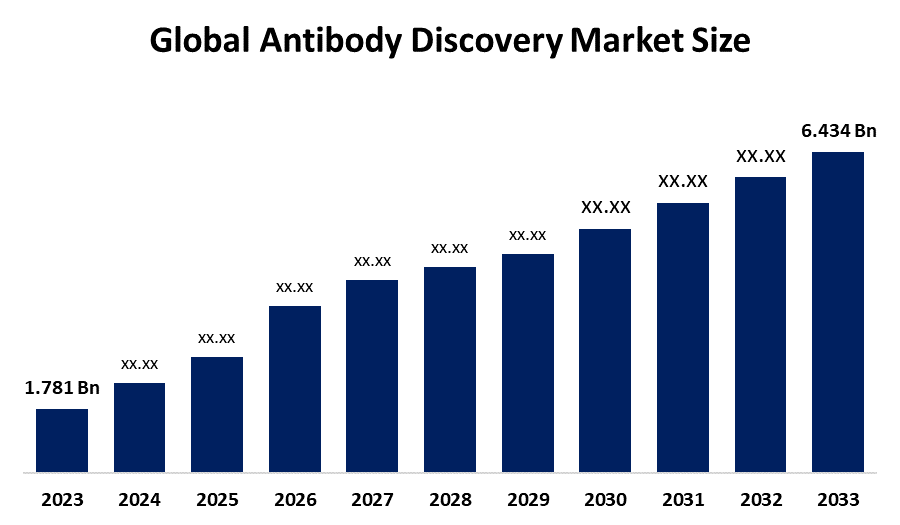
- The Global Antibody Discovery Market Size Was Estimated at USD 1.781 Billion in 2024
- The Market Size is Expected to Grow at a CAGR of around 12.39% from 2025 to 2035
- The Worldwide Antibody Discovery Market Size is Expected to Reach USD 6.434 Billion by 2035
- Asia Pacific is expected to grow the fastest during the forecast period.
Get more details on this report -
According to a research report published by Spherical Insights and Consulting, the global antibody discovery market size was worth around USD 1.781 billion in 2024 and is predicted to grow to around USD 6.434 billion by 2035 with a compound annual growth rate (CAGR) of 12.39% from 2025 to 2035. Global shift towards artificial intelligence and machine learning, high throughput single cell screening, advanced phage and yeast display, novel antibody formats, and adoption of robotics and automated workflows are all driving opportunities in the antibody discovery market.
Market Overview
The antibody discovery market represents the worldwide business sector which aims to find, develop and improve antibodies used in medical treatments, diagnostic tests and scientific research. It includes various technologies together with services that enable scientists to discover new antibodies through hybridoma creation, phage display, recombinant antibody development, bioinformatics tools, and high throughput testing. The market growth emerges from multiple key opportunities which include increasing rates of chronic diseases and infectious diseases together with rising requirements for targeted biologics, progress in immunotherapy, personalized medicine, and expansion of biotechnology research activities. The discovery process gains speed and accuracy through AI-driven antibody design together with automated screening methods and next-generation sequencing.
Governments contribute essential support through their financial backing of antibody research programs and development of biologics regulatory systems together with establishment of public private partnerships and creation of programs which speed up antibody based treatment research and development globally. For example, in February 2026, India’s Biopharma SHAKTI Initiative invest INR 10000 crore during five years to develop domestic biologics and biosimilars capabilities which will create better clinical trial systems and provide essential regulatory assistance while supporting research that speeds up advanced antibody and ADC production.
In March 2020, the U.S. BARDA supports the antibody discovery and biopharmaceutical market by funding vaccine and therapeutic manufacturing, allocated USD 3.5 billion under the CARES Act to boost domestic vaccine and therapeutic production which includes antibody based products to support the entire development process from discovery until commercialization in 2025-2026. The quick speed of technological advancement is one of the main drivers of the antibody discovery market's expansion.
Report Coverage
This research report categorizes the antibody discovery market based on various segments and regions, forecasts revenue growth, and analyzes trends in each submarket. The report analyses the key growth drivers, opportunities, and challenges influencing the antibody discovery market. Recent market developments and competitive strategies, such as expansion, product launch, development, partnership, merger, and acquisition, have been included to draw the competitive landscape in the market. The report strategically identifies and profiles the key market players and analyses their core competencies in each sub-segment of the antibody discovery market.
Global Antibody Discovery Market Report Coverage
| Report Coverage | Details |
|---|---|
| Base Year: | 2024 |
| Market Size in 2024: | USD 1.781 billion |
| Forecast Period: | 2025-2035 |
| Forecast Period CAGR 2025-2035 : | CAGR of 12.39% |
| 2035 Value Projection: | USD 6.434 billion |
| Historical Data for: | 2020-2023 |
| No. of Pages: | 159 |
| Tables, Charts & Figures: | 121 |
| Segments covered: | By Type,By Nature,By End User |
| Companies covered:: | WuXi Biologics, Genmab, Adimab., Thermo Fisher Scientific, Charles River Laboratories, Twist Bioscience, AbCellera Biologics, Harbour BioMed, Evotec, ImmunoPrecise Antibodies, Creative Biolabs, Lonza Group, Biocytogen, FairJourney Biologics, Aragen Life Sciences,and Others key players |
| Pitfalls & Challenges: | COVID-19 Empact, Challenge, Future, Growth, & Analysis |
Get more details on this report -
Driving Factors
Rapid technological innovation is one of the main drivers of the antibody discovery market's growth. The market for antibody discovery is primarily driven by the rising prevalence of chronic and infectious diseases and the growing requirement for specific biologics and immunotherapeutic treatments. The field advances through innovation because companies invest their resources into developing personalized medicine solutions which include precision therapeutics, AI-powered antibody designing, high-throughput screening and next-generation sequencing techniques. The research development process and commercial activities have experienced growth because pharmaceutical and biotechnology companies now invest more resources while government funding programs and regulatory initiatives provide strong support.
In November 2025, India launched the RDI Scheme with a fund of INR 1 lakh crore to accelerate private-sector R&D in deep-tech and biotechnology, directly supporting the development of therapeutic antibodies and antibody-drug conjugates.
Restraining Factors
High development and deployment costs, strict regulatory requirements, intellectual property issues and patent expirations, limited success rates in early-stage discovery, and challenges related to antibody specificity, stability, and potential immunogenicity are the main factors restricting the antibody discovery market.
Market Segmentation
The antibody discovery market share is classified into type, nature, and end user.
- The monoclonal antibodies segment dominated the market in 2024, approximately 60%, and is projected to grow at a substantial CAGR during the forecast period.
Based on the type, the antibody discovery market is divided into monoclonal antibodies, bispecific antibodies, antibody drug conjugates, immunoconjugates, and others. Among these, the monoclonal antibodies segment dominated the market in 2024, approximately 60%, and is projected to grow at a substantial CAGR during the forecast period. High therapeutic efficacy against cancers and infectious diseases, high specificity, strong clinical success with numerous FDA approvals, high throughput screening technologies, and efficient development of targeted therapies is driving the monoclonal antibodies industry.
- The human antibodies segment accounted for the largest share in 2024, approximately 53%, and is anticipated to grow at a significant CAGR during the forecast period.
Based on the nature, the antibody discovery market is divided into human antibodies, humanized antibodies, chimeric antibodies, and murine antibodies. Among these, the human antibodies segment accounted for the largest share in 2024, approximately 53%, and is anticipated to grow at a significant CAGR during the forecast period. Superior safety profile, low immunogenicity, improved efficacy compared to non-human or chimeric alternatives, and ideal for targeted therapies in oncology and immunology is driving the human antibodies industry.
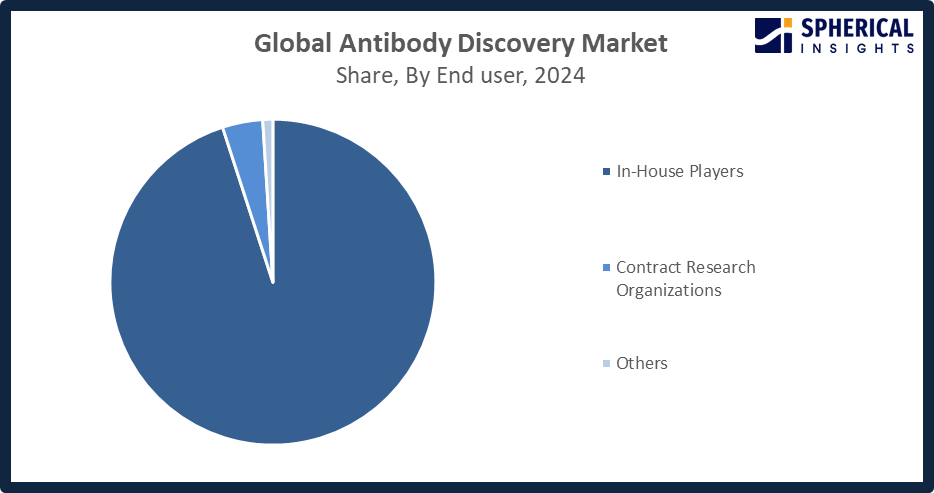
- The in-house players segment accounted for the highest market revenue in 2024, approximately 98%, and is anticipated to grow at a significant CAGR during the forecast period.
Based on the end user, the antibody discovery market is divided into in-house players, contract research organizations, and others. Among these, the in-house players segment accounted for the highest market revenue in 2024, approximately 98%, and is anticipated to grow at a significant CAGR during the forecast period. Increased ability to maintain full control over intellectual property, accelerate development timelines, directly integrate discovery with clinical translation, and advanced antibody engineering mean is bolstering in-house players market.
Get more details on this report -
Regional Segment Analysis of the Antibody Discovery Market
- North America (U.S., Canada, Mexico)
- Europe (Germany, France, U.K., Italy, Spain, Rest of Europe)
- Asia-Pacific (China, Japan, India, Rest of APAC)
- South America (Brazil and the Rest of South America)
- The Middle East and Africa (UAE, South Africa, Rest of MEA)
North America is anticipated to hold the largest share of the antibody discovery market over the predicted timeframe.
North America is anticipated to hold the largest share of the antibody discovery market over the predicted timeframe. The existing research infrastructure in North America is propelled by government support to operate advanced research facilities which include high-throughput screening systems, AI-powered discovery equipment, and premier research laboratories. The region's position benefits from its strong biopharmaceutical sector which consists of numerous major pharmaceutical and biotechnology firms that focus on antibody research and development. The combination of governmental and private funding organizations together with a supportive regulatory framework enables organizations to conduct research and develop novel biologic technologies at an accelerated pace.
Government initiatives include the U.S. FDA announced its plans for modernizing antibody drug development through its April 2025 announcement which includes less animal testing and more human-focused and AI-based testing methods and the U.S. NIAID issued a notice in December 2024 which emphasized research on monoclonal antibody discovery. Canada allocated USD 225 million in federal and provincial funds to AbCellera in May 2023 for new biotech campus to build antibody drug development facilities and May 2020 investment of USD 175.6 million in AbCellera Biologics aims to support COVID-19 antibody research and enhance domestic antibody discovery capabilities.
Asia Pacific is expected to grow at a rapid CAGR in the antibody discovery market during the forecast period. China and Japan and India are investing major funds into research and development activities which create the need for specialized antibody discovery facilities. The demand for advanced antibody discovery services increases because the region contains major pharmaceutical and biotechnology research centers. The region experiences increased funding for biologics research as both governments and private organizations provide financial support at reduced research and clinical study costs. The region experiences strong growth as chronic diseases are becoming more common and new antibody-based therapeutic products are entering development.
Government launches include India’s DBT-BIRAC joint call for proposals on monoclonal antibodies and mRNA therapeutics in February 2025, China’s NMPA introduces 30 day expedited clinical review pathway for drug development in October 2025 and July 2025 innovation Drug R&D major special project call for antibody and biologics research, and Japan’s November 2025, AMED updates next generation drug discovery platform programme supporting antibody medicines.
Competitive Analysis:
The report offers the appropriate analysis of the key organizations/companies involved within the antibody discovery market, along with a comparative evaluation primarily based on their product of offering, business overviews, geographic presence, enterprise strategies, segment market share, and SWOT analysis. The report also provides an elaborative analysis focusing on the current news and developments of the companies, which includes product development, innovations, joint ventures, partnerships, mergers & acquisitions, strategic alliances, and others. This allows for the evaluation of the overall competition within the market.
List of Key Companies
- WuXi Biologics
- Genmab
- Adimab.
- Thermo Fisher Scientific
- Charles River Laboratories
- Twist Bioscience
- AbCellera Biologics
- Harbour BioMed
- Evotec
- ImmunoPrecise Antibodies
- Creative Biolabs
- Lonza Group
- Biocytogen
- FairJourney Biologics
- Aragen Life Sciences
- Others
Key Target Audience
- Market Players
- Investors
- End-users
- Government Authorities
- Consulting and Research Firm
- Venture capitalists
- Value-Added Resellers (VARs)
Recent Development
• In February 2026, BASF announced the expansion of its dispersions production capacity at its Mangalore site in India. The new production line will boost the supply of high-performance dispersions used in coatings and construction chemicals. This expansion will also support an extended derivative supply network.
• In September 2024, BASF partnered with Future Foam to develop the first flexible foam product using 100% biomass-balanced TDI, produced at its Geismar, Louisiana facility. This innovation marks a significant step toward sustainability by utilizing eco-friendly feedstocks.
• In July 2024, Covestro and Neste announced a collaboration to produce bio-based aniline using renewable feedstocks, achieving up to a 90% reduction in carbon footprint compared to conventional petrochemical methods.
• In May 2024, Huntsman Corporation acquired specialty chemical assets for USD 1.1 billion, strengthening its portfolio of aniline-based products for the electronics and automotive sectors.
• In May 2024, Wanhua Chemical Co., Ltd. inaugurated a new aniline production facility in Yantai, China, with an annual capacity of 400,000 metric tons. The facility utilizes advanced catalytic technology to enhance energy efficiency and reduce waste.
• In January 2024, Dow entered into a strategic collaboration with Ford Motor Company to develop advanced polyurethane foam formulations for electric vehicles, leveraging aniline derivatives for improved thermal management and lightweight components.
Market Segment
This study forecasts revenue at global, regional, and country levels from 2020 to 2035. Spherical Insights has segmented the antibody discovery market based on the below-mentioned segments:
Global Antibody Discovery Market, By Type
- Monoclonal Antibodies
- Bispecific Antibodies
- Antibody Drug Conjugates
- Immunoconjugates
- Others
Global Antibody Discovery Market, By Nature
- Human Antibodies
- Humanized Antibodies
- Chimeric Antibodies
- Murine Antibodies
Global Antibody Discovery Market, By End User
- In-House Players
- Contract Research Organizations
- Others
Global Antibody Discovery Market, By Regional Analysis
- North America
- US
- Canada
- Mexico
- Europe
- Germany
- UK
- France
- Italy
- Spain
- Russia
- Rest of Europe
- Asia Pacific
- China
- Japan
- India
- South Korea
- Australia
- Rest of Asia Pacific
- South America
- Brazil
- Argentina
- Rest of South America
- Middle East & Africa
- UAE
- Saudi Arabia
- Qatar
- South Africa
- Rest of the Middle East & Africa
Need help to buy this report?