Global Agentic AI in Digital Engineering Market Size, Share, and COVID-19 Impact Analysis, By Technology Type (Generative AI for Design, Digital Twins and Physics-based Simulation, AI in Robotics and Automation, and Explainable AI (XAI)), By Deployment Model (On-Premise, Cloud-Based, and Hybrid), By Application Phase (Product Design & Development, Predictive Engineering Analytics, Autonomous Testing & QA, and Process & Workflow Optimization), and By Region (North America, Europe, Asia-Pacific, Latin America, Middle East, and Africa), Analysis and Forecast 2025 - 2035
Industry: Information & Technology
Global Agentic AI in Digital Engineering Market Insights Forecasts to 2035
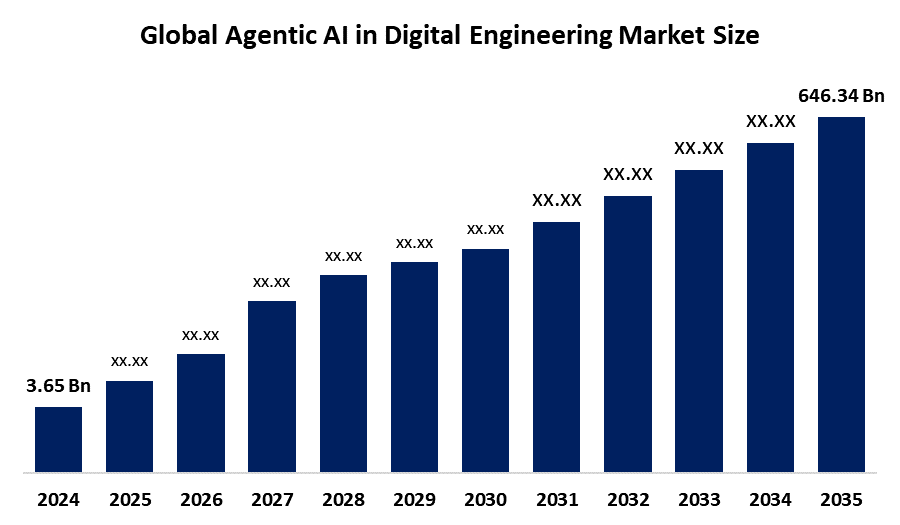
- The Global Agentic AI in Digital Engineering Market Size Was Estimated at USD 3.65 Billion in 2024
- The Market Size is Expected to Grow at a CAGR of around 60.1% from 2025 to 2035
- The Worldwide Agentic AI in Digital Engineering Market Size is Expected to Reach USD 646.34 Billion by 2035
- Asia Pacific is expected to grow the fastest during the forecast period.
Get more details on this report -
According to a research report published by Spherical Insights and Consulting, the global agentic AI in digital engineering market size was worth around USD 3.65 billion in 2024 and is predicted to grow to around USD 646.34 billion by 2035 with a compound annual growth rate (CAGR) of 60.1% from 2025 to 2035. The agentic AI in digital engineering market is growing due to the need for autonomous, multi-step workflow automation, accelerating innovation, reducing time-to-market, and integrating physics-based digital twins. Increased complexity in product design and advancements in AI models are driving this rapid adoption.
Agentic AI in Digital Engineering Market Key Takeaways
- North America dominated the global agentic AI in digital engineering market with the largest share of 40% in 2024.
- Asia-Pacific is expected to grow at the fastest CAGR in the market during the forecast period.
- By technology type, the generative AI for design segment accounted for a considerable revenue share of 45% in the market in 2024.
- By technology type, the AI in robotics and automation segment is expected to grow at the fastest CAGR in the market between 2024 and 2035.
- By deployment model, the cloud-based segment dominated the global market in 2024, with an approximate 50% share market.
- By deployment model, the hybrid model segment is expected to show the fastest growth over the forecast period.
- By application phase, the product design and development segment accounted for the 38% share in the market in 2024.
- By application phase, the predictive engineering analytics segment is expected to grow with the highest CAGR in the market during the studied years.
Market Overview
The global agentic AI in digital engineering market refers to artificial intelligence systems that autonomously perform tasks, make decisions, and complete complex engineering workflows with minimal human intervention. These systems are used across product design and development, predictive engineering analytics, process automation, and AI-enhanced simulation testing. Key applications include generative design, where AI autonomously iterates through thousands of design variations, and intelligent digital twins that actively optimize operations in real-time. In January 2026, European Commission launched two Horizon Europe calls, allocating €307.3 million for AI and related technologies. Of this, €85.5 million targets next-generation AI agents and robotics, promoting industrial and service applications and directly advancing digital engineering innovation across the European Union.
Market growth is driven by the imperative to accelerate innovation and reduce time-to-market, the escalating complexity of modern products, and rapid advancements in foundational AI models and computational infrastructure. Significant opportunities lie in hyper-integration with physics-based digital twins and simulation environments, allowing autonomous agents to experiment, learn, and optimize in dynamic virtual spaces. In March 2026, Infocomm Media Development Authority introduced the Model AI Governance Framework for Agentic AI, guiding responsible deployment. Building on prior frameworks for traditional and generative AI, it supports in-house and third-party AI solutions, complementing Singapore’s broader AI strategy and upcoming National AI Council initiatives.
Impact of AI in the Agentic AI in Digital Engineering Market
AI serves as the foundational engine powering the agentic AI in the digital engineering market. It enables autonomous agents to perceive complex environments, reason through engineering constraints, make intelligent decisions, and execute actions without human intervention. This transforms traditional digital engineering by accelerating generative design iterations, enabling predictive maintenance through intelligent digital twins, and optimizing complex simulations in real-time. The result is dramatically reduced development cycles, enhanced innovation capacity, and the ability to solve previously intractable engineering challenges across aerospace, automotive, and manufacturing sectors.
Agentic AI in Digital Engineering Market Trends
- Integration with Digital Twins: Agentic AI is increasingly being combined with digital twin technology, allowing engineers to simulate, monitor, and optimize real-world systems virtually. This trend enables predictive maintenance, performance optimization, and reduced prototyping costs, making engineering workflows more efficient and data-driven.
- Generative Design and Autonomous Optimization: Agentic AI is driving automated generative design, where systems independently propose optimized product designs based on constraints and objectives. This reduces human intervention, accelerates development cycles, and supports innovation in industries like aerospace, automotive, and electronics.
- Edge AI and Real-Time Decision Making: Deployment of agentic AI at the edge is growing, allowing autonomous processing of engineering data close to devices or sensors. This reduces latency, enhances real-time control, and supports applications in robotics, IoT-enabled manufacturing, and high-speed automated testing.
Report Coverage
This research report categorizes the agentic AI in digital engineering market based on various segments and regions, forecasts revenue growth, and analyzes trends in each submarket. The report analyses the key growth drivers, opportunities, and challenges influencing the agentic AI in digital engineering market. Recent market developments and competitive strategies, such as expansion, type launch, development, partnership, merger, and acquisition, have been included to draw the competitive landscape in the market. The report strategically identifies and profiles the key market players and analyses their core competencies in each sub-segment of the agentic AI in digital engineering market.
Driving Factors
Key driving factors for the global agentic AI in digital engineering market include the growing need for automation in complex engineering processes, increasing adoption of AI-driven design and simulation tools, and rising availability of big data. The market is driven by demand for faster product development and reduced operational costs. Additionally, increasing use of digital twins and generative design, accounting for over 40% adoption in advanced manufacturing, is accelerating innovation. Expanding cloud infrastructure and AI integration across industries further enhances scalability, efficiency, and real-time decision-making capabilities. In August 2025, the United Kingdom launched public-private partnerships to develop agentic AI tools for public services. Initial trials focus on employment and skills, with future use in automated citizen services. A National AI Tender using a Scan, Pilot, Scale approach highlights growing global investment in agentic AI innovation.
Restraining Factors
The global agentic AI in digital engineering market faces restraints due to high implementation costs, data security concerns, and integration complexity with legacy systems. Limited skilled workforce and lack of standardized frameworks further hinder adoption, while regulatory uncertainties and trust issues in autonomous decision-making systems also restrict widespread deployment across industries.
Market Segmentation
Technology Type Insights
Which technology type segment dominated the agentic AI in digital engineering market?
The generative AI for design segment held a dominant position in the market in 2024, due to its ability to autonomously explore thousands of design permutations, optimizing for performance, cost, and manufacturability. This accelerates innovation cycles and reduces material waste. By integrating with simulation tools, it enables real-time validation, making it indispensable for aerospace, automotive, and industrial engineering sectors.
The AI in robotics and automation segment is expected to show the fastest growth over the forecast period, due to the rapid adoption of autonomous systems in manufacturing and logistics. This surge is fueled by advancements in physical AI, enabling robots to handle complex tasks, with the global market expected to grow at over 40% annually through 2030.
Deployment Model Insights
How the cloud-based segment dominated the agentic AI in digital engineering market?
The cloud-based segment registered its dominance over the global market in 2024 by offering scalable infrastructure for complex simulations and AI model training. It enables seamless collaboration across distributed teams, reduces upfront capital expenditure, and provides access to high-performance computing resources on demand. This flexibility accelerates deployment cycles and democratizes access to advanced engineering tools for enterprises of all sizes, solidifying cloud platforms as the preferred deployment model.
The hybrid segment is expected to gain the highest market share between 2024 and 2035. The growth is due to combining on-premise security with cloud scalability. This balanced approach meets enterprise demands for data privacy while leveraging cloud computing power for intensive AI engineering tasks, ensuring operational flexibility and regulatory compliance.
Get more details on this report -
Application Phase Insights
Which application phase segment led the agentic AI in digital engineering market?
The product design and development segment led the market in 2024 by leveraging agentic AI to automate complex design iterations, optimize performance parameters, and accelerate time-to-market. AI agents enable rapid prototyping, generative design exploration, and real-time simulation feedback. This transforms traditional workflows, allowing engineers to focus on innovation while AI handles computational tasks, driving efficiency and reducing development costs across industries.
The predictive engineering analytics segment is expected to expand rapidly in the market in the coming years, driven by surging demand for AI-driven failure prediction, performance forecasting, and proactive system optimization. This growth empowers industries to minimize downtime, extend asset lifespan, and make data-informed decisions throughout the engineering lifecycle.
Regional Segment Analysis of the Agentic AI in Digital Engineering Market
- North America (U.S., Canada, Mexico)
- Europe (Germany, France, U.K., Italy, Spain, Rest of Europe)
- Asia-Pacific (China, Japan, India, Rest of APAC)
- South America (Brazil and the Rest of South America)
- The Middle East and Africa (UAE, South Africa, Rest of MEA)
North America AI in Digital Engineering Market Trends
Why North America dominated the agentic AI in digital engineering market?
North America held a major market share in 2024, due to advanced AI research, robust high-performance computing infrastructure, and strong government initiatives supporting AI innovation. The region benefits from a skilled talent pool, extensive R&D investment, and active collaboration between academia, industry, and startups, particularly in sectors like aerospace, automotive, and manufacturing, driving widespread adoption and market leadership. In October 2025, Canada allocated $925.6 million over five years for sovereign AI infrastructure, including $800 million to expand domestic compute capacity. The plan also establishes an Office of Digital Transformation and promotes development of made-in-Canada AI tools to modernize government operations and services.
U.S. Agentic AI in Digital Engineering Market Trends
The U.S. dominates the market in North America, due to the increased adoption in aerospace, automotive, and manufacturing. Key trends include autonomous design systems, generative AI integration, cloud-based simulation, and government-backed R&D initiatives. Rising investment in AI infrastructure and collaboration with startups further accelerates innovation and market expansion. In March 2024, the U.S. General Services Administration expanded its 10x program, funding AI-focused projects, with nearly 20% of submissions related to artificial intelligence. Initiatives explore using large language models to enhance search and user experience, supporting innovation in government digital services through feasibility stage funding.
Asia Pacific Agentic AI in Digital Engineering Market Trends
How is Asia-Pacific growing in the agentic AI in digital engineering market?
Asia-Pacific is expected to experience the fastest growth during the predicted timeframe, led by China, India, and Singapore, driven by government initiatives, digital transformation strategies, and investment in advanced manufacturing. Key growth factors include the adoption of autonomous design and simulation tools, the development of AI talent, and partnerships between academia, industry, and startups. Increasing focus on smart factories, industrial automation, and AI-driven product design accelerates market expansion across the region. In January 2026, Asia/Pacific governments are embracing agentic AI to automate policy-driven decision-making and service delivery. According to IDC, 40% of national governments plan to allocate 10% of IT budgets to data architecture and governance, addressing key barriers to scaling autonomous AI capabilities.
India Agentic AI in Digital Engineering Market Trends
India’s agentic AI in digital engineering market is expanding rapidly, fueled by government initiatives like NM-ICPS, investment in AI research, and digital transformation in manufacturing and infrastructure. Key trends include autonomous design, multilingual AI solutions, collaboration with global tech partners, and adoption of AI-driven simulation and automation tools across industries. In February 2026, India AI Impact Summit 2026 hosted an Agentic AI roundtable, gathering global tech, policy, and legal leaders. Discussions highlighted autonomous AI agents’ impact on safety, accountability, and cybersecurity, with insights from payments, cloud, and design sectors. Austin Mayron emphasized standards-led collaboration for responsible innovation.
Competitive Analysis:
The report offers the appropriate analysis of the key organizations/companies involved within the agentic AI in digital engineering market, along with a comparative evaluation primarily based on their type of offering, business overviews, geographic presence, enterprise strategies, segment market share, and SWOT analysis. The report also provides an elaborative analysis focusing on the current news and developments of the companies, which includes type development, innovations, joint ventures, partnerships, mergers & acquisitions, strategic alliances, and others. This allows for the evaluation of the overall competition within the market.
List of Key Companies
- NVIDIA Corporation
- Dassault Systemes
- Autodesk, Inc.
- Siemens
- Google LLC
- ANSYS, Inc.
- IBM Watsonx
- PTC Inc.
- Accenture PLC
- Synopsys Inc.
- Microsoft Corporation
- Adept AI Labs Inc.
- Cadence Design Systems
- Ampcome Technologies Pvt. Ltd
- Others
Key Target Audience
- Market Players
- Investors
- End-users
- Government Authorities
- Consulting and Research Firm
- Venture capitalists
- Value-Added Resellers (VARs)
Recent Development
- In March 2026, Siemens unveiled the Questa One Agentic Toolkit, introducing domain-scoped agentic AI workflows for its Questa One verification software. The toolkit enables intelligent, multi-step, framework-agnostic verification workflows, accelerating design closure while preserving human expertise and ensuring trusted, high-quality IC verification outcomes.
- In March 2026 at Mobile World Congress, Google Cloud enhanced Cloud Spanner Graph and Vertex AI for telecoms, enabling agentic AI with network digital twins, real-time GNN predictions, unified data layers, and autonomous telco agents, automating data governance and network management while accelerating intelligent, self-driving telecom operations.
- In January 2026, IBM launched IBM Enterprise Advantage, an asset-based consulting service enabling organizations to build, govern, and scale internal AI platforms. The service integrates with existing cloud providers and AI models, including AWS, Google Cloud, Azure, and IBM watsonx, accelerating agentic AI adoption without infrastructure changes.
- In January 2026, Singapore, through Infocomm Media Development Authority, launched the Model AI Governance Framework for Agentic AI. The framework provides risk assessment, human accountability, and technical controls, supporting responsible deployment of autonomous agents in advanced manufacturing and digital engineering, aligned with national AI Missions.
- In December 2025, Google announced development of agentic AI travel booking tools within AI Mode, capable of autonomously booking flights and hotels. Collaborating with partners like Booking.com, Expedia, and major hotel chains, the initiative aims to save travelers time and boost booking confidence, though no launch timeline is set.
- In August 2025, Singapore launched Microsoft’s Agentic AI Accelerator under the Enterprise Compute Initiative introduced by Lawrence Wong. The program supports 300 companies with up to S$250,000 in Azure credits, plus AI training and tools, accelerating enterprise AI adoption and digital transformation.
Market Segment
This study forecasts revenue at global, regional, and country levels from 2020 to 2035. Spherical Insights has segmented the agentic AI in digital engineering market based on the below-mentioned segments:
Global Agentic AI in Digital Engineering Market, By Technology Type
- Generative AI for Design
- Digital Twins and Physics-based Simulation
- AI in Robotics and Automation
- Explainable AI (XAI)
Global Agentic AI in Digital Engineering Market, By Deployment Model
- On-Premise
- Cloud-Based
- Hybrid
Global Agentic AI in Digital Engineering Market, By Application Phase
- Product Design & Development
- Predictive Engineering Analytics
- Autonomous Testing & QA
- Process & Workflow Optimization
Global Agentic AI in Digital Engineering Market, By Regional Analysis
- North America
- US
- Canada
- Mexico
- Europe
- Germany
- UK
- France
- Italy
- Spain
- Russia
- Rest of Europe
- Asia Pacific
- China
- Japan
- India
- South Korea
- Australia
- Rest of Asia Pacific
- South America
- Brazil
- Argentina
- Rest of South America
- Middle East & Africa
- UAE
- Saudi Arabia
- Qatar
- South Africa
- Rest of the Middle East & Africa
Need help to buy this report?