Why Military Satellites Become the Backbone of Upcoming Conflicts: Statistics and Market Dynamics
RELEASE DATE: Mar 2026 Author: Spherical InsightsRequest Free Sample Speak to Analyst
How does a military satellite look in a defence skeleton?
Military satellites are specialised space-based equipment intended to aid in security and defence activities. By offering safe communications, information collection, navigation, early warning and environmental monitoring, they are essential to contemporary combat. Military satellites are becoming essential instruments for international defence plans by incorporating cutting-edge sensors and AI-driven analytics, guaranteeing technological dominance and operational resilience in modern wars. While reconnaissance or spy satellites gather intelligence on adversary movements and facilities, communication satellites, SATCOM, guarantee encrypted military communications. Precise targeting and troop coordination are made possible by navigation satellites like GPS, BeiDou and GLONASS. Weather monitoring satellites provide environmental data for the battlefield, while early warning satellites identify missile launches, providing crucial response time.
Navigate Future Markets with Confidence: Insights from Spherical Insights LLP
The insights presented in this blog are derived from comprehensive market research conducted by Spherical Insights LLP, a trusted advisory partner to leading global enterprises. Backed by in-depth data analysis, expert forecasting, and industry-specific intelligence, our reports empower decision-makers to identify strategic growth opportunities in fast-evolving sectors. Clients seeking detailed market segmentation, competitive landscapes, regional outlooks, and future investment trends will find immense value in the full report. By leveraging our research, businesses can make informed decisions, gain a competitive edge, and stay ahead in the transition toward sustainable and profitable solutions.
Unlock exclusive market insights-Download the Brochure now and dive deeper into the future of the Military Satellite
How do they play a key role in current warfare in the Middle East region?
In Middle Eastern combat, military satellites are essential because battlefield success is determined by quick intelligence, secure communication and accurate targeting. They offer early warning systems to identify ballistic launches, GPS-based navigation for precise strikes, SATCOM for encrypted coordination and reconnaissance photography to track missile locations and troop movements. Although its systems are still less sophisticated, Iran depends on satellites for missile guidance and regional deterrence. For the United States, satellites support AI-assisted targeting and global command networks, guaranteeing superiority in operations like Operation Epic Fury. With its Arrow missile defence integration and Ofek reconnaissance satellites, Israel employs space assets to safeguard national security and combat regional threats. In ongoing Middle Eastern conflicts, these satellite systems work together to change the battlefield by facilitating quicker decision-making, better situational awareness and strategic resilience.
Market Size and Growth
The industry expansion and its trends to uplift
Key developments, including mega constellations and small satellites, are propelling the market's growth. For military operations, smaller and more affordable satellites provide greater flexibility. Mega constellations composed of numerous small satellites improve communication and surveillance capabilities by offering broad coverage and real-time data.
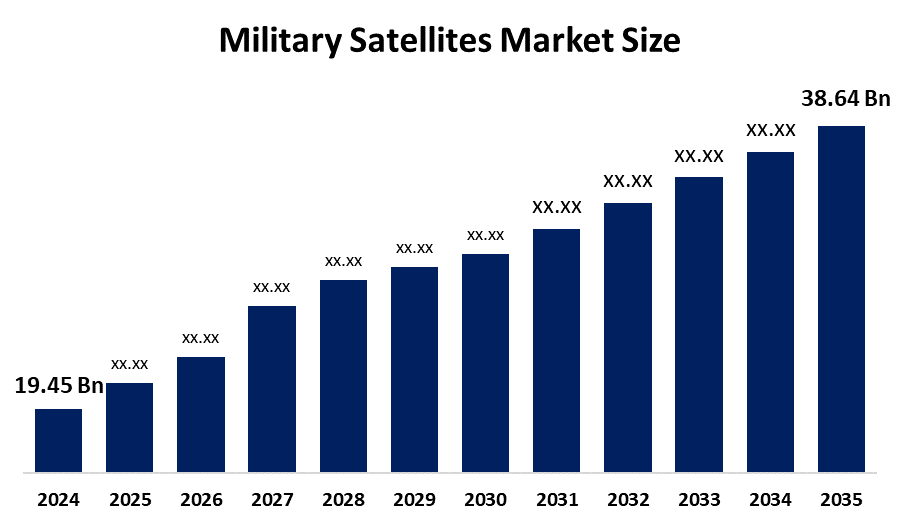
The Global market is witnessing steady growth, with its valuation reaching USD 19.45 billion in 2024. According to recent projections, the market is expected to expand significantly and reach USD 38.64 billion by 2035, reflecting strong demand and continued industry development. During the forecast period from 2024 to 2035, the market is anticipated to grow at a compound annual growth rate (CAGR) of 6.44%, driven by technological advancements, increasing investments, and rising global demand across multiple sectors.
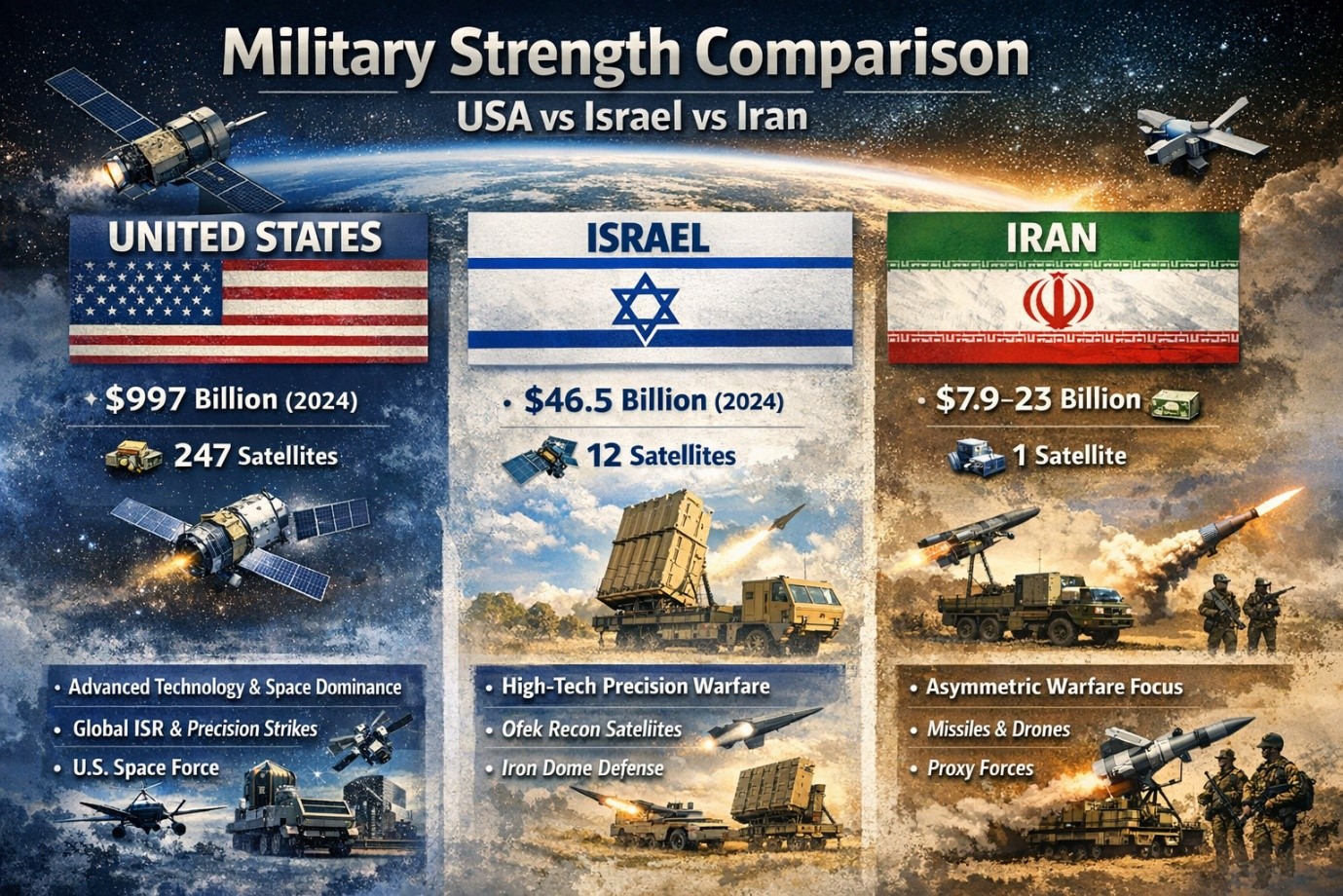
The dynamic that differs between the USA, Israel, and Iran in terms of military strength on the current battlefield
USA
Combining conventional forces with a vast space-based intelligence and communication network, the United States maintains the most sophisticated military ecosystem in the world. Approximately 247 military satellites, considerably more than any other country, are operated by the United States to facilitate worldwide communications, missile warning, navigation and surveillance. Precision strikes, drone operations, and real-time battlefield knowledge are made possible by the integration of these satellites with systems like the Global Positioning System. Strong private sector space firms and the US Space Force operational command are further advantages for the nation. The United States can coordinate joint operations in the air, sea, land, cyber and space domains on the modern battlefield thanks to its satellite dominance, which offers unparalleled situational awareness and strategic surveillance across the globe.
Israel
The Israeli military is smaller, but it makes up for it with highly advanced intelligence and technology systems. The nation has about twelve military satellites, many of which are utilised for Middle East monitoring and reconnaissance. High-resolution photography for tracking opponents and directing precision strikes is provided by systems like the Ofek surveillance satellites. Network-centric warfare, which integrates satellites with drones, missile defence systems and cyber intelligence, is a key component of Israel's security strategy. Recent satellite launches have improved ongoing surveillance over areas of regional conflict, making it possible to quickly identify military movements and missile launches. Israel has a considerable technological advantage on contemporary battlefields thanks to its combination of sophisticated sensors, AI-driven intelligence analysis and highly skilled military forces, even though its numbers are smaller than those of superpowers.
Unlock exclusive market insights-Download the Brochure now and dive deeper into the future of the Military Satellite
Iran
Iran's military approach is quite distinct, depending less on sophisticated space technology and more on asymmetric warfare, ballistic missiles and regional proxy troops. The country's weak capacity for space-based intelligence in comparison to the United States and Israel is demonstrated by the fact that it currently has only one military or dual-use satellite in operation. With domestic launches and collaboration with allies like Russia, which has assisted in the launch of multiple Iranian satellites into orbit, Iran has made an effort to broaden its space program. Instead of providing sophisticated real-time war intelligence, these satellites primarily assist basic Earth observation and communications. For the purpose of maintaining strategic deterrence in regional crises, Iran uses ground-based radar drone networks and missile weapons to make up for its weak satellite coverage.
Top Companies in Military Satellite Manufacturing Across the World
- Lockheed Martin Space Systems
- Boeing Defence Space and Security
- Northrop Grumman Innovation Systems
- Raytheon Technologies RTX
- Airbus Defence and Space
- Thales Alenia Space
- China Aerospace Science and Technology Corporation CASC
- Russian Satellite Communications Company RSCC
- Israel Aerospace Industries IAI
- Indian Space Research Organisation ISRO Military Division
- Lockheed Martin Space Systems (USA)
Lockheed Martin Space Systems is a key player in the creation of US military satellites that support secure communications, missile warning, and navigation. A 1 billion dollar deal to supply 18 missile tracking satellites for the Space Development Agency Tracking Layer, a component of the Proliferated Warfighter Space Architecture, was awarded to the company in December 2025. These satellites will enable real-time tracking in low Earth orbit and improve coordination of missile defence. To prevent electronic jamming and guarantee accurate navigation in contested areas, Lockheed is also developing GPS enhancements. Lockheed's contribution to secure military networks is reinforced by the US Space Force FY2026 budget, which provides 277 million dollars for satellite initiatives like MILNET. Lockheed Martin continues to be a key component of America space based security strategy thanks to its enormous defence backlog and strong government backing.
- Northrop Grumman Innovation Systems (USA)
Northrop Grumman Innovation Systems, which specialises in missile warning, secure communications and reconnaissance payloads, is a key player in the creation of American military satellites. The corporation is recovering in 2026 with new SDA satellite contracts and classified programs following an 8 per cent drop in space sales in 2025. Project Talon, which combines autonomous systems with space defence, and its contributions to nuclear triad modernisation are among its projects. Northrop continues to have a $ 91.4 billion backlog and $10.8 billion in space sales. The Pentagon's $ 13.4 billion budget for AI and autonomy helps fund its cyber defence and satellite initiatives. Northrop Grumman, at the centre of American modernisation, keeps developing military satellite technology to guarantee superiority and resilience in contested space and combat zones.
- Israel Aerospace Industries [IAI] (Israel)
Israel Aerospace Industries IAI which provides communications, missile defence, and reconnaissance capabilities, is a key player in Israel's military satellite program. Its SATCOM technologies improve military coordination while its Ofek satellites provide high-resolution imagery for intelligence purposes. IAI and Germany signed a 3.1 billion dollar contract in January 2026 to extend the Arrow 3 missile defence system, incorporate satellite-based tracking and strengthen Israel's international security alliances. Strong financing for space and missile projects is guaranteed by Israel's 2026 defence budget of about 19 billion dollars. IAI continues to develop satellite-based border security technology and remains a key component of Israel's defence strategy, guaranteeing technological dominance and resilience in regional and international crises.
- Thales Alenia Space (France)
Thales Alenia Space, which offers secure communications, missile defence integration and reconnaissance, is a pillar of the European military satellite and defence industry. In March 2026, it introduced SkyDefender, a multi-domain air and missile defence system intended to combat ballistic missiles, drones and hypersonic threats. The system enhances NATO military capabilities by integrating cyber-resilient structures, AI-driven command networks, and sophisticated sensors. With strong investment from the European Union and NATO, Thales continues to expand its portfolio of military satellites, strengthening Europe's strategic independence.
- Indian Space Research Organisation [ISRO] (India)
India's defence satellite program is led by the Indian Space Research Organisation Military Division, which offers safe communications, navigation and reconnaissance capabilities. While NavIC guarantees precise targeting and troop coordination, its GSAT satellites support encrypted military networks. The Department of Space received 13705.63 crore rupees in 2026 from the Union Budget, which is an increase compared with the previous year. This funding supports infrastructure improvements, enhanced payload development, and new rocket and satellite missions. The ISRO military division is improving India's strategic autonomy in space, guaranteeing resilience against electronic warfare and strengthening participation in next-generation battlefield operations.
Unlock exclusive market insights-Download the Brochure now and dive deeper into the future of the Military Satellite
The partnership that influences military satellite deployment
USA
In March 2026, the United States expanded military satellite cooperation with allies like Japan to build anti-jamming defence communication satellites. These partnerships improved secure battlefield communications, strengthened allied interoperability, and enhanced space-based ISR networks for missile detection, targeting and joint military operations across the Indo-Pacific.
Israel
In March 2026, Israel collaborated closely with the United States on satellite-based intelligence and surveillance systems during military operations against Iran. These space-based ISR capabilities enabled precision targeting, missile tracking, and real-time battlefield monitoring, strengthening joint operational effectiveness and allied coordination in the region.
Iran
In July 2025, Iran strengthened space cooperation with Russia, which launched Iranian communication satellites such as Nahid 2. This partnership boosted Tehran's satellite communication and surveillance capability, helped compensate for limited domestic launch capacity and supported military intelligence and strategic monitoring across regional defence operations.
From the remaining geographical continents
Europe
European countries such as Germany and France developed the Odin Eye satellite early warning system to detect missile launches from space. The program strengthened NATO-level missile defence by enhancing Europe's ability to track ballistic and hypersonic threats and improve collective security coordination.
Asia Pacific
The United States and Japan satellite partnership, including projects like the IHI SSTL satellite constellation, expanded to improve ISR capabilities and secure communications across the Indo-Pacific defence network. These initiatives enhanced missile detection, targeting, and joint military operations by strengthening allied space-based surveillance and battlefield interoperability.
South America
Countries such as Brazil and Argentina increased cooperation with US and European space companies to develop Earth observation satellites. These projects enhanced border surveillance and military intelligence, providing improved monitoring capabilities, strategic awareness and strengthened defence partnerships across South America, evolving security landscape.
Africa
African nations, including Nigeria and South Africa, partnered with global satellite providers to improve reconnaissance satellites. These collaborations enhanced counter terrorism monitoring and maritime security, strengthened regional intelligence networks, and provided advanced surveillance capabilities to support military operations and strategic defence across the continent.
Unlock exclusive market insights-Download the Brochure now and dive deeper into the future of the Military Satellite
Quick Outlook
Their ability to provide secure communication, intelligence gathering, navigation, missile warning, and real-time battlefield awareness, military satellites have become an essential component of modern combat. The market is expected to grow from 19.45 billion in 2024 to 38.64 billion by 2035 with a CAGR of 6.44%. Moreover, nations including the United States, Israel, and Iran depend more on space-based capabilities. These satellites facilitate strategic decision-making, AI-driven monitoring, and precision strikes, especially in regions like the Middle East. Small satellite constellations and international collaborations in Europe, Asia Pacific, Africa and South America also contribute to growth, strengthening international military networks and shaping the future of multi-domain warfare.
About the Spherical Insights & Consulting
Spherical Insights & Consulting is a market research and consulting firm which provides actionable market research study, quantitative forecasting and trends analysis provides forward-looking insight especially designed for decision makers and aids ROI.
Which is catering to different industry such as financial sectors, industrial sectors, government organizations, universities, non-profits and corporations. The company's mission is to work with businesses to achieve business objectives and maintain strategic improvements.
CONTACT US:
For More Information on Your Target Market, Please Contact Us Below:
Phone: +1 303 800 4326 (the U.S.)
Phone: +91 90289 24100 (APAC)
Email: inquiry@sphericalinsights.com, sales@sphericalinsights.com
Contact Us: https://www.sphericalinsights.com/contact-us
Need help to buy this report?