Top 25 Companies in the Global Database Encryption Market (2024–2035): Spherical Insights Analysis
RELEASE DATE: Mar 2026 Author: Spherical InsightsRequest Free Sample Speak to Analyst
Introduction
Database encryption is the basis for keeping information safe by changing data into code that only people with the right keys can read. Over time, encryption gotten better from hiding data to using special algorithms. Now we have ways like field-level encryption and homomorphic encryption, which let us work with data securely without showing the original information. In the world, these systems are very important. They help keep health records in hospitals and protect lots of transaction data in big banking systems around the world. At the time, there is more pressure from governments to do this. New rules from the European Data Protection Board and recent orders from the United States government have made encryption something that companies must do, not something they can choose to do. These new rules focus on having zero-trust security models and making kinds of cryptography that can stop very complex cyber threats. Because of this, companies now have a responsibility. Strong database encryption is not a technical thing; it is a main way to protect companies from losing a lot of money and damaging their reputation if there is a data breach. Database encryption is a part of keeping information safe, and companies need to take it seriously.
Navigate Future Markets with Confidence: Insights from Spherical Insights LLP
The insights presented in this blog are derived from comprehensive market research conducted by Spherical Insights LLP, a trusted advisory partner to leading global enterprises. Backed by in-depth data analysis, expert forecasting, and industry-specific intelligence, our reports empower decision-makers to identify strategic growth opportunities in fast-evolving sectors. Clients seeking detailed market segmentation, competitive landscapes, regional outlooks, and future investment trends will find immense value in the full report. By leveraging our research, businesses can make informed decisions, gain a competitive edge, and stay ahead in the transition toward sustainable and profitable solutions.
Unlock exclusive market insights—Download the Brochure now and dive deeper into the future of the Database Encryption Market.
Global Database Encryption Market Size & Statistics
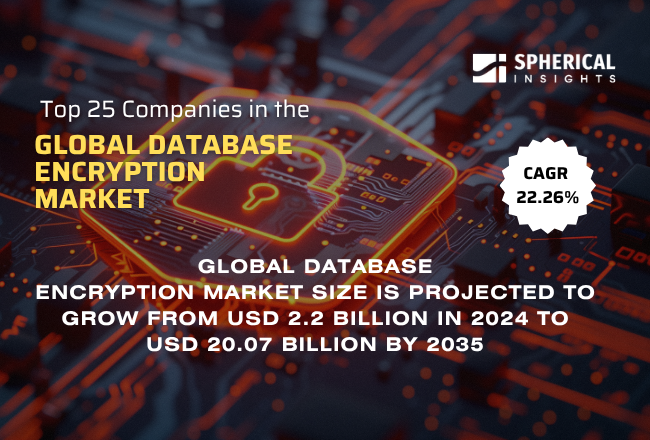
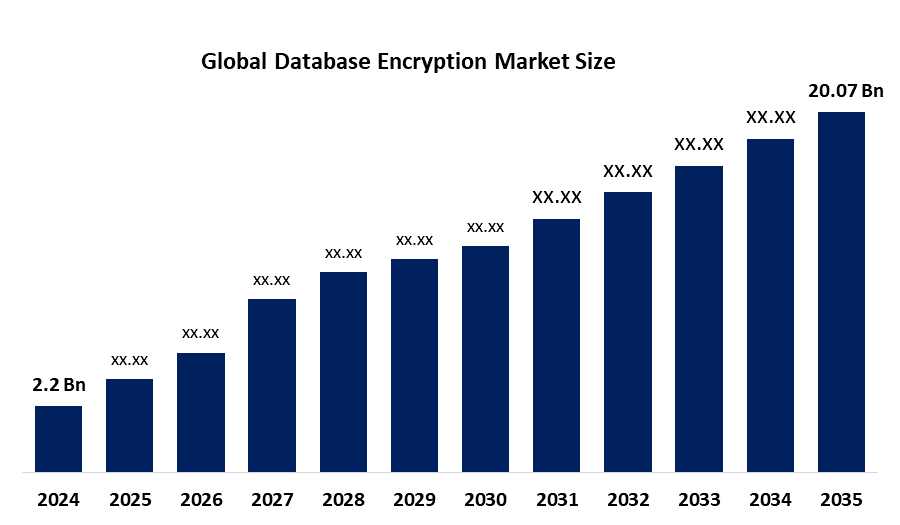
- The Global Database Encryption Market is estimated to be worth USD 2.2 billion in 2024.
- The market is projected to expand at a robust CAGR of 22.26% between 2024 and 2035.
- The Global Database Encryption Market size is anticipated to reach approximately USD 20.07 billion by 2035.
- North America holds the highest revenue share, currently exceeding 35% of the global market. This dominance is fuelled by the early adoption of Zero Trust architectures and strict federal mandates,
- Asia-Pacific is identified as the fastest-growing region, with a projected CAGR outperforming the global average. Expansion is driven by India’s Digital Personal Data Protection (DPDP) Rules 2025.
Regional Growth & Demand Analysis
North America continues to serve as the primary engine for the global database encryption landscape, defined by a rapid move toward Zero Trust Architectures and the integration of Post-Quantum Cryptography (PQC) into federal and corporate frameworks. Growth is fuelled by a massive transition toward Data-Centric security, where organisations prioritise encrypting information at the field and column level rather than just the perimeter. This shift is solidified by the U.S. National Cyber Strategy 2026, which mandates that critical infrastructure ranging from energy grids to financial data centres implement advanced encryption to neutralise sophisticated state-sponsored threats. The region's demand is specifically centred on automated key lifecycle management and Bring Your Own Key (BYOK) models, meeting the needs of a professional workforce operating in high-compliance environments like healthcare (HIPAA) and finance (PCI DSS).
Asia-Pacific stands as the fastest-growing region, increasingly influenced by large-scale digital sovereignty movements and massive government-led legislative overhauls. This surge is supported by high-level policy frameworks such as India’s Digital Personal Data Protection (DPDP) Rules 2025, which have fundamentally replaced optional security with mandatory encryption and 72-hour breach reporting for any entity handling Indian citizen data. These efforts focus on bridging the security gap in mobile-first economies, where a significant share of the population accesses banking and government services via smartphones. Local innovation hubs in Singapore and India are simultaneously developing bandwidth-efficient encryption tools designed for distributed NoSQL databases, positioning the region as a global leader in securing high-velocity, unstructured data for the next generation of digital-native enterprises.
Global Database Encryption Market Segmentation
The Global Database Encryption Market is strategically categorised By Encryption Type (Transparent Data Encryption (TDE), Column-Level, and Application-Level Methods) and By Deployment Mode (Spanning Cloud-Native SaaS, On-Premise, and Hybrid Infrastructures). It is further segmented By Organization Size (distinguishing between large enterprises and SMEs) with targeted analysis across End-User Verticals (such as BFSI, healthcare, government, and IT). This comprehensive framework covers major geographic regions, North America, Europe, Asia-Pacific, Latin America, and MEA, providing a detailed forecast of security capital expenditure and the transition toward granular, data-centric protection for the 2024–2035 period.
Ready to lead the Database Encryption Market ?
Discover the regional trends and growth factors shaping the industry. We’re here to assist with expert, personalized data.
Call +1 303 800 4326 or Send us a message for a personalized consultation.
Top 10 Trends in the Global Database Encryption Market
- Transition toward Post-Quantum Cryptography (PQC) for Long-Term Data Immunity
- Widespread Adoption of Homomorphic Encryption for Secure Data Processing without Decryption
- Integration of AI-Driven Automated Key Lifecycle Management and Rotation
- Rise of Bring Your Own Key (BYOK) and Hold Your Own Key (HYOK) Cloud Models
- Shift from Perimeter Security to Granular Field-Level and Column-Level Encryption
- Implementation of Zero-Trust Architecture (ZTA) for Database Access Control
- Deployment of Hardware Security Modules (HSM) as a Service for Scalable Hybrid Clouds
- Expansion of Format-Preserving Encryption (FPE) for Legacy Application Compatibility
- Evolution of Sovereign Cloud Encryption to Meet Regional Data Residency Mandates
- Growth of Transparent Data Encryption (TDE) for High-Performance NoSQL and Big Data Clusters
- Post-Quantum Cryptography (PQC) Transition
As quantum computing advances, traditional encryption faces potential obsolescence. Organisations are now adopting NIST-approved quantum-resistant algorithms to pre-empt harvest now, decrypt later tactics, ensuring that long-term data like government secrets and intellectual property remain immune to future processing breakthroughs.
- Homomorphic Encryption Adoption
This technology allows for secure data processing without decryption, enabling analytics to run directly on ciphertext. It eliminates the traditional vulnerability window during computation, allowing sectors like healthcare and finance to extract insights from sensitive records while keeping the raw data mathematically locked.
- AI-Driven Key Management
Automation is replacing manual oversight in the encryption key lifecycle. AI layers now manage the generation and rotation of keys based on real-time threat telemetry, triggering emergency re-keying if suspicious access is detected, which drastically reduces the risk of human error or compromised credentials.
- Rise of BYOK and HYOK Models
To combat blind subpoenas and cloud provider access, enterprises are using Bring Your Own Key (BYOK) and Hold Your Own Key (HYOK). This ensures that even if data resides on a third-party server, the enterprise maintains exclusive physical control over the master keys, effectively isolating the data from the provider.
- Granular Field-Level Encryption
Security is shifting from the database perimeter to individual data cells. By encrypting specific fields like Social Security numbers instead of the entire disk, organisations ensure that even users with administrative database access cannot view the most sensitive crown jewels without explicit, high-level clearance.
Empower your strategic planning:
Stay informed with the latest industry insights and market trends to identify new opportunities and drive growth in the global database encryption market. To explore more in-depth trends, insights, and forecasts, please refer to our detailed report.
Unlock exclusive market insights—Download the Brochure now and dive deeper into the future of the Database Encryption Market.
Top 25 Companies in the Global Database Encryption Market
- Microsoft Corporation
- International Business Machines (IBM) Corporation
- Thales S.A.
- Oracle Corporation
- Broadcom Inc. (Symantec)
- Amazon Web Services (AWS), Inc.
- Google LLC
- Cisco Systems, Inc.
- Dell Technologies Inc.
- Hewlett Packard Enterprise (HPE)
- Sophos Ltd.
- Check Point Software Technologies Ltd.
- Fortinet, Inc.
- McAfee Corp.
- Trend Micro Incorporated
- NetApp, Inc.
- OpenText (Micro Focus)
- PKWARE, Inc.
- WinMagic Inc.
- Post-Quantum
- Vormetric (A Thales Company)
- Gemalto (A Thales Company)
- Penta Security Systems
- Informatica
- SAS Institute Inc.
- Microsoft Corporation
Headquarters: Redmond, Washington, USA
As a dominant force in both cloud and on-premise ecosystems, Microsoft transitioned from providing simple database tools to offering an integrated Security Copilot ecosystem. By 2026, their strategy is centred on Microsoft Purview, which utilises generative AI to automate data discovery and classification across multi-cloud environments. Their current focus is on Always Encrypted technology with secure enclaves, allowing sensitive SQL data to be processed while remaining encrypted in the CPU memory. They are increasingly positioning themselves as the go-to provider for Sovereign Cloud solutions, meeting strict EU Data Boundary requirements through automated, transparent encryption.
- International Business Machines (IBM) Corporation
Headquarters: Armonk, New York, USA
IBM remains the primary innovator for high-stakes enterprise security, moving beyond traditional encryption into the realm of Quantum-Safe Cryptography. In 2026, the company’s roadmap is heavily invested in Guardium Insights, a platform that leverages AI to detect anomalous database access patterns in real-time. Their unique value proposition lies in Fully Homomorphic Encryption (FHE), which enables organisations to perform analytics on encrypted datasets without ever exposing the raw information. IBM is currently positioning itself as the leader in Data-Centric security for the banking and financial sectors, where they provide the underlying cryptographic fabric for global transaction processing.
- Thales S.A.
Headquarters: Paris, France
Thales evolved from a hardware security provider into a global leader in Digital Identity and Data Sovereignty. Their 2026 strategy is anchored by the CipherTrust Data Security Platform, which unifies key management across fragmented hybrid cloud infrastructures. By integrating Post-Quantum Cryptographic (PQC) algorithms into their hardware security modules (HSMs), they ensure long-term data immunity against future computational threats. They are increasingly focused on the AI as an Insider Threat narrative, providing specialised encryption tools that prevent autonomous AI agents from accessing sensitive data tiers without explicit, policy-driven authorisation.
- Oracle Corporation
Headquarters: Austin, Texas, USA
Oracle continues to dominate the mission-critical database market by embedding security directly into the database kernel rather than treating it as an add-on. Their flagship Autonomous Database now utilises Security 360 protocols, which automate the entire encryption and patching lifecycle to eliminate human error. In 2026, Oracle’s innovation centres on Oracle Database 23ai, which integrates AI vector search with field-level encryption. This allows companies to build sophisticated AI applications that can search and retrieve data while maintaining Transparent Data Encryption (TDE) at scale, making them a top choice for regulated industries requiring high-performance, self-securing data estates.
- Broadcom Inc.
Headquarters: Palo Alto, California, USA
Following the acquisition of Symantec, Broadcom streamlined its portfolio to focus on Information-Centric Protection for the world’s largest government and corporate entities. Their 2026 approach moves away from standalone products toward an Adaptive Defence Strategy, where database encryption is tightly coupled with Data Loss Prevention (DLP) and Zero Trust Network Access. Their current technology focus is on PGP (Pretty Good Privacy) Client ecosystems and endpoint-to-database encryption, ensuring that data remains protected as it moves between mobile field devices and central repositories. They are positioning themselves as the essential utility for Hardened Infrastructure, specifically for the defence and telecommunications sectors.
Are you ready to discover more about the database encryption market?
The report provides an in-depth analysis of the leading companies operating in the global database encryption market. It includes a comparative assessment based on their product portfolios, business overviews, geographical footprint, strategic initiatives, market segment share, and SWOT analysis. Each company is profiled using a standardised format that includes:
Unlock exclusive market insights—Download the Brochure now and dive deeper into the future of the Database Encryption Market.
Company Profiles
- Microsoft Corporation
- Business Overview
- Company Snapshot
- Products Overview
- Company Market Share Analysis
- Company Coverage Portfolio
- Financial Analysis
- Recent Developments
- Merger and Acquisitions
- SWOT Analysis
- International Business Machines (IBM) Corporation
- Thales S.A.
- Oracle Corporation
- Broadcom Inc. (Symantec)
- Amazon Web Services (AWS), Inc.
- Google LLC
- Cisco Systems, Inc.
- Dell Technologies Inc.
- Hewlett Packard Enterprise (HPE)
- Sophos Ltd.
- Check Point Software Technologies Ltd.
- Fortinet, Inc.
- McAfee Corp.
- Trend Micro Incorporated
- NetApp, Inc.
- OpenText (Micro Focus)
- PKWARE, Inc.
- WinMagic Inc.
- Post-Quantum
- Vormetric (A Thales Company)
- Gemalto (A Thales Company)
- Penta Security Systems
- Informatica
- SAS Institute Inc.
Conclusion
The global database encryption market is rapidly evolving from a peripheral security measure into the core of modern data sovereignty, driven by the necessity to protect information across diverse cloud and mobile environments. As we move toward 2035, the industry is shifting toward a data-centric architecture characterised by the integration of Post-Quantum Cryptography (PQC) and AI-driven automation, ensuring long-term immunity against emerging computational threats. This transition is further catalysed by strict international mandates like the DPDP Act and GDPR, which have turned granular, field-level encryption into a mandatory baseline for corporate liability. Ultimately, the market’s trajectory underscores a future where homomorphic encryption and sovereign key management allow organisations to maintain total control over their crown jewels, even as they embrace the complexities of global digital transformation.
Our Report
https://www.sphericalinsights.com/reports/japan-fresh-fruits-market
https://www.sphericalinsights.com/reports/italy-contraceptive-devices-market
https://www.sphericalinsights.com/reports/italy-cybersecurity-market
https://www.sphericalinsights.com/reports/italy-beauty-and-personal-care-market
About the Spherical Insights & Consulting
Spherical Insights & Consulting is a market research and consulting firm which provides actionable market research study, quantitative forecasting and trends analysis provides forward-looking insight especially designed for decision makers and aids ROI.
Which is catering to different industry such as financial sectors, industrial sectors, government organizations, universities, non-profits and corporations. The company's mission is to work with businesses to achieve business objectives and maintain strategic improvements.
CONTACT US:
For More Information on Your Target Market, Please Contact Us Below:
Phone: +1 303 800 4326 (the U.S.)
Phone: +91 90289 24100 (APAC)
Email: inquiry@sphericalinsights.com, sales@sphericalinsights.com
Contact Us: https://www.sphericalinsights.com/contact-us
Need help to buy this report?