Top 25 Companies in Global Insect Growth Regulator Market (2026–2035): Statistics Report Till 2035 Forecast
RELEASE DATE: Apr 2026 Author: Spherical InsightsRequest Free Sample Speak to Analyst
Description
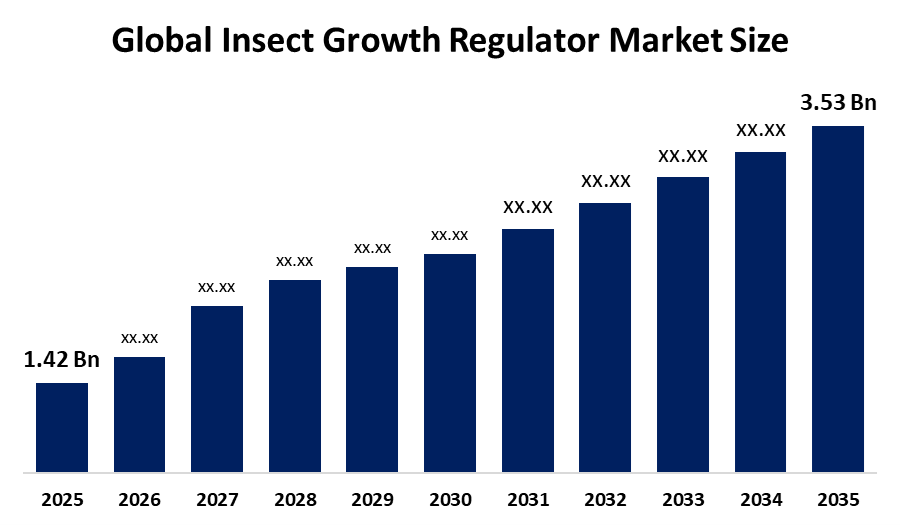
According to a research report published by Spherical Insights & Consulting, the Global Insect Growth Regulator Market Size is projected to grow from USD 1.42 Billion in 2025 to USD 3.53 Billion by 2035, at a CAGR of 9.53% during the forecast period 2026–2035. The Global Insect Growth Regulator market is driven by demand for eco-friendly pest control, rising pesticide resistance, strict regulations on chemicals, and increasing adoption of integrated pest management and organic farming practices worldwide.
Introduction
The Global Insect Growth Regulator (IGR) market refers to the worldwide industry involved in the production and application of chemical substances that disrupt the life cycle of insects by interfering with growth and reproduction, offering targeted pest control with lower toxicity compared to conventional pesticides. The market is experiencing robust growth due to rising demand for environment-friendly crop protection solutions, driven by increasing environmental concerns and stricter regulatory limits on chemical pesticide residues. Eco-friendly IGRs are being widely adopted in agriculture and pest management as they decompose rapidly and pose minimal risk to non-target organisms, aligning with sustainable and organic farming practices. Growth factors include heightened awareness of human and environmental health impacts, escalating resistance to traditional insecticides, and the expansion of integrated pest management (IPM) strategies that favour selective, low-toxicity control agents. Technological advancements such as formulation innovations, precision application systems (e.g., drone-assisted spraying), and compatibility with biological control agents are enhancing efficacy and broadening IGR applications across agriculture, livestock, and urban pest control sectors. Government initiatives and policies promoting sustainable agriculture, reduced chemical pesticide usage, and support for safer pest control alternatives further stimulate market adoption globally.
January 2026 — India’s Pesticides Management Bill, 2025. The draft Pesticides Management Bill, 2025 was highlighted in January 2026 as a major overhaul of pesticide regulation, replacing the older Insecticides Act to focus on risk-based approvals, environmental safety, and support for safer pesticide alternatives — aligning with sustainable pest management trends that benefit markets like IGRs
October 2025 - UK National Action Plan on pesticides. The United Kingdom published its Pesticides National Action Plan 2025, emphasizing sustainable pesticide regulation and reduced environmental impact, supporting markets for safer alternatives like IGRs
Navigate Future Markets with Confidence: Insights from Spherical Insights LLP
The insights presented in this blog are derived from comprehensive market research conducted by Spherical Insights LLP, a trusted advisory partner to leading global enterprises. Backed by in-depth data analysis, expert forecasting, and industry-specific intelligence, our reports empower decision-makers to identify strategic growth opportunities in fast-evolving sectors. Clients seeking detailed market segmentation, competitive landscapes, regional outlooks, and future investment trends will find immense value in the full report. By leveraging our research, businesses can make informed decisions, gain a competitive edge, and stay ahead in the transition toward sustainable and profitable solutions.
Unlock exclusive market insights—Download the Brochure now and dive deeper into the future of the Insect Growth Regulator Market.
Insect Growth Regulator Market Size & Statistics
- The Market Size for Insect growth regulator Was Estimated to be worth USD 1.42 Billion in 2025.
- The Market is Going to Expand at a CAGR of 9.53% between 2026 and 2035.
- The Global Insect Growth Regulator Market Size is anticipated to reach USD 3.53 Billion by 2035.
- North America is expected to generate the highest demand during the forecast period in the Insect growth regulator Market.
- Asia Pacific is expected to grow the fastest during the forecast period in the Insect growth regulator Market.
Market Segmentation
Global Insect Growth Regulator Market Size, Share, And COVID-19 Impact Analysis Product Type (Chitin Synthesis Inhibitors, And Others), By Form (Liquid Concentrates, And Others), By Application (Open Cultivation Crops, Protected Cultivation Crops, And Others), By End Use (Agricultural Pest-Management Service Providers, And Others), By Regional (North America, Europe, South America, Asia Pacific, Middle East And Africa) And Global Insect Growth Regulator Market Insights, Industry Trend, Forecasts To 2026- 2035.
Regional growth and revenue
Asia Pacific is expected to grow at the fastest rate during the forecast period in the Insect growth regulator market. Asia-Pacific is experiencing rapid growth due to increasing awareness of sustainable agriculture, rising middle-class income, and expanding food demand. Governments in countries like China and India promote eco-friendly pest control, boosting the adoption of insect growth regulators and integrated pest management practices.
North America is expected to generate the highest revenue during the forecast period in the Insect growth regulator market. North America leads in revenue due to advanced agricultural technologies, strong regulatory frameworks by the U.S. Environmental Protection Agency, and widespread adoption of integrated pest management. High awareness and demand for sustainable, low-toxicity pest control solutions further drive market dominance.
Ready to lead the Insect Growth Regulator Market?
Discover the regional trends and growth factors shaping the industry. We’re here to assist with expert, personalized data.
Call +1 303 800 4326 or Send us a message for a personalized consultation.
Top 10 Trends in the Insect Growth Regulator Market
- Rising Demand for Eco-Friendly Pest Control Solutions
- Increasing Adoption of Integrated Pest Management (IPM)
- Growing Insect Resistance to Conventional Pesticides
- Expansion of Organic Farming Practices
- Stringent Government Regulations on Chemical Pesticides
- Advancements in Bio-Based and Biopesticide Formulations
- Increasing Urban Pest Control and Public Health Programs
- Technological Innovations in Formulation and Application Methods
- Growing Demand from Emerging Economies
- Integration of Digital Agriculture and Precision Farming
Unlock exclusive market insights—Download the Brochure now and dive deeper into the future of the Insect Growth Regulator Market.
- Rising Demand for Eco-Friendly Pest Control Solutions
The increasing environmental and health concerns associated with conventional chemical pesticides have significantly accelerated the demand for eco-friendly pest control solutions. Insect growth regulators (IGRs) are gaining traction as they specifically target insect development processes without causing harm to non-target organisms, including humans and beneficial insects. Their low toxicity, biodegradability, and minimal environmental persistence make them suitable for sustainable agriculture. Additionally, growing consumer preference for residue-free food products and stricter regulations on pesticide usage are encouraging farmers and pest control operators to shift toward environmentally responsible alternatives, thereby driving the adoption of IGRs globally.
- Increasing Adoption of Integrated Pest Management (IPM)
Integrated Pest Management (IPM) practices are becoming increasingly popular across agricultural and urban sectors, as they emphasize the use of multiple pest control strategies to minimize environmental impact. IGRs play a critical role in IPM systems due to their targeted mode of action and compatibility with biological control agents. Governments and agricultural organizations worldwide are promoting IPM to reduce reliance on harmful chemical pesticides. This shift is encouraging the incorporation of IGRs as a key component of sustainable pest control programs, improving pest resistance management and ensuring long-term agricultural productivity.
- Growing Insect Resistance to Conventional Pesticides
The widespread and repeated use of traditional chemical pesticides has led to the development of resistance among various insect species, reducing the effectiveness of conventional pest control methods. This growing resistance problem has increased the need for alternative solutions such as insect growth regulators, which operate through unique mechanisms by disrupting insect development rather than directly killing them. As a result, IGRs are being increasingly integrated into pest management strategies to enhance effectiveness and delay resistance buildup. This trend is particularly significant in agriculture, where maintaining crop yield and quality is essential.
- Expansion of Organic Farming Practices
The global expansion of organic farming is a major factor contributing to the growth of the insect growth regulator market. Organic agriculture emphasizes the use of environmentally safe and sustainable inputs, limiting the application of synthetic chemical pesticides. IGRs, especially those derived from natural or biological sources, are increasingly being adopted as they align with organic farming standards. Rising consumer awareness regarding food safety, coupled with increasing demand for organic produce, is encouraging farmers to transition toward sustainable pest control solutions. This trend is expected to further strengthen the demand for IGRs in the coming years.
- Stringent Government Regulations on Chemical Pesticides
Governments across the globe are implementing stringent regulations and policies to control the use of hazardous chemical pesticides due to their adverse effects on human health and the environment. Regulatory bodies are promoting the adoption of safer and more sustainable pest control alternatives, including insect growth regulators. Bans, restrictions, and residue limits on conventional pesticides are pushing agricultural producers and pest management professionals to explore low-toxicity options. Additionally, government initiatives supporting sustainable agriculture and integrated pest management are creating a favorable regulatory environment for the growth of the IGR market.
Empower your strategic planning:
Stay informed with the latest industry insights and market trends to identify new opportunities and drive growth in the Insect growth regulator market. To explore more in-depth trends, insights, and forecasts, please refer to our detailed report.
Top 25 Companies Leading the Insect Growth Regulator Market
- Bayer AG
- Syngenta AG
- BASF SE
- Sumitomo Chemical Co., Ltd.
- FMC Corporation
- Corteva Agriscience
- ADAMA Agricultural Solutions Ltd.
- Nufarm Limited
- Dow AgroSciences LLC
- Central Garden & Pet Company
- Valent BioSciences LLC
- Valent U.S.A. LLC
- Russell IPM Ltd
- OHP, Inc.
- Control Solutions Inc.
- MGK (McLaughlin Gormley King Company)
- Gowan Company LLC
- Certis USA LLC
- AMVAC Chemical Corporation
- Arysta LifeScience Corporation
- Chemtura Corporation
- Nissan Chemical Corporation
- Rentokil Initial plc
- Rollins, Inc.
- Terminix Global Holdings, Inc.
Unlock exclusive market insights—Download the Brochure now and dive deeper into the future of the Insect Growth Regulator Market.
- Bayer AG
Headquarters: Leverkusen, Germany
Bayer AG is a leading global player in the insect growth regulator market, driven by its strong crop science division and extensive portfolio of pest control solutions. The company focuses on sustainable agriculture by developing low-toxicity and environmentally friendly insecticides, including advanced IGR formulations. Bayer invests heavily in research and development to enhance product efficiency and resistance management. Its global presence, strong distribution network, and strategic collaborations enable it to maintain a competitive edge. Recent innovations in integrated pest management and digital farming solutions further strengthen its market position, making it a dominant force in both agricultural and non-agricultural pest control segments.
- Syngenta AG
Headquarters: Basel, Switzerland
Syngenta AG is a major contributor to the insect growth regulator market, offering a wide range of crop protection solutions integrated with advanced technologies. The company focuses on innovation-driven pest control strategies, including IGR-based products that disrupt insect life cycles effectively. Syngenta’s strong emphasis on research, sustainability, and digital agriculture platforms enhances its product portfolio and customer reach. The company is actively developing next-generation pest control formulations to address resistance issues and improve crop productivity. Its global footprint and strong partnerships with farmers and agricultural stakeholders position it as a key leader in sustainable pest management solutions.
- BASF SE
Headquarters: Ludwigshafen, Germany
BASF SE is a key player in the insect growth regulator market, known for its advanced chemical and biological crop protection solutions. The company emphasizes innovation and sustainability, developing IGR products that align with regulatory standards and environmental safety requirements. BASF leverages its strong R&D capabilities to introduce novel formulations that improve pest control efficiency and reduce resistance. Its diversified agricultural solutions portfolio and global reach support strong market penetration. The company actively invests in digital agriculture and precision farming technologies, enhancing product application and effectiveness. BASF’s strategic focus on sustainable pest management strengthens its leadership in the global IGR market.
- Sumitomo Chemical Co., Ltd.
Headquarters: Tokyo, Japan
Sumitomo Chemical Co., Ltd. plays a significant role in the insect growth regulator market through its diversified agrochemical and environmental health product portfolio. The company develops innovative IGR solutions that target insect development stages, improving pest control efficiency while minimizing environmental impact. It has a strong presence in the Asia-Pacific and expanding operations in Europe and the Americas through acquisitions and partnerships. Sumitomo focuses on sustainable agriculture and integrated pest management practices, aligning its product development with global regulatory trends. Continuous investment in research and strategic expansion initiatives strengthens its position in the competitive IGR market.
- FMC Corporation
Headquarters: Philadelphia, Pennsylvania, USA
FMC Corporation is a prominent player in the insect growth regulator market, specializing in agricultural sciences and crop protection technologies. The company offers innovative pest management solutions, including IGR-based products that support sustainable farming practices. FMC emphasizes research-driven innovation, focusing on improving product performance and environmental safety. Its strong global distribution network and partnerships with agricultural stakeholders enhance market reach. The company is actively expanding its portfolio through product launches and technological advancements, particularly in biological and low-toxicity solutions. FMC’s commitment to sustainability and precision agriculture strengthens its competitive position in the global IGR market.
Are you ready to discover more about the Insect growth regulator market?
The report provides an in-depth analysis of the leading companies operating in the global Insect growth regulator market. It includes a comparative assessment based on their product portfolios, business overviews, geographical footprint, strategic initiatives, market segment share, and SWOT analysis. Each company is profiled using a standardized format that includes:
Company Profiles
- Bayer AG
- Business Overview
- Company Snapshot
- Products Overview
- Company Market Share Analysis
- Company Coverage Portfolio
- Financial Analysis
- Recent Developments
- Merger and Acquisitions
- SWOT Analysis
- Syngenta AG
- BASE SE
- Sumitomo Chemical Co., Ltd.
- FMC Corporation
- Corteva Agriscience
- ADAMA Agricultural Solutions Ltd.
- Nufarm Limited
- Dow AgroSciences LLC
- Others.
Conclusion
The global insect growth regulator (IGR) market is poised for steady growth, driven by increasing demand for sustainable and environmentally friendly pest control solutions. Rising concerns over pesticide resistance, stricter regulatory frameworks, and growing adoption of integrated pest management practices are key factors supporting market expansion. Technological advancements in formulation and application methods further enhance the effectiveness and adoption of IGRs across agriculture and urban pest control. Additionally, the expansion of organic farming and government initiatives promoting safer alternatives are creating favourable market conditions. With strong participation from leading agrochemical companies and continuous innovation, the IGR market is expected to witness sustained development and wider global adoption in the coming years.
Unlock exclusive market insights—Download the Brochure now and dive deeper into the future of the Insect Growth Regulator Market.
Our Reports:
Germany Fatty Methyl Ester Sulfonate Market Size Growth to 2035
Germany Antibiotic Resistance Market Size Growth, Forecast to 2035
Germany Gaming Console Market Size Growth, Forecast to 2035
France Medical Washer Disinfectors Market Size Growth, Forecast to 2035
France Commercial Refrigeration Equipment Market Size, Growth, Forecast to 2035
France Next-Generation Cancer Diagnostics Market Size, Forecast to 2035
About the Spherical Insights & Consulting
Spherical Insights & Consulting is a market research and consulting firm which provides actionable market research study, quantitative forecasting and trends analysis provides forward-looking insight especially designed for decision makers and aids ROI. Which is catering to different industry such as financial sectors, industrial sectors, government organizations, universities, non-profits and corporations. The company's mission is to work with businesses to achieve business objectives and maintain strategic improvements.
CONTACT US:
For More Information on Your Target Market, Please Contact Us Below:
Phone: +1 303 800 4326 (the U.S.)
Phone: +91 90289 24100 (APAC)
Email: inquiry@sphericalinsights.com, sales@sphericalinsights.com
Contact Us: https://www.sphericalinsights.com/contact-us
Need help to buy this report?