Top 25 Companies in Global Critical Communication Market (2025–2035): Statistics Report Till 2035 Forecast
RELEASE DATE: Apr 2026 Author: Spherical InsightsRequest Free Sample Speak to Analyst
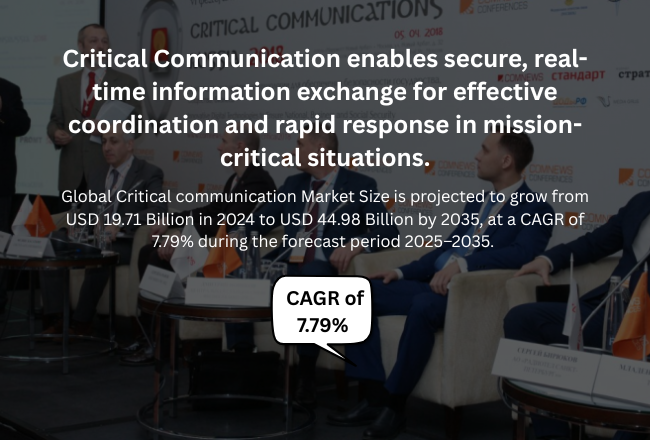
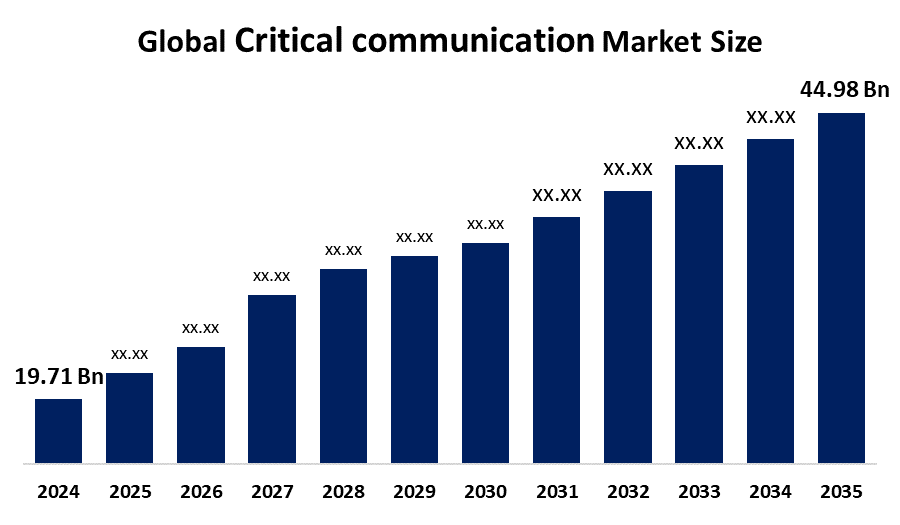
According to a research report published by Spherical Insights & Consulting, the Global Critical communication Market Size is projected to grow from USD 19.71 Billion in 2024 to USD 44.98 Billion by 2035, at a CAGR of 7.79% during the forecast period 2025–2035. The critical communication market is driven by security needs, disaster management needs, LTE and 5G network adoption, smart city projects, and emergency response infrastructure upgrades from outdated systems.
Introduction
The critical communication market refers to communication systems which provide reliable and secure real-time links between emergency responders and mission-critical operations. The critical communication market is driven by public safety agencies together with defense and transportation and utilities and industrial sectors use these systems to manage their response activities during emergency situations and security threats. The market experiences growth due to public safety infrastructure investments increases, security threats rise and emergency response networks receive modernization. The combination of LTE, 5G broadband communication together with AI analytics, cloud platforms and IoT devices enables organizations to achieve better network performance and operational control through advanced technological systems.The U.S. government supports critical communication innovation through the Public Safety Communications Research (PSCR) Program, which develops advanced wireless technologies, interoperability standards, and mission-critical communication tools to enhance connectivity, reliability, and coordination for first responders during emergencies and disaster response operations. The European Union is developing the European Critical Communication System (EUCCS) to establish a secure, interoperable communication network linking law enforcement and emergency services, improving cross-border coordination, operational efficiency, and reliable communication during disasters and security incidents.The Canadian government is developing a Public Safety Broadband Network (PSBN) to provide secure, resilient, and interoperable communication services for first responders and public safety agencies, enabling reliable connectivity, improved coordination, and efficient emergency response across Canada during disasters and critical incidents.The critical communication market provides new business opportunities due to expanding 5G networks, increased public safety funding, and growing need for dependable emergency communication systems. The development of smart cities together with disaster management systems, the use of AI, IoT and cloud-based platforms create new business opportunities for advanced mission-critical communication solutions.
Navigate Future Markets with Confidence: Insights from Spherical Insights LLP
The insights presented in this blog are derived from comprehensive market research conducted by Spherical Insights LLP, a trusted advisory partner to leading global enterprises. Backed by in-depth data analysis, expert forecasting, and industry-specific intelligence, our reports empower decision-makers to identify strategic growth opportunities in fast-evolving sectors. Clients seeking detailed market segmentation, competitive landscapes, regional outlooks, and future investment trends will find immense value in the full report. By leveraging our research, businesses can make informed decisions, gain a competitive edge, and stay ahead in the transition toward sustainable and profitable solutions.
Unlock exclusive market insights—Download the Brochure now and dive deeper into the future of the Critical Communication Market.
Critical communication Market Size & Statistics
- The Market Size for Critical communication Was Estimated to be worth USD 19.71 Billion in 2024.
- The Market is Going to Expand at a CAGR of 7.79% between 2025 and 2035.
- The Global Critical Communication Market Size is anticipated to reach USD 44.98 Billion by 2035.
- North America is expected to generate the highest demand during the forecast period in the Critical communication Market
- Asia Pacific is expected to grow the fastest during the forecast period in the Critical communication Market.
Market Segmentation
Global Critical communication Market Size, Share, and COVID-19 Impact Analysis, By Solution Type (Hardware, Service, Software), By Technology (Land Mobile Radio(LMR), Long-Term Evolution (LTE)), By End-User (Public Safety and Government Agencies, Transportation and Logistics, Utilities, Mining and Industrial, Oil and Gas, Others), and By Region (North America, Europe, Asia-Pacific, Latin America, Middle East, and Africa) and Global Critical communication Market Insights, Industry Trend, Forecasts to 2035
Unlock exclusive market insights—Download the Brochure now and dive deeper into the future of the Critical Communication Market.
Regional growth and demand
Asia Pacific is expected to grow the fastest during the forecast period in the critical communication market. The critical communication market will experience its fastest growth in Asia Pacific because of quick urbanization and higher public safety expenditures and the development of smart city programs. The governments of China and India and Japan and South Korea are modernizing their emergency communication systems while they build advanced LTE and 5G mission-critical networks. The combination of more natural disasters and higher population density and increased industrial operations creates a greater demand for dependable emergency communication networks. The region sees faster adoption of advanced critical communication technologies because strong government backing for digital infrastructure and expanding transportation systems and defense and public safety agency modernization efforts.In August 2025, Telecom Regulatory Authority of India (TRAI) Chairman emphasized accelerating infrastructure policies for critical communications.
TRAI reiterated recommendations for a pan-India integrated broadband PPDR network, a hybrid dedicated model for priority regions, and 10 MHz paired spectrum in the 700 MHz band for railway safety.North America is expected to generate the highest demand during the forecast period in the Critical communication market. The critical communication market will see its highest demand from North America because of its substantial investments in public safety systems and advanced communication technologies. The region has well-established emergency response systems and early adoption of LTE and 5G-based mission-critical networks. The government programs that establish nationwide broadband networks for first responders and upgrade outdated radio communication systems create additional demand. The United States and Canada adopt advanced critical communication solutions because of major technology companies, high defense expenditures, and rising secure communication needs in transportation, utility, and law enforcement sectors.
In February, 2026, Mobile Communications America, Inc. was recognized by Nokia Corporation as the Top Mission-Critical Partner for North America for 2025, highlighting strong regional infrastructure deployment. North America is projected to generate the highest demand in the global critical communication market during the forecast period.
Ready to lead the critical communication market ?
Discover the regional trends and growth factors shaping the industry. We’re here to assist with expert, personalized data.
Call +1 303 800 4326 or Send us a message for a personalized consultation.
Top 10 Trends in the Critical communication Market
- 5G Integration for Ultra-Low Latency
- AI-Driven Analytics and Predictive Insights
- Rise of Mission-Critical Push-to-X (MCX)
- Hybrid Networks
- Focus on Interoperability
- Expansion of Private Networks
- Enhanced Cybersecurity Protocols
- Cloud-Based Command and Control
- IoT Integration for Field Awareness
- Modernization of Public Safety Infrastructure
Unlock exclusive market insights—Download the Brochure now and dive deeper into the future of the Critical Communication Market.
- 5G Integration for Ultra-Low Latency
The critical communication networks experience enhanced performance through 5G technology which delivers better system reliability and faster data transmission. The 5G system enables real-time video streaming and remote monitoring and emergency response through its combination of ultra-low latency with high bandwidth and rapid data transmission capabilities. The public safety organizations can send emergency situation high-resolution images and drone footage and location information to each other through their communication systems. The technology enables secure development of advanced applications which include smart city surveillance systems and emergency vehicles that operate without human control thus enabling mission-critical operations to achieve better communication reliability and operational efficiency.
2.AI-Driven Analytics and Predictive Insights
Artificial Intelligence enables advanced data analysis and forecasting capabilities which transform essential communication systems. The AI tools analyze data streams from sensors and cameras and communication devices to detect potential risks and unusual activities which authorities need to investigate. Predictive analytics can forecast equipment failures, network disruptions, or potential safety threats before they occur. The emergency services and infrastructure operators obtain the capacity to handle emergencies through their enhanced understanding of situations which enables them to make quicker decisions based on better information during major incidents
3.Rise of Mission-Critical Push-to-X (MCX)
The modern critical communication networks require Mission-Critical Push-to-X (MCX) technologies which include push-to-talk (PTT) and push-to-video and push-to-data as essential components. The solutions provide immediate communication capabilities through broadband LTE and 5G networks while preserving the dependable performance of conventional radio systems. The MCX applications enable first responders to share voice and video and data at the same time which helps them coordinate their activities more effectively during emergency situations.
4.Hybrid Networks (LMR + LTE/5G)
Hybrid communication networks which use Land Mobile Radio (LMR) together with LTE and 5G technologies have become essential components of critical communication systems. The LMR networks enable emergency services to maintain dependable voice communications while LTE and 5G networks deliver fast data transmission which includes video streaming and real-time data transfer. Organizations can achieve uninterrupted network access in difficult operational conditions by utilizing combined technological systems. Agencies can use hybrid networks to modernize their outdated systems while preserving their existing operational capabilities and improving their communication systems.
5.Focus on Interoperability
Interoperability serves as the primary focus of contemporary critical communication systems because it enables different agencies and devices and network technologies to communicate without any barriers. The police and fire departments and medical teams and government agencies need to work together during emergencies to establish effective coordination. The latest communication platforms now enable systems from different networks to operate together by implementing standardized protocols which enable seamless interoperability. Improved interoperability enables better collaboration between emergency management organizations because it reduces response times and guarantees precise information sharing between all involved parties.
Unlock exclusive market insights—Download the Brochure now and dive deeper into the future of the Critical Communication Market.
Empower your strategic planning:
Stay informed with the latest industry insights and market trends to identify new opportunities and drive growth in the critical communication market. To explore more in-depth trends, insights, and forecasts, please refer to our detailed report.
Top 20 Companies Leading the Critical Communication Market
- Motorola Solutions, Inc.
- Nokia Corporation
- Telefonaktiebolaget LM Ericsson
- Hytera Communications Corporation Limited
- Huawei Technologies Co., Ltd.
- L3Harris Technologies, Inc.
- Airbus SAS
- Leonardo S.p.A.
- Thales Group
- ZTE Corporation
- AT&T Inc.
- Cobham Limited
- Inmarsat PLC
- Tait Communications
- JVCKENWOOD Cooperation
- Sepura Limited
- Rohde and Schwarz
- General Dynamics
- RTX Corporation
- ASELSAN A.S.
- Motorola Solutions, Inc.
Headquarters: Chicago, Illinois, United States
Motorola Solutions provides mission-critical communication systems which public safety agencies and government organizations and enterprises use for their operations. The company specializes in Land Mobile Radio (LMR) and broadband communication solutions and video security technologies. The company offers advanced push-to-talk systems and command center software and AI surveillance solutions as part of its product line. The company establishes itself as a unique entity through its strong public safety communication work and complete hardware plus software systems and its long-term relationships with police and fire and emergency response organizations in different countries.
2.Nokia Corporation
Headquarters: Espoo, Finland
Nokia Corporation is a global telecommunications technology company known for developing 5G infrastructure and mission-critical communication networks and private wireless solutions. The company delivers secure broadband Internet access to industrial sectors which include transportation and energy and public safety. Nokia stands out because of its private LTE plus 5G networks expertise and advanced network automation capabilities and cloud-native architecture. The company provides solutions which establish dependable high-speed communication networks that enable organizations to transmit data in real-time while they undergo digital transformation across vital business sectors throughout the globe.
3 .Telefonaktiebolaget LM Ericsson
Headquarters: Stockholm, Sweden
Ericsson stands as a top international provider which delivers telecommunications equipment together with services that include 5G network infrastructure and mission-critical broadband communication systems. The company offers network solutions which meet the communication needs of public safety and defense and enterprise sectors. Ericsson stands apart from its competitors because of its extensive research and development capabilities which enable it to lead the worldwide 5G network rollout. The technology provides essential network elements which deliver ultra-reliable connectivity and low-latency communication plus scalable network architecture to support various use cases.
4.Hytera Communications Corporation Limited
Headquarters: Shenzhen, China
The main office of Hytera Communications Corporation Limited operates from its location in Shenzhen, China. The company provides professional mobile radio (PMR) systems plus digital two-way radios and broadband communication systems, which serve public safety organizations and industrial operations. The company focuses on technologies such as TETRA, DMR, and LTE-based communication networks. The company establishes its market position through affordable communication systems and its strong emerging market presence. The company's products operate in multiple sectors, which include transportation systems and energy networks and utility services and security operations that require dependable instant communication systems.
5 .Huawei Technologies Co., Ltd.
Headquarters: Shenzhen, China
Huawei Technologies operates as an international technology enterprise that develops telecommunications infrastructure systems and 5G networking technology and essential communication systems. The company provides integrated solutions for industries such as public safety, transportation, energy, and smart cities. Huawei establishes its competitive advantage through extensive research funding and cutting-edge network solutions and its expertise in 5G systems and cloud computing and artificial intelligence. The communication systems enable organizations to achieve high data transfer rates while maintaining secure connections throughout their extensive mission-critical communication networks.
Unlock exclusive market insights—Download the Brochure now and dive deeper into the future of the Critical Communication Market.
Are you ready to discover more about the Critical communication market?
The report provides an in-depth analysis of the leading companies operating in the global critical communication market. It includes a comparative assessment based on their product portfolios, business overviews, geographical footprint, strategic initiatives, market segment share, and SWOT analysis. Each company is profiled using a standardized format that includes:
Company Profiles
- Motorola Solutions, Inc.
- Business Overview
- Company Snapshot
- Products Overview
- Company Market Share Analysis
- Company Coverage Portfolio
- Financial Analysis
- Recent Developments
- Merger and Acquisitions
- SWOT Analysis
- Nokia Corporation
- Telefonaktiebolaget LM Ericsson
- Hytera Communications Corporation Limited
- Huawei Technologies Co., Ltd.
- L3Harris Technologies, Inc.
- Airbus SAS
- Leonardo S.p.A.
- Thales Group
- Others.
Unlock exclusive market insights—Download the Brochure now and dive deeper into the future of the Critical Communication Market.
Conclusion
The global critical communication market is expected to grow significantly through 2035 because emergency and mission-critical operations require secure and reliable real-time communication systems which need critical communication services. Public safety agencies and defense organizations and transportation networks and industrial sectors need these systems to manage their responses during emergencies which include disasters and security threats and operational emergencies. The market expansion is driven by three major factors which include increasing funding for public safety systems and the replacement of old communication systems and the rising need for better security measures. Critical communication solutions undergo transformation through technological developments which include LTE and 5G networks and artificial intelligence and IoT integration and cloud-based command platforms because these technologies allow quicker data transmission and better system links and superior operational awareness. Government initiatives and funding programs across several regions are also strengthening the development of nationwide broadband networks for first responders. North America will create the greatest demand because of its strong technological adoption together with infrastructure spending while the Asia Pacific region will experience its quickest growth because of urban development and smart city projects. The market will experience sustained growth for an extended period because of ongoing technological advancements and infrastructure development efforts.
Need help to buy this report?