
Top 25 Companies in Global Aviation Fuel Terminals Market: Expert View by Spherical Insights
RELEASE DATE: Mar 2026 Author: Spherical InsightsRequest Free Sample Speak to Analyst
Description
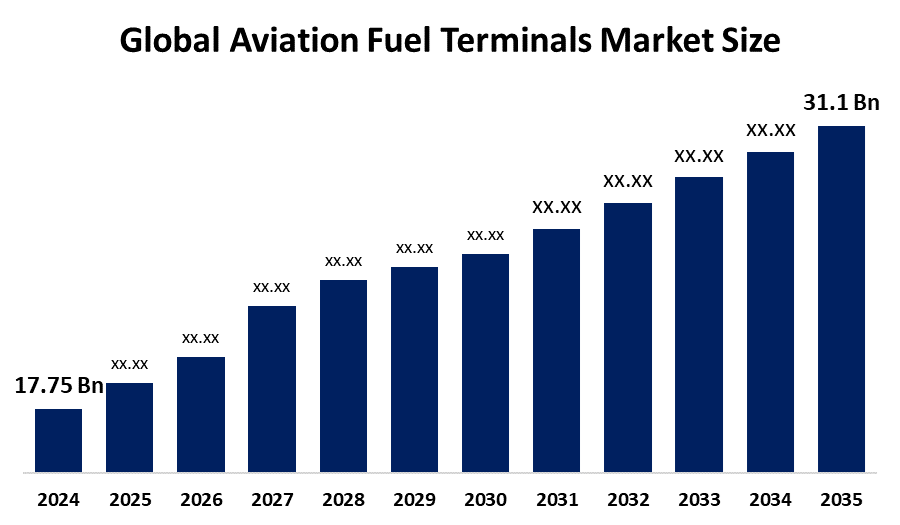
According to a research report published by Spherical Insights & Consulting, the Global Aviation Fuel Terminals Market Size is projected to grow from USD 17.75 Billion in 2024 to USD 31.1 Billion by 2035, at a CAGR of 5.23% during the forecast period 2025–2035. The global aviation fuel terminals market is driven by rising global burden of chronic and infectious diseases, the transition toward personalized medicine, growing healthcare investments in diagnostic infrastructure, and an increasing emphasis on decentralized testing.
Introduction
The aviation fuel terminals market establishes itself as a vital component within the aviation and energy infrastructure sector because airports worldwide need better systems to store and move their fuel supplies. Aviation fuel terminals function as dedicated storage and distribution centres for jet fuel, which provides secure and consistent fueling services to aircraft. The terminals use advanced technology systems, which enable them to control fuel quality and manage safety procedures while they automatically monitoring their operations to meet rigorous aviation regulations. The market experiences growth because air passenger numbers keep increasing and air cargo demand grows, while airports in developing countries build new infrastructure. The sector experiences growth because sustainable aviation fuel SAF usage becomes more important, which leads to improvements in fuel terminal facilities that need to support new fuel types and blending processes. The market expansion receives support from government funding of airport development projects, which pair with public-private partnership initiatives. Aviation fuel terminals maintain their essential function in the global aviation industry because they help improve operational efficiency and safety standards while promoting environmental sustainability practices in the entire aviation sector.
Navigate Future Markets with Confidence: Insights from Spherical Insights LLP
The insights presented in this blog are derived from comprehensive market research conducted by Spherical Insights LLP, a trusted advisory partner to leading global enterprises. Backed by in-depth data analysis, expert forecasting, and industry-specific intelligence, our reports empower decision-makers to identify strategic growth opportunities in fast-evolving sectors. Clients seeking detailed market segmentation, competitive landscapes, regional outlooks, and future investment trends will find immense value in the full report. By leveraging our research, businesses can make informed decisions, gain a competitive edge, and stay ahead in the transition toward sustainable and profitable solutions.
Unlock exclusive market insights—Download the Brochure now and dive deeper into the future of the Aviation Fuel Terminals Market.
Aviation Fuel Terminals Market Size & Statistics
- The Market Size for Aviation Fuel Terminals Was Estimated to be worth USD 17.75 Billion in 2024.
- The Market is Going to Expand at a CAGR of 5.23% between 2025 and 2035.
- The Global Aviation Fuel Terminals Market Size is anticipated to reach USD 31.1 Billion by 2035.
- North America is expected to generate the highest demand during the forecast period in the Aviation Fuel Terminals Market.
- Asia Pacific is expected to grow the fastest during the forecast period in the Aviation Fuel Terminals Market.
Market Segmentation
Global Aviation Fuel Terminals Market Size, Share, and Analysis, By Terminal Type (Fixed Base Operator (FBO) Terminal, Commercial Airports Terminal, Military Airbase Terminal, Helipad Terminal, and Others), By Terminal Ownership (Government-owned Terminal, Private-owned Terminal, and Joint Venture Terminal), By Terminal Capacity (Small-scale Terminal, Medium-scale Terminal, and Large-scale Terminal), and By Region (North America, Europe, Asia-Pacific, Latin America, Middle East, and Africa), and Aviation Fuel Terminals Market Insights, Industry Trend, Forecasts to 2035
Regional growth and demand
Asia Pacific is expected to grow the fastest during the forecast period in the aviation fuel terminals market. The region is experiencing rapid growth because more people are using aeroplanes, new airport facilities are being built, and more money is being spent on aviation logistics. The demand from China and India is increasing because both countries are constructing new airports and upgrading their fuel storage and distribution systems. The market is growing because more people are using sustainable aviation fuels SAF and there is a demand for efficient fuel handling technologies. The region experiences strong growth because airlines operate more flights and aviation infrastructure develops continuously.
North America is expected to generate the highest demand during the forecast period in the aviation fuel terminals market. The region has achieved dominance because it possesses established aviation infrastructure that supports high air traffic and major airlines, together with airport operators. The United States and Canada maintain their airport development through ongoing financial support, which funds airport expansion projects and modernizes fuel storage facilities, together with distribution networks. The commercial aviation industry and cargo aviation industry experience constant demand because of growing sustainable aviation fuel adoption and strict safety regulations.
Ready to lead the Aviation Fuel Terminals Market ?
Discover the regional trends and growth factors shaping the industry. We’re here to assist with expert, personalized data.
Call +1 303 800 4326 or Send us a message for a personalized consultation.
Top 10 Trends in the Aviation Fuel Terminals Market
- Expansion of global airport infrastructure and new terminal construction
- Growing adoption of sustainable aviation fuels (SAF) and biofuels
- Modernization of fuel storage and distribution systems
- Increasing automation and digital monitoring of fuel terminals
- Rising demand due to growth in air passenger and cargo traffic
- Integration of advanced safety and environmental compliance systems
- Development of high-capacity fuel storage facilities at major airports
- Increasing investments in military and private airfield fuel terminals
- Adoption of underground and space-efficient fuel storage solutions
- Focus on supply chain optimization and fuel logistics efficiency
- Expansion of Global Airport Infrastructure and New Terminal Construction
The aviation fuel terminals market is expanding because airport infrastructure development occurs throughout the world. The increasing air traffic demands new airports and terminal upgrades, which both governments and private stakeholders are funding. The expansion requires sophisticated fuel storage and distribution systems, which are essential for maintaining efficient aircraft operations. Emerging economies are particularly driving this trend through large-scale airport development projects, which require modern aviation fuel terminals with high capacity, safety standards, and automated fueling systems.
- Growing Adoption of Sustainable Aviation Fuels (SAF) and Biofuels
The aviation industry is adopting sustainable aviation fuels because this technology helps them achieve their target of decreasing carbon emissions. The aviation industry is upgrading its fuel terminals to create facilities that can manage the blending, storage, and distribution of sustainable aviation fuels. Environmental regulations and airline sustainability commitments drive the current trend of the industry. Terminal operators are constructing new infrastructure that enables them to handle alternative fuels while maintaining safety and system compatibility. The implementation of sustainable aviation fuel will change how fuel logistics operate and enable the aviation industry to achieve environmentally friendly operations in all international markets.
- Modernization of Fuel Storage and Distribution Systems
Aviation fuel terminals need modernization work to achieve better operational performance, enhanced security, and dependable service. The implementation of advanced storage tanks and automated pipelines with digital monitoring systems will create better fuel handling operations at the facility. The upgrades create better operational safety measures and protect against fuel contamination risks while improving supply chain operations. Modern systems enable terminals to manage increasing fuel demand because they support higher throughput capabilities. The growing demand provides essential support for airports, which need to maintain their fuel supply during times of high activity and expansion.
- Increasing Automation and Digital Monitoring of Fuel Terminals
Automation is changing aviation fuel terminals through the implementation of smart technologies, which include IoT sensors, real-time monitoring systems and data analytics capabilities. The systems enable precise monitoring of fuel levels, fuel quality and fuel distribution operations. The process of automation leads to decreased human mistakes while it improves safety standards and boosts operational productivity. Digital monitoring systems enable companies to perform predictive maintenance while they investigate potential problems at an increased speed. The trend serves a vital purpose by securing dependable fuel operations throughout busy aviation areas.
- Rising Demand Due to Growth in Air Passenger and Cargo Traffic
The rising demand for aviation fuel terminals results from the growing number of air passengers and cargo shipments. The expanding route network and aircraft fleet of airlines drive the need for more effective fuel storage and distribution systems. The growth of global trade and e-commerce has resulted in substantial expansion for cargo aviation. Terminal operations need to increase their fuel handling capacity while maintaining a continuous fuel supply for their operations. The rising air traffic demand requires airports to improve their fuel terminal systems because fuel terminal capacity and efficiency have become critical needs.
Unlock exclusive market insights—Download the Brochure now and dive deeper into the future of the Aviation Fuel Terminals Market.
Empower your strategic planning:
Stay informed with the latest industry insights and market trends to identify new opportunities and drive growth in the aviation fuel terminals market. To explore more in-depth trends, insights, and forecasts, please refer to our detailed report.
Top 25 Companies Leading the Aviation Fuel Terminals Market
- ExxonMobil Corporation
- Shell plc
- BP plc
- TotalEnergies SE
- Chevron Corporation
- Phillips 66
- Valero Energy Corporation
- Marathon Petroleum Corporation
- PetroChina Company Limited
- Indian Oil Corporation
- Sinopec Group
- Neste Corporation
- Saudi Aramco
- QatarEnergy
- Eni S.p.A.
- Repsol S.A.
- ConocoPhillips
- Hess Corporation
- Reliance Industries Limited
- SK Innovation
- PBF Energy
- Murphy Oil Corporation
- Bharat Petroleum Corporation Limited
- Formosa Petrochemical Corporation
- World Fuel Services Corporation
- ExxonMobil Corporation
Headquarters: Irving, Texas, USA
ExxonMobil Corporation holds an essential position in the aviation fuel terminals market because of its wide-reaching fuel supply network and its terminal facilities that spread across the entire world. The company operates and manages large-scale aviation fuel storage and distribution facilities, which provide dependable fuel service to major airports throughout the globe. The company's logistics operations use advanced systems to handle fuel needs while maintaining high standards of quality and safety requirements. ExxonMobil provides services to commercial airlines and cargo operators, together with military aviation units. The company maintains its commitment to developing sustainable aviation fuel technologies. Recent Development: In 2025, ExxonMobil increased its aviation fuel terminal capabilities by adding facilities for SAF blending and distribution.
- Shell plc
Headquarters: London, United Kingdom
Shell plc maintains its essential position in the aviation fuel terminals market through its worldwide network of fuel distribution and storage systems. The company operates advanced aviation fuel terminals that ensure efficient fuel distribution, quality control, and safety compliance. Shell provides dependable fueling services to commercial and cargo aviation operations across its network of major international airports. The company currently makes investments in sustainable aviation fuel (SAF) and solutions for low-carbon energy production. Recent Development: In 2025, Shell expanded its SAF supply chain and upgraded fuel terminal infrastructure to support sustainable aviation initiatives.
- BP plc
Headquarters: London, United Kingdom
BP plc functions as a major player within the aviation fuel terminals market by delivering complete fuel storage solutions, which include storage capabilities and fuel distribution services. The company operates a wide network of aviation fuel terminals and supplies jet fuel to major airlines globally. BP focuses on operational efficiency, fuel quality and safety standards. The company is currently developing digital fuel management systems while working on sustainable aviation fuel production. Recent Development: BP improved its aviation fuel terminal operations through digital monitoring systems in 2025 while establishing a broader network of SAF partnerships.
- TotalEnergies SE
Headquarters: Paris, France
TotalEnergies SE plays a significant role in the aviation fuel terminals market by providing integrated fuel storage and distribution solutions. The company operates aviation fuel terminals across key global airports and supports efficient fuel logistics. TotalEnergies focuses on sustainability by investing in biofuels and low-carbon aviation energy solutions. Its infrastructure ensures high safety and quality standards. Recent Development: In 2025, TotalEnergies expanded its SAF production capacity, which will connect to its aviation fuel terminal networks.
- Chevron Corporation
Headquarters: San Ramon, California, USA
Chevron Corporation has established itself as a leading entity within the aviation fuel terminals industry through its worldwide provision of dependable fuel supply services and terminal operations. The company operates fuel storage facilities together with transportation networks and distribution systems that enable its aircraft operations. Chevron concentrates on achieving operational excellence through its commitment to safety practices and efficient supply chain management. The company dedicates resources to developing environmentally friendly fuel technologies while creating sustainable solutions for aviation operations. Chevron expanded its aviation fuel infrastructure and dedicated more resources to sustainable aviation fuel projects during recent development activities.
Unlock exclusive market insights—Download the Brochure now and dive deeper into the future of the Aviation Fuel Terminals Market.
Are you ready to discover more about the aviation fuel terminals market?
The report provides an in-depth analysis of the leading companies operating in the global aviation fuel terminals market. It includes a comparative assessment based on their product portfolios, business overviews, geographical footprint, strategic initiatives, market segment share, and SWOT analysis. Each company is profiled using a standardized format that includes:
Company Profiles
- ExxonMobil Corporation
- Business Overview
- Company Snapshot
- Products Overview
- Company Market Share Analysis
- Company Coverage Portfolio
- Financial Analysis
- Recent Developments
- Merger and Acquisitions
- SWOT Analysis
- Shell plc
- BP plc
- TotalEnergies SE
- Chevron Corporation
- Phillips 66
- Valero Energy Corporation
- Marathon Petroleum Corporation
- PetroChina Company Limited
Conclusion
The global aviation fuel terminals market is expanding steadily because of three main factors, which include increasing air traffic, rising demand for efficient fuel storage and distribution systems and continuous development of airport infrastructure. The terminals provide safe procedures for aviation fuel, which include safe handling and storage and delivery operations while protecting essential quality and safety requirements. The system creates better operational performance and dependable operations through its combination of automated processes, digital tracking and advanced fuel management technologies. The major companies, which include exxonmobil corporation, shell plc, bp plc, totalenergies se and chevron corporation, are expanding their worldwide business activities, which creates substantial market expansion. The aviation fuel terminals function as essential support systems that maintain airport operations and provide necessary fuel resources while supporting the development of worldwide aviation and logistics systems.
Our Industry Reports:
North America Tetra Pak Carton Market Size, Share, Trend To 2035
South Korea Frozen Pizza Market Size, Share, Trend To 2035
United Kingdom AI in Warehousing Market Size, Share, Trend To 2035
United States Continuous Positive Airway Pressure Devices (CPAP) Market Size, Scope to 2035
About the Spherical Insights & Consulting
Spherical Insights & Consulting is a market research and consulting firm which provides actionable market research study, quantitative forecasting and trends analysis provides forward-looking insight especially designed for decision makers and aids ROI. Which is catering to different industry such as financial sectors, industrial sectors, government organizations, universities, non-profits and corporations. The company's mission is to work with businesses to achieve business objectives and maintain strategic improvements.
CONTACT US:
For More Information on Your Target Market, Please Contact Us Below:
Phone: +1 303 800 4326 (the U.S.)
Phone: +91 90289 24100 (APAC)
Email: inquiry@sphericalinsights.com, sales@sphericalinsights.com
Contact Us: https://www.sphericalinsights.com/contact-us
Need help to buy this report?