Top 20 Companies in Global Vehicle Cameras Market (2024–2035): Competitive Analysis & Forecast
RELEASE DATE: Mar 2026 Author: Spherical InsightsRequest Free Sample Speak to Analyst
Introduction
The global vehicle cameras market comprises imaging systems installed in vehicles to enhance driver awareness, safety, and automation capabilities. These systems are integral to advanced driver assistance systems (ADAS), supporting applications such as lane detection, parking assistance, and collision avoidance. The market is expanding in line with the broader shift toward connected, electric, and autonomous mobility. Market growth is strongly influenced by rising road safety concerns. According to the World Health Organization, approximately 1.19 million people die annually in road traffic accidents, with 20–50 million injuries reported each year. Additionally, road crashes cost countries nearly 3% of their GDP, prompting governments to mandate safety technologies such as rear-view and surround-view cameras. These regulations are accelerating the adoption of camera-based systems globally. Opportunities exist in AI-enabled vision systems, thermal imaging, and 360-degree camera integration, particularly in emerging economies where vehicle safety adoption is still evolving. Recent developments include increased government-backed initiatives promoting intelligent transport systems and collaborations between automakers and technology firms to deploy camera-based perception systems for autonomous driving.
Navigate Future Markets with Confidence: Insights from Spherical Insights LLP
The insights presented in this blog are derived from comprehensive market research conducted by Spherical Insights LLP, a trusted advisory partner to leading global enterprises. Backed by in-depth data analysis, expert forecasting, and industry-specific intelligence, our reports empower decision-makers to identify strategic growth opportunities in fast-evolving sectors. Clients seeking detailed market segmentation, competitive landscapes, regional outlooks, and future investment trends will find immense value in the full report. By leveraging our research, businesses can make informed decisions, gain a competitive edge, and stay ahead in the transition toward sustainable and profitable solutions.
Unlock exclusive market insights—Download the Brochure now and dive deeper into the future of the Global Vehicle Cameras Market.
Market Segmentation
Global Vehicle Cameras Market Size, Share, and, By Camera Type (Front View Camera, Rear View Camera, Side View Camera, and Surround View Camera), By Technology (Digital Cameras, Infrared Cameras, and Thermal Cameras), By Application (Advanced Driver Assistance Systems (ADAS), Parking Assistance, Lane Departure Warning, and Collision Avoidance), By Vehicle Type (Passenger Cars and Commercial Vehicles), By Level of Autonomy (Semi-Autonomous and Autonomous), By Distribution Channel (OEM and Aftermarket), By Region (North America, Europe, Asia-Pacific, Latin America, and Middle East & Africa), Analysis and Forecast 2024 – 2035.
Global Vehicle Cameras Market Size & Statistics
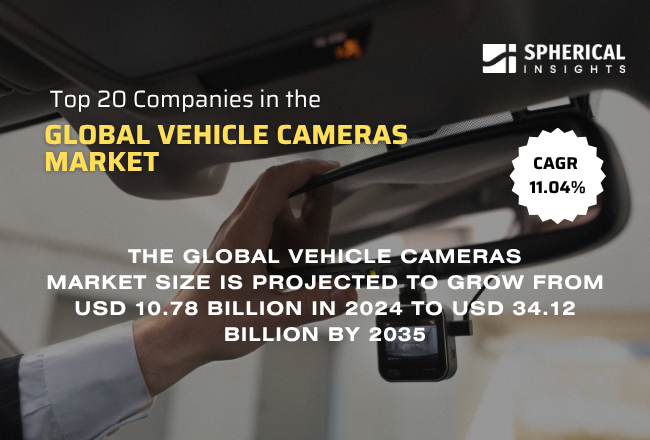
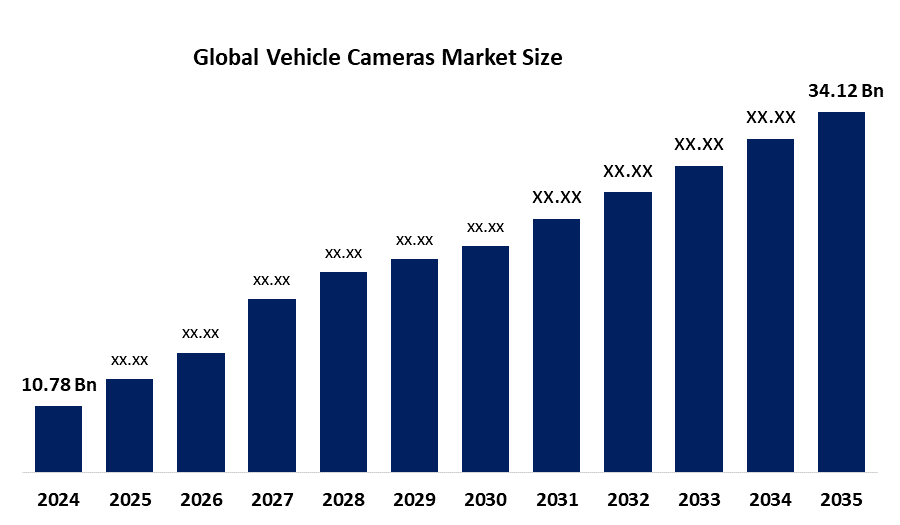
- The market size for Global Vehicle Cameras was estimated to be worth USD 10.78 billion in 2024.
- The market is going to expand at a CAGR of 11.04% between 2024 and 2035.
- The Global Vehicle Cameras market size is anticipated to reach USD 34.12 billion by 2035.
- North America is expected to generate the largest revenue during the forecast period in the Global Vehicle Cameras market
- Asia Pacific is expected to grow at the fastest rate during the forecast period in the Global Vehicle Cameras market.
Regional growth and demand
Asia Pacific is expected to grow at the fastest rate during the forecast period in the global vehicle cameras market. Asia Pacific is expected to grow at the fastest rate due to the rapid vehicle production expansion, particularly in China, India, and Japan. Increasing government mandates for vehicle safety systems, rising adoption of electric vehicles, and growing middle-class demand for advanced features are key contributors. Additionally, strong investments in smart mobility and autonomous technologies further accelerate regional growth.
North America is expected to generate the largest revenue during the forecast period in the global vehicle cameras market. North America is expected to generate the highest revenue due to early adoption of ADAS technologies and stringent safety regulations led by agencies such as the National Highway Traffic Safety Administration. High consumer awareness, presence of major automotive technology companies, and strong integration of advanced safety features in vehicles continue to reinforce the region’s leading position.
Ready to lead the Vehicle Cameras Market ?
Discover the regional trends and growth factors shaping the industry. We’re here to assist with expert, personalized data.
Call +1 303 800 4326 or Send us a message for a personalized consultation.
Top 10 Trends in the Global Vehicle Cameras Market
- Increasing Integration of Advanced Driver Assistance Systems (ADAS)
- Rising Adoption of Autonomous Driving Technologies
- Growing Demand For 360-Degree Surround View Systems
- Advancements In AI-Powered Image Processing
- Expansion Of Electric Vehicle (EV) Ecosystem
- Development Of Thermal and Infrared Camera Solutions
- Integration Of Camera-Monitor Systems Replacing Mirrors
- Declining Costs of High-Resolution Camera Sensors
- Increasing Regulatory Mandates for Vehicle Safety
- Growth Of Aftermarket Camera Installations
- Increasing Integration of Advanced Driver Assistance Systems (ADAS)
The integration of ADAS is a primary trend shaping the vehicle cameras market. Cameras serve as critical inputs for systems such as lane departure warning, adaptive cruise control, and automatic emergency braking. Automakers are increasingly equipping vehicles with multiple cameras to enhance real-time environmental perception. Regulatory authorities across developed regions are also mandating safety features, accelerating adoption. Continuous improvements in camera resolution and processing capabilities are enhancing system accuracy. As ADAS becomes a standard feature rather than a premium offering, demand for vehicle cameras is expected to expand significantly across both passenger and commercial vehicle segments.
- Rising Adoption of Autonomous Driving Technologies
The advancement of autonomous driving technologies is significantly influencing the demand for vehicle cameras. Autonomous systems rely heavily on visual data for object detection, navigation, and decision-making processes. Cameras, combined with sensors such as LiDAR and radar, provide comprehensive environmental awareness. Increasing investments by automotive and technology companies in self-driving platforms are accelerating innovation. Governments are also supporting pilot programs and regulatory frameworks for autonomous mobility. As vehicles progress from semi-autonomous to fully autonomous capabilities, the number and sophistication of cameras per vehicle are expected to increase, driving sustained market growth.
- Growing Demand for 360-Degree Surround View Systems
Surround view systems are gaining traction as consumers prioritize enhanced visibility and safety during parking and low-speed maneuvers. These systems use multiple cameras placed around the vehicle to create a bird’s-eye view, improving driver awareness of blind spots. Automakers are increasingly incorporating this feature in mid-range vehicles, expanding its market reach. Technological advancements have improved image stitching and real-time processing, resulting in more accurate visual outputs. The growing urbanization and congestion levels further drive demand for such systems, as they assist drivers in navigating tight spaces and reducing minor collisions.
- Advancements in AI-Powered Image Processing
Artificial intelligence is transforming vehicle camera capabilities by enabling real-time object recognition, scene interpretation, and predictive analysis. AI-powered systems enhance the accuracy and responsiveness of ADAS and autonomous driving functions. Deep learning algorithms allow cameras to detect pedestrians, traffic signs, and obstacles with higher precision under varying conditions. Continuous improvements in edge computing and embedded systems are enabling faster data processing within vehicles. This trend is also supporting the development of intelligent safety features, such as driver monitoring systems. As AI technology evolves, it is expected to significantly improve the efficiency and reliability of vehicle camera systems.
- Expansion of Electric Vehicle (EV) Ecosystem
The rapid expansion of the electric vehicle ecosystem is contributing to increased adoption of vehicle cameras. EV manufacturers are integrating advanced technologies to differentiate their offerings, including sophisticated camera-based safety and monitoring systems. Cameras support functions such as energy-efficient driving assistance and enhanced navigation. Government incentives and environmental regulations are accelerating EV adoption globally. Additionally, EV platforms often incorporate digital architectures that facilitate seamless integration of camera systems. As EV production continues to grow, particularly in emerging markets, the demand for vehicle cameras is expected to rise in parallel with the broader electrification trend.
Empower your strategic planning:
Stay informed with the latest industry insights and market trends to identify new opportunities and drive growth in the global vehicle cameras market. To explore more in-depth trends, insights, and forecasts, please refer to our detailed report.
Unlock exclusive market insights—Download the Brochure now and dive deeper into the future of the Global Vehicle Cameras Market.
Top 20 Companies Leading the Global Vehicle Cameras Market
- Robert Bosch GmbH
- Continental AG
- Magna International Inc.
- Valeo SA
- Denso Corporation
- ZF Friedrichshafen AG
- Aptiv PLC
- Mobileye Global Inc.
- Panasonic Holdings Corporation
- Autoliv Inc.
- Sony Semiconductor Solutions Corporation
- OMNIVISION Technologies Inc.
- Samsung Electronics
- onsemi
- LG Innotek
- STMicroelectronics
- Sunny Optical Technology
- Nidec Corporation
- Ficosa International S.A.
- Teledyne FLIR LLC
- Robert Bosch GmbH
Headquarters: Gerlingen, Germany
Robert Bosch GmbH, active in over 60 countries, is a leading global supplier of automotive technologies, including advanced vehicle camera systems. The company plays a central role in the development of ADAS and autonomous driving solutions, offering multi-functional camera platforms that enhance vehicle safety and perception. Its camera technologies are widely integrated by major automotive manufacturers worldwide. Bosch’s strong global manufacturing and R&D footprint enables continuous innovation in imaging and sensor fusion technologies. Through its comprehensive mobility solutions portfolio, the company remains a key contributor to the advancement of intelligent and connected vehicle ecosystems globally.
- Continental AG
Headquarters: Hanover, Germany
Continental AG, active in more than 50 countries, is a major automotive supplier with a strong presence in vehicle camera and ADAS technologies. The company develops high-performance camera systems that support safety, automation, and driver assistance applications. Its solutions are widely adopted across passenger and commercial vehicles globally. Continental focuses on integrating cameras with radar and other sensors to deliver comprehensive environmental perception systems. With extensive global operations and partnerships with leading automakers, the company continues to strengthen its position in the evolving mobility landscape by advancing intelligent safety and autonomous driving technologies.
- Magna International Inc.
Headquarters: Aurora, Ontario, Canada
Magna International Inc., active in over 25 countries, is a prominent global automotive supplier offering advanced vision systems and camera modules. The company provides complete camera-based solutions, including surround-view and driver monitoring systems, supporting enhanced safety and automation. Magna collaborates with leading automotive manufacturers to integrate its camera technologies into next-generation vehicles. Its global manufacturing footprint and engineering expertise enable scalable and customizable solutions. By focusing on innovation in imaging and sensor integration, Magna plays a significant role in advancing vehicle safety systems and contributing to the global adoption of ADAS technologies.
- Valeo SA
Headquarters: Paris, France
Valeo SA, active in more than 30 countries, is a leading provider of automotive vision systems, particularly known for its surround-view and thermal imaging camera technologies. The company develops advanced camera solutions that support parking assistance, driver monitoring, and autonomous driving applications. Valeo’s technologies are widely implemented in vehicles to enhance visibility and safety. Its strong emphasis on innovation and sustainable mobility solutions enables continuous advancement in imaging systems. With a broad global presence and strategic collaborations, Valeo remains a key contributor to the development of intelligent vehicle perception systems worldwide.
- Denso Corporation
Headquarters: Kariya, Japan
Denso Corporation, active in over 35 countries, is a major global automotive technology supplier specializing in advanced driver assistance and camera systems. The company develops high-quality imaging solutions that support functions such as object detection, lane recognition, and collision avoidance. Denso collaborates closely with global automakers to integrate its camera technologies into modern vehicles. Its strong focus on research and development enables continuous improvements in sensor accuracy and system reliability. Through its extensive global operations and commitment to innovation, Denso plays a vital role in enhancing vehicle safety and supporting the transition toward autonomous mobility.
Are you ready to discover more about the global vehicle cameras market?
The report provides an in-depth analysis of the leading companies operating in the global vehicle cameras market. It includes a comparative assessment based on their product portfolios, business overviews, geographical footprint, strategic initiatives, market segment share, and SWOT analysis. Each company is profiled using a standardized format that includes:
Unlock exclusive market insights—Download the Brochure now and dive deeper into the future of the Global Vehicle Cameras Market.
Company Profiles
- Robert Bosch GmbH
- Business Overview
- Company Snapshot
- Products Overview
- Company Market Share Analysis
- Company Coverage Portfolio
- Financial Analysis
- Recent Developments
- Merger and Acquisitions
- SWOT Analysis
- Continental AG
- Magna International Inc.
- Valeo SA
- Denso Corporation
- ZF Friedrichshafen AG
- Aptiv PLC
- Mobileye Global Inc.
- Panasonic Holdings Corporation
- Others.
Conclusion
The global vehicle cameras market is witnessing steady growth, driven by increasing demand for advanced driver assistance systems, rising road safety concerns, and rapid advancements in automotive imaging technologies. Vehicle cameras provide enhanced visibility, real-time monitoring, and improved driving safety across passenger and commercial vehicles, supporting the transition toward autonomous mobility. Continuous innovations in AI-based image processing, sensor integration, and 360-degree vision systems further enhance system accuracy and reliability. Leading companies such as Robert Bosch GmbH, Continental AG, Magna International Inc., Valeo SA, and Denso Corporation are expanding their global presence, contributing to market development. Overall, vehicle cameras play a crucial role in enhancing automotive safety and enabling the evolution of intelligent and connected vehicles worldwide
Our Report
https://www.sphericalinsights.com/reports/japan-fresh-fruits-market
https://www.sphericalinsights.com/reports/italy-contraceptive-devices-market
https://www.sphericalinsights.com/reports/italy-cybersecurity-market
https://www.sphericalinsights.com/reports/italy-beauty-and-personal-care-market
About the Spherical Insights & Consulting
Spherical Insights & Consulting is a market research and consulting firm which provides actionable market research study, quantitative forecasting and trends analysis provides forward-looking insight especially designed for decision makers and aids ROI.
Which is catering to different industry such as financial sectors, industrial sectors, government organizations, universities, non-profits and corporations. The company's mission is to work with businesses to achieve business objectives and maintain strategic improvements.
CONTACT US:
For More Information on Your Target Market, Please Contact Us Below:
Phone: +1 303 800 4326 (the U.S.)
Phone: +91 90289 24100 (APAC)
Email: inquiry@sphericalinsights.com, sales@sphericalinsights.com
Contact Us: https://www.sphericalinsights.com/contact-us
Need help to buy this report?