Top 20 Companies in Global Thrombolytic Drugs Market (2020–2035): Competitive Analysis & Forecast
RELEASE DATE: Mar 2026 Author: Spherical InsightsRequest Free Sample Speak to Analyst
Description
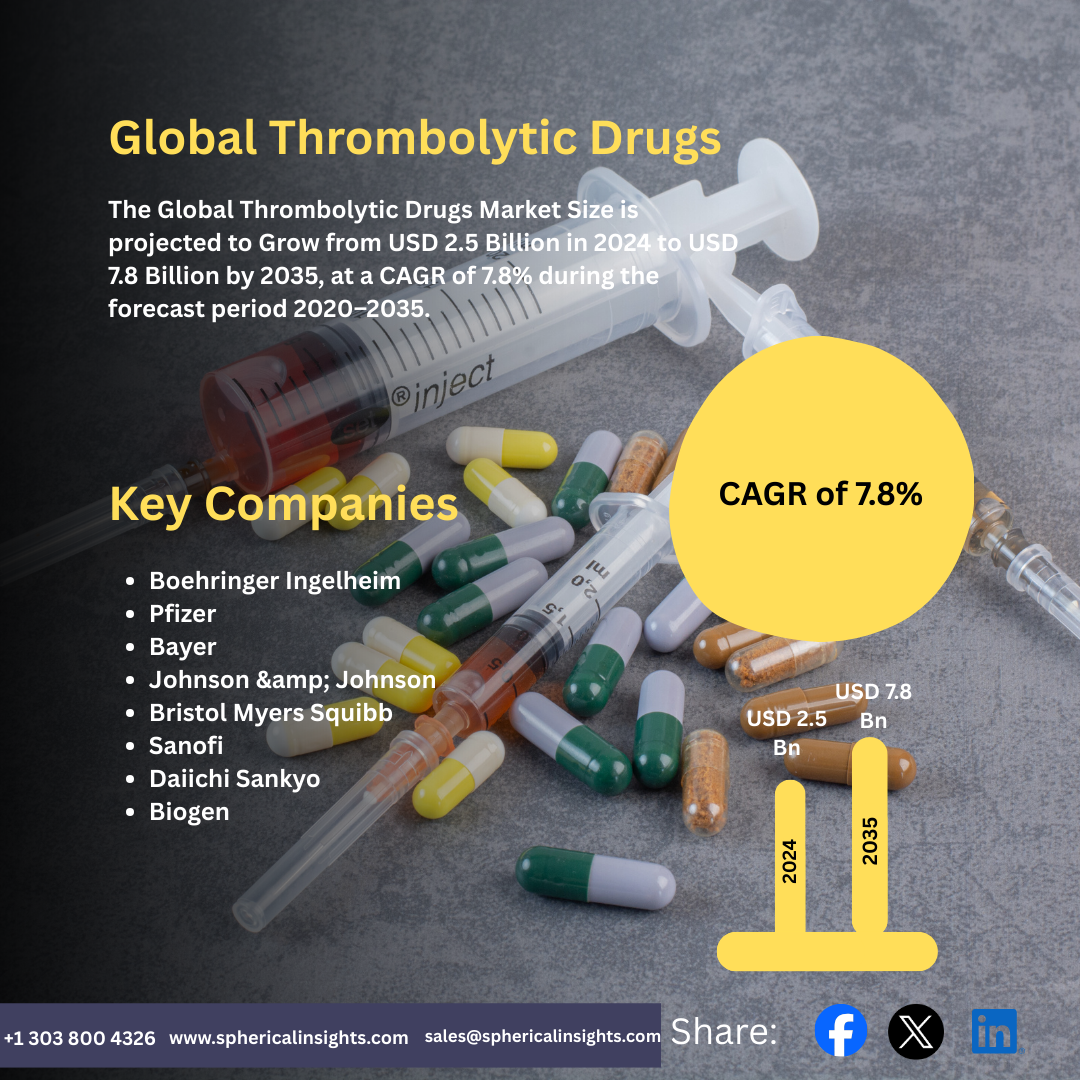
According to a Research Report Published by Spherical Insights & Consulting, The Global Thrombolytic Drugs Market Size is projected to Grow from USD 2.5 Billion in 2024 to USD 7.8 Billion by 2035, at a CAGR of 7.8% during the forecast period 2020–2035. The Global Thrombolytic Drugs Market is driven by rise in global cardiovascular disease prevalence affecting hundreds of millions, and a rapidly aging demographic that demands efficient, time-sensitive reperfusion, and development of nanoparticle drug delivery.
Introduction
The Global Thrombolytic Drugs Market refers to a high-stakes arena of cardiovascular drugs focuses on life-saving agents designed to dissolve obstructing blood clots within the vascular system. Defined by their ability to trigger plasminogen activation, these clot-busters serve as the frontline defense against acute myocardial infarction and ischemic strokes. Currently, innovation is pivoting toward third-generation agents such as Tenecteplase, which offers enhanced fibrin specificity and a longer half-life, enabling rapid bolus administration rather than complex infusions. Furthermore, cutting-edge research is advancing nanotechnology-based delivery systems that aim to localize drug release directly at the thrombus site, effectively slashing the systemic bleeding risks that have long hampered thrombolytic therapy.
This clinical evolution is significantly bolstered by government support and funding, including public R&D grants for investigator-led multicenter trials and expedited regulatory pathways in major markets like Japan and the U.S. Additionally, public health frameworks are increasingly adopting value-based payment incentives to ensure these high-cost treatments are accessible to aging populations while reducing long-term disability costs. The primary driving factors for this market include a sobering rise in global cardiovascular disease prevalence affecting hundreds of millions, and a rapidly aging demographic that demands efficient, time-sensitive reperfusion. The synergy between precision nanomedicine and aggressive public health policies ensures this sector remains both a humanitarian necessity and a powerhouse of pharmaceutical growth.
Navigate Future Markets with Confidence: Insights from Spherical Insights LLP
The insights presented in this blog are derived from comprehensive market research conducted by Spherical Insights LLP, a trusted advisory partner to leading global enterprises. Backed by in-depth data analysis, expert forecasting, and industry-specific intelligence, our reports empower decision-makers to identify strategic growth opportunities in fast-evolving sectors. Clients seeking detailed market segmentation, competitive landscapes, regional outlooks, and future investment trends will find immense value in the full report. By leveraging our research, businesses can make informed decisions, gain a competitive edge, and stay ahead in the transition toward sustainable and profitable solutions.
Unlock exclusive market insights—Download the Brochure now and dive deeper into the future of the Thrombolytic Drugs Market.
Thrombolytic Drugs Market Size & Statistics
- The Market Size for Thrombolytic Drugs Was Estimated to be worth USD 2.5 Billion in 2024.
- The Market is Going to Expand at a CAGR of 7.8% between 2020 and 2035.
- The Global Thrombolytic Drugs Market Size is anticipated to reach USD 7.8 Billion by 2035.
- North America is expected to generate the highest demand during the forecast period in the Thrombolytic Drugs Market
- Asia Pacific is expected to grow the fastest during the forecast period in the Thrombolytic Drugs Market.
Regional growth and demand
Asia Pacific is expected to grow the fastest during the forecast period in the Thrombolytic Drugs market. Asia Pacific is expected to grow fastest due to a staggering increase in the geriatric demographic and a rising incidence of ischemic strokes linked to shifting dietary habits and urban lifestyles. Government-led initiatives to establish and improve rural access to life-saving medications are significantly lowering the barriers to treatment, and the emergence of domestic pharmaceutical players producing cost-effective biosimilars and third-generation thrombolytics is making these advanced therapies more accessible to a broader patient base than ever before.
North America is expected to generate the highest demand during the forecast period in the Thrombolytic Drugs market. North America is expected to generate the highest demand due to a sophisticated healthcare infrastructure, robust reimbursement frameworks and the early adoption of next-generation drug delivery systems, such as ultrasound-assisted thrombolysis, solidifying its market position. And the prevalence of lifestyle-related cardiovascular conditions in an aging U.S. and Canadian population also creates a consistent, high-volume demand for these emergency interventions
Top 10 Trends in the Thrombolytic Drugs Market
- Nanoparticle Drug Delivery
- Cost-Effective Biosimilars
- Expansion of Tele-stroke Networks and Remote Consultations
- Development of Next-generation Biologics
- Integration of Artificial Intelligence in Triage
- Expansion of Therapeutic Time Window
- Specialized Mobile Stroke Units
- Precision Medicine & Biomarkers
- Temperature Stable Formulation
- Ultra Low Dose Preventative Applications
Unlock exclusive market insights—Download the Brochure now and dive deeper into the future of the Thrombolytic Drugs Market.
- Nanoparticle Drug Delivery
Cutting-edge research is focusing on encapsulating thrombolytic agents within nanoparticles engineered to release their payload only upon encountering specific clot biomarkers. This highly localized approach dramatically reduces the systemic bleeding risks traditionally associated with clot-busting drugs.
- Tele-Stroke Networks and Remote Consultation
Robust telehealth networks are connecting rural and under-resourced hospitals with centralized stroke specialists. This allows remote neurologists to rapidly review scans and authorize the administration of thrombolytics, bridging the geographical gap in acute stroke care..
- Specialized Mobile Stroke Units
Specialized ambulances equipped with portable CT scanners and onboard neurology consults are bringing the emergency room directly to the patient. Administering thrombolytics pre-hospital saves crucial minutes, epitomizing the "time is brain" philosophy and reducing long-term disability.
- Ultra-Low-Dose Preventative Applications
Moving beyond acute emergency use, researchers are investigating the efficacy of ultra-low-dose thrombolytic regimens for the long-term prevention of clots. This targets patients with severe, recurrent thromboembolic disorders who do not respond to standard oral anticoagulants.
- Temperature-Stable Formulations
Research and development efforts are prioritizing the creation of powder-based, lyophilized drug formulations that do not require stringent cold-chain storage. This logistical breakthrough ensures that life-saving medications can be stockpiled safely in rural clinics and developing regions.
Empower your strategic planning:
Stay informed with the latest industry insights and market trends to identify new opportunities and drive growth in the thrombolytic drugs market. To explore more in-depth trends, insights, and forecasts, please refer to our detailed report.
Unlock exclusive market insights—Download the Brochure now and dive deeper into the future of the Thrombolytic Drugs Market.
Top 20 Companies Leading the Thrombolytic Drugs Market
- Boehringer Ingelheim
- Pfizer
- Bayer
- Johnson & Johnson
- Bristol Myers Squibb
- Sanofi
- Daiichi Sankyo
- Biogen
- Emcure Pharmaceuticals
- Tasly Pharmaceuticals
- Livzon Pharmaceutical Group
- Aspen Pharmacare
- Viatris
- Grifolis
- CSL Behring
- Abbott Laboratories
- Novartis
- Chiesi Farmaceutici
- Gennova Biopharmaceuticals
- GlaxoSmithKline
- Boehringer Ingelheim
Headquarters: Ingelheim am Rhein, Germany
Boehringer Ingelheim, active in over 130 countries, a titan in the global cardiovascular space and acts as the primary driver of advanced thrombolytic access outside of North America. The company holds the international commercialization rights for key recombinant tissue plasminogen activators, marketing them globally to ensure that stroke and heart attack patients receive immediate, life-saving reperfusion therapy. Their market activity is characterized by a massive, highly resilient global supply chain designed to deliver temperature-sensitive biologic therapies to critical care units across Europe, Asia, and Latin America.
- Chiesi Farmaceutici
Headquarters: Parma, Italy
Chiesi Farmaceutici, active in over 100 countries, prominent European multinational that has carved out a highly specialized niche within the hospital-based acute care and thrombolytic drugs market. Their primary involvement centers around the distribution and life-cycle management of Reteplase, a third-generation recombinant tissue plasminogen activator. Unlike some of the broader, multi-indication thrombolytics, the therapies managed by Chiesi are often distinctly tailored for the rapid management of acute myocardial infarction (heart attacks) in fast-paced clinical environments. The company’s strategic activity focuses on the pharmacological advantages of their specific molecular agents, such as the ability to administer the drug via a convenient double-bolus injection rather than a prolonged continuous infusion
- Teva Pharmaceutical Industries
Headquarters: Tel Aviv, Israel
Teva Pharmaceutical Industries, active in over 60 countries, as one of the world's foremost leaders in generic medications, Teva’s primary activity in this space involves the manufacturing and global distribution of off-patent, foundational thrombolytic agents such as Urokinase and Streptokinase. While top-tier markets shift entirely toward recombinant tPAs, Teva recognizes that vast portions of the global population still rely heavily on these highly effective, first-generation clot-busters for the management of deep vein thrombosis, pulmonary embolisms, and myocardial infarctions.
Unlock exclusive market insights—Download the Brochure now and dive deeper into the future of the Thrombolytic Drugs Market.
- Pfizer
Headquarters: New York, United States
Pfizer, active in over 125 countries, Pfizer leads the market in developing and supplying the essential, high-potency anticoagulants and targeted antiplatelet agents that are universally written into acute stroke and myocardial infarction protocols alongside tPA administration. Furthermore, Pfizer leverages its massive global footprint to fund extensive cardiovascular research, focusing on the genomic factors that influence how different populations metabolize clot-busting drugs. Their educational outreach and clinical trials constantly seek to optimize the exact sequencing and dosing of thrombolytics in conjunction with their own vascular therapies, ensuring holistic, long-term survival for patients suffering from acute thromboembolic events.
- Livzon Pharmaceutical Group
Headquarters: Zhuhai, Guangdong, China
Livzon Pharmaceutical Group, active in over 50 countries, is a dominant force in the Asian thrombolytic drugs market, specializing heavily in the complex bio-fermentation and biological extraction of first- and second-generation fibrinolytic enzymes. Their flagship activity in this sector revolves around the mass production of Urokinase. Unlike recombinant drugs created in laboratories, Urokinase is traditionally derived from human biological sources, requiring an incredibly sophisticated and stringently monitored extraction, purification, and viral-inactivation process. Livzon has perfected this highly technical manufacturing pipeline, positioning itself as a critical supplier of this enzyme not just domestically within China, but across extensive export networks in Asia, Africa, and parts of Europe.
Are you ready to discover more about the Thrombolytic Drugs market?
The report provides an in-depth analysis of the leading companies operating in the global Thrombolytic Drugs market. It includes a comparative assessment based on their product portfolios, business overviews, geographical footprint, strategic initiatives, market segment share, and SWOT analysis. Each company is profiled using a standardized format that includes:
Company Profiles
- Boehringer Ingelheim
- Business Overview
- Company Snapshot
- Products Overview
- Company Market Share Analysis
- Company Coverage Portfolio
- Financial Analysis
- Recent Developments
- Merger and Acquisitions
- SWOT Analysis
- Pfizer
- Bayer
- Johnson & Johnson
- Bristol Myers Squibb
- Sanofi
- Daiichi Sankyo
- Biogen
- Emcure Pharmaceuticals
- Others.
Conclusion
The global thrombolytic drugs market is witnessing robust growth, driven by the rising prevalence of cardiovascular diseases, technological advancements in targeted drug delivery, and supportive government healthcare policies. Thrombolytic drugs provide critical, life-saving solutions for acute myocardial infarctions, ischemic strokes, and severe pulmonary embolisms, enabling rapid blood clot dissolution and significantly reducing long-term severe patient disabilities. Innovations in third-generation agents like Tenecteplase, localized nanoparticle delivery systems, and AI-powered diagnostic triage further enhance treatment efficacy and patient safety by minimizing systemic bleeding risks. Leading companies such as Genentech, Boehringer Ingelheim, Emcure Pharmaceuticals, Chiesi Farmaceutici, and Teva Pharmaceutical Industries are expanding their global presence, contributing to market development and accessibility. Overall, thrombolytic drugs play a vital role in advancing acute cardiovascular emergency care and improving patient survival rates worldwide.
About the Spherical Insights & Consulting
Spherical Insights & Consulting is a market research and consulting firm which provides actionable market research study, quantitative forecasting and trends analysis provides forward-looking insight especially designed for decision makers and aids ROI.
Which is catering to different industry such as financial sectors, industrial sectors, government organizations, universities, non-profits and corporations. The company's mission is to work with businesses to achieve business objectives and maintain strategic improvements.
CONTACT US:
For More Information on Your Target Market, Please Contact Us Below:
Phone: +1 303 800 4326 (the U.S.)
Phone: +91 90289 24100 (APAC)
Email: inquiry@sphericalinsights.com, sales@sphericalinsights.com
Contact Us: https://www.sphericalinsights.com/contact-us
Need help to buy this report?