Top 20 Companies in Global Optical Imaging Systems Market (2024–2035): Competitive Analysis & Forecast
RELEASE DATE: Apr 2026 Author: Spherical InsightsRequest Free Sample Speak to Analyst
Introduction
The global optical imaging systems market refers to technologies that use light-based methods, such as optical coherence tomography and fluorescence imaging, to visualize tissues for diagnosis and research. These systems enable high-resolution, non-invasive imaging and are widely applied in ophthalmology, oncology, and neurology. Market growth is primarily driven by the increasing burden of chronic diseases and the rising demand for early diagnosis. According to the World Health Organization, chronic diseases account for nearly 74% of global deaths, reinforcing the need for advanced diagnostic tools. Technological advancements, including AI-integrated imaging and improved resolution capabilities, further enhance clinical efficiency and expand applications. Additionally, increasing healthcare investments and the shift toward minimally invasive procedures are accelerating adoption. Opportunities lie in AI-integrated imaging, portable devices, and emerging markets where healthcare access is improving. A notable development includes March 2026 trends showing AI-enabled optical imaging improving diagnostic accuracy by up to 18% in clinical settings, accelerating adoption globally.
Navigate Future Markets with Confidence: Insights from Spherical Insights LLP
The insights presented in this blog are derived from comprehensive market research conducted by Spherical Insights LLP, a trusted advisory partner to leading global enterprises. Backed by in-depth data analysis, expert forecasting, and industry-specific intelligence, our reports empower decision-makers to identify strategic growth opportunities in fast-evolving sectors. Clients seeking detailed market segmentation, competitive landscapes, regional outlooks, and future investment trends will find immense value in the full report. By leveraging our research, businesses can make informed decisions, gain a competitive edge, and stay ahead in the transition toward sustainable and profitable solutions.
Unlock exclusive market insights—Download the Brochure now and dive deeper into the future of the Global Optical Imaging Systems Market.
Market Segmentation
Global Optical Imaging Systems Market Size, Share, and, By Product (Imaging Systems, Cameras, Software, Lenses, and Illumination Systems), By Technology (Optical Coherence Tomography, Near-Infrared Spectroscopy, Hyperspectral Imaging, and Photoacoustic Imaging), By Application (Ophthalmology, Oncology, Dermatology, Cardiology, and Neurology), By End User (Hospitals & Clinics, Research Laboratories, and Pharmaceutical & Biotechnology Companies), By Region (North America, Europe, Asia-Pacific, Latin America, and Middle East & Africa), Analysis and Forecast 2024 – 2035.
Global Optical Imaging Systems Market Size & Statistics
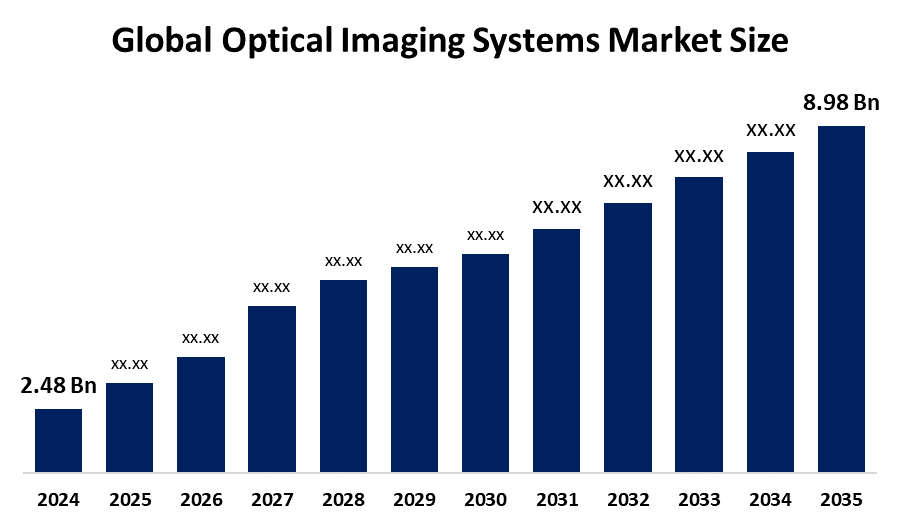
- The Market size for Global Optical Imaging Systems was estimated to be worth USD 2.48 Billion in 2024.
- The Market is going to expand at a CAGR of 12.41% between 2024 and 2035.
- The Global Optical Imaging Systems market size is anticipated to reach USD 8.98 Billion by 2035.
- North America is expected to generate the largest revenue during the forecast period in the Global Optical Imaging Systems Market
- Asia Pacific is expected to grow at the fastest rate during the forecast period in the Global Optical Imaging Systems Market.
Regional growth and demand
Asia Pacific is expected to grow at the fastest rate during the forecast period in the global optical imaging systems market. Asia Pacific is expected to grow at the fastest rate due to expanding healthcare infrastructure and rising investments in advanced diagnostic technologies. Countries such as China and India are accelerating adoption through government-led healthcare initiatives and increasing research activities. The region also benefits from cost-effective clinical trials and a growing geriatric population. Additionally, improving access to medical imaging in emerging economies is further supporting rapid market expansion.
North America is expected to generate the largest revenue during the forecast period in the global optical imaging systems market. North America is expected to generate the highest revenue due to expanding healthcare infrastructure and rising investments in advanced diagnostic technologies. Countries such as China and India are accelerating adoption through government-led healthcare initiatives and increasing research activities. The region also benefits from cost-effective clinical trials and a growing geriatric population. Additionally, improving access to medical imaging in emerging economies is further supporting rapid market expansion.
Ready to lead the Global Optical Imaging Systems Market?
Discover the regional trends and growth factors shaping the industry. We’re here to assist with expert, personalized data.
Call +1 303 800 4326 or Send us a message for a personalized consultation.
Top 10 Trends in the Global Optical Imaging Systems Market
- Integration of Artificial Intelligence in Imaging Systems
- Rising Adoption of Non-Invasive Diagnostic Techniques
- Advancements In Optical Coherence Tomography Technologies
- Increasing Demand for Portable and Handheld Imaging Devices
- Expansion of Applications in Oncology and Neurology
- Growing Use of Multimodal Imaging Systems
- Increasing Investments in Biomedical Research
- Development of High-Resolution and Real-Time Imaging Solutions
- Rising Demand in Emerging Economies
- Integration of Cloud-Based Data Management Solutions
Unlock exclusive market insights—Download the Brochure now and dive deeper into the future of the Global Optical Imaging Systems Market.
- Integration of Artificial Intelligence in Imaging Systems
The integration of artificial intelligence is transforming optical imaging systems by enhancing diagnostic accuracy and workflow efficiency. AI algorithms assist in image reconstruction, pattern recognition, and early disease detection, particularly in oncology and ophthalmology. These systems reduce human error and enable clinicians to interpret complex imaging data more effectively. Furthermore, AI-driven automation accelerates analysis time, supporting high patient throughput in healthcare facilities. Continuous advancements in machine learning models and increasing investments in digital healthcare are expected to further expand the adoption of AI-integrated optical imaging systems across both clinical and research environments globally.
- Rising Adoption of Non-Invasive Diagnostic Techniques
The increasing preference for non-invasive diagnostic techniques is a significant trend in the optical imaging systems market. These technologies enable visualization of internal tissues without surgical intervention, reducing patient discomfort and recovery time. Optical imaging methods such as fluorescence imaging and optical coherence tomography are widely used in early disease detection and monitoring. The growing burden of chronic diseases and the need for safer diagnostic alternatives are driving adoption across hospitals and diagnostic centers. Additionally, regulatory support for minimally invasive procedures is encouraging healthcare providers to invest in advanced optical imaging solutions worldwide.
- Advancements in Optical Coherence Tomography Technologies
Advancements in optical coherence tomography (OCT) technologies are significantly improving imaging precision and clinical applicability. Innovations such as swept-source OCT and spectral-domain OCT provide higher resolution and deeper tissue penetration, enabling detailed visualization of microstructures. These developments are particularly beneficial in ophthalmology for diagnosing retinal disorders at early stages. Furthermore, OCT is increasingly being explored in cardiology and dermatology applications. Continuous research and development efforts, along with integration of advanced software capabilities, are enhancing the performance and reliability of OCT systems, thereby strengthening their role in modern diagnostic imaging practices globally.
- Increasing Demand for Portable and Handheld Imaging Devices
The demand for portable and handheld optical imaging devices is increasing due to the need for point-of-care diagnostics and remote healthcare delivery. These compact systems offer flexibility and ease of use in diverse clinical settings, including emergency care and rural healthcare facilities. Technological advancements have enabled miniaturization without compromising imaging quality, making them suitable for real-time diagnostics. Additionally, portable devices support telemedicine initiatives by enabling data sharing and remote consultations. The growing emphasis on decentralized healthcare and cost-effective diagnostic solutions is expected to drive the widespread adoption of portable optical imaging systems.
- Expansion of Applications in Oncology and Neurology
The expansion of optical imaging applications in oncology and neurology is driving market growth by enabling early detection and precise disease monitoring. In oncology, these systems assist in tumor visualization, margin assessment, and treatment guidance. In neurology, optical imaging supports brain mapping and monitoring of neurological disorders. Increasing research on biomarkers and disease progression is further enhancing the utility of these technologies. Moreover, the rising prevalence of cancer and neurological conditions is creating sustained demand for advanced imaging solutions. Continuous innovation and interdisciplinary research are expected to broaden application scope and improve clinical outcomes significantly.
Empower your strategic planning:
Stay informed with the latest industry insights and market trends to identify new opportunities and drive growth in the global optical imaging systems market. To explore more in-depth trends, insights, and forecasts, please refer to our detailed report.
Top 20 Companies Leading the Global Optical Imaging Systems Market
- Carl Zeiss Meditec AG
- Koninklijke Philips
- Canon Medical Systems Corporation
- Heidelberg Engineering
- Topcon Corporation
- Optovue, Inc.
- iThera Medical GmbH
- Fujifilm Holdings Corporation
- Leica Microsystems
- Nikon Corporation
- Olympus Corporation
- Bruker Corporation
- Thermo Fisher Scientific
- Hamamatsu Photonics
- PerkinElmer, Inc.
- Thorlabs, Inc.
- Headwall Photonics, Inc.
- Jenoptik AG
- Keyence Corporation
- Hitachi High-Tech Corporation
Unlock exclusive market insights—Download the Brochure now and dive deeper into the future of the Global Optical Imaging Systems Market.
- Carl Zeiss Meditec AG
Headquarters: Jena, Germany
Carl Zeiss Meditec AG, active in over 100 countries, is a leading provider of optical imaging systems with a strong focus on ophthalmology and microsurgery. The company specializes in advanced optical coherence tomography systems and surgical visualization technologies that support precise diagnosis and treatment. It plays a significant role in the global market by enabling early disease detection and improving clinical outcomes. Its integrated digital platforms and continuous innovation strengthen its position across hospitals and specialty clinics. Through a comprehensive portfolio of imaging solutions, the company contributes to the advancement of high-precision, image-guided healthcare worldwide.
- Koninklijke Philips
Headquarters: Amsterdam, Netherlands
Koninklijke Philips, active in more than 100 countries, is a prominent healthcare technology company with a strong presence in advanced diagnostic imaging systems. The company offers a broad portfolio that integrates optical imaging with digital health solutions to enhance clinical decision-making. Its global market activity is driven by continuous innovation in imaging platforms, workflow optimization, and patient-centric technologies. Philips supports healthcare providers through connected care solutions and advanced visualization tools. By leveraging its strong research capabilities and global reach, the company plays a vital role in improving diagnostic accuracy and operational efficiency across healthcare systems worldwide.
- Canon Medical Systems Corporation
Headquarters: Otawara, Japan
Canon Medical Systems Corporation, active in over 140 countries, is a major player in the global diagnostic imaging landscape. The company develops a wide range of imaging technologies, including systems that incorporate optical imaging capabilities for enhanced visualization. Its solutions are widely used across hospitals and research institutions to support accurate diagnosis and treatment planning. Canon emphasizes innovation, quality, and integration of advanced imaging with healthcare IT systems. Through continuous technological advancements and a strong global distribution network, the company contributes significantly to improving patient care and expanding access to advanced diagnostic imaging worldwide.
- Heidelberg Engineering, Inc.
Headquarters: Heidelberg, Germany
Heidelberg Engineering, Inc., active in more than 80 countries, is a specialized provider of ophthalmic diagnostic imaging solutions. The company is widely recognized for its expertise in optical coherence tomography and retinal imaging technologies. Its systems are extensively used in clinical and research settings for early detection and monitoring of eye diseases. Heidelberg Engineering plays a focused role in the global market by delivering high-resolution imaging and data management solutions tailored to ophthalmology. Its commitment to precision and innovation supports clinicians in improving diagnostic accuracy and advancing eye care practices across international healthcare markets.
- Topcon Corporation
Headquarters: Tokyo, Japan
Topcon Corporation, active in over 120 countries, is a key participant in the global optical imaging systems market, particularly in ophthalmic and healthcare imaging solutions. The company provides advanced diagnostic instruments, including optical coherence tomography and retinal imaging systems. Its technologies are designed to enhance early diagnosis and disease management in clinical environments. Topcon’s global market presence is supported by continuous product innovation and integration of imaging with digital healthcare platforms. By offering reliable and efficient imaging solutions, the company contributes to improving accessibility and quality of eye care services across diverse healthcare settings worldwide.
Are you ready to discover more about the global optical imaging systems market?
The report provides an in-depth analysis of the leading companies operating in the global optical imaging systems market. It includes a comparative assessment based on their product portfolios, business overviews, geographical footprint, strategic initiatives, market segment share, and SWOT analysis. Each company is profiled using a standardized format that includes:
Company Profiles
- Carl Zeiss Meditec AG
- Business Overview
- Company Snapshot
- Products Overview
- Company Market Share Analysis
- Company Coverage Portfolio
- Financial Analysis
- Recent Developments
- Merger and Acquisitions
- SWOT Analysis
- Koninklijke Philips
- Canon Medical Systems Corporation
- Heidelberg Engineering
- Topcon Corporation
- Optovue, Inc.
- iThera Medical GmbH
- Fujifilm Holdings Corporation
- Leica Microsystems
- Others.
Unlock exclusive market insights—Download the Brochure now and dive deeper into the future of the Global Optical Imaging Systems Market.
Conclusion
The global optical imaging systems market is poised for significant expansion, driven by the rising burden of chronic diseases, increasing demand for non-invasive diagnostics, and continuous technological advancements. As highlighted, the market is expected to witness strong growth through 2035, supported by expanding clinical applications and increasing healthcare investments worldwide. Innovations such as AI-integrated imaging, portable diagnostic devices, and high-resolution visualization technologies are reshaping diagnostic accuracy and efficiency. Additionally, growing adoption across emerging economies and research institutions is further accelerating market penetration. Leading companies including Carl Zeiss Meditec AG, Koninklijke Philips, and Canon Medical Systems Corporation continue to drive innovation and global competitiveness. Overall, the market presents substantial opportunities for stakeholders, with technological evolution and increasing healthcare demand expected to sustain long-term growth and industry transformation.
Our Industry Reports:
Brazil Bioherbicides Market Size, Growth, Analysis to 2035
https://www.sphericalinsights.com/reports/brazil-bioherbicides-market
Brazil Biostimulant Market Size, Share, Trend
https://www.sphericalinsights.com/reports/brazil-biostimulant-market
Brazil Ceramics Market Size, Share, Trend
https://www.sphericalinsights.com/reports/brazil-ceramics-market
Brazil Electric Motors Market Size, Share, Trend
https://www.sphericalinsights.com/reports/brazil-electric-motors-market
Brazil Isopropyl Alcohol Market Size, Share Report 2035
https://www.sphericalinsights.com/reports/brazil-isopropyl-alcohol-market
About the Spherical Insights & Consulting
Spherical Insights & Consulting is a market research and consulting firm which provides actionable market research study, quantitative forecasting and trends analysis provides forward-looking insight especially designed for decision makers and aids ROI. Which is catering to different industry such as financial sectors, industrial sectors, government organizations, universities, non-profits and corporations. The company's mission is to work with businesses to achieve business objectives and maintain strategic improvements.
CONTACT US:
For More Information on Your Target Market, Please Contact Us Below:
Phone: +1 303 800 4326 (the U.S.)
Phone: +91 90289 24100 (APAC)
Email: inquiry@sphericalinsights.com, sales@sphericalinsights.com
Contact Us: https://www.sphericalinsights.com/contact-us
Need help to buy this report?