Top 20 Companies in Global Depth Sensing Market: Industry Intelligence Report by Spherical Insights (2024–2035)
RELEASE DATE: Mar 2026 Author: Spherical InsightsRequest Free Sample Speak to Analyst
Introduction
The depth sensing refers to the technology that allows devices to measure the depth and relationships in images. In the global depth sensing market, this technology is used in consumer, automotive, as well as industrial applications. These applications enable users to leverage advanced features such as 3D imaging, gestures, and object detection. The depth sensing technology is used in value creation within various industries. The technology also supports various applications such as facial recognition, augmented reality navigation, healthcare imaging, surveillance, smart manufacturing processes.
The Indian government is investing heavily in Industry 4.0 initiatives through programs such as Make in India and Digital India, driving over 10% annual growth in machine vision and robotics adoption, thereby significantly boosting demand in the global depth sensing market.
The global depth sensing market is experiencing rapid innovations with the integration of AI-powered 3D sensing technology, which is providing opportunities for better object recognition and analysis in smart devices. The new developments in event-based sensors and solid-state LiDAR are providing opportunities in terms of increased speeds, accuracy, and efficiency. The future opportunities are expected in autonomous vehicles, AR/VR, and metaverse applications, industrial IoT-enabling automation, and healthcare imaging.
Navigate Future Markets with Confidence: Insights from Spherical Insights LLP
The insights presented in this blog are derived from comprehensive market research conducted by Spherical Insights LLP, a trusted advisory partner to leading global enterprises. Backed by in-depth data analysis, expert forecasting, and industry-specific intelligence, our reports empower decision-makers to identify strategic growth opportunities in fast-evolving sectors. Clients seeking detailed market segmentation, competitive landscapes, regional outlooks, and future investment trends will find immense value in the full report. By leveraging our research, businesses can make informed decisions, gain a competitive edge, and stay ahead in the transition toward sustainable and profitable solutions.
Depth Sensing Market & Statistics
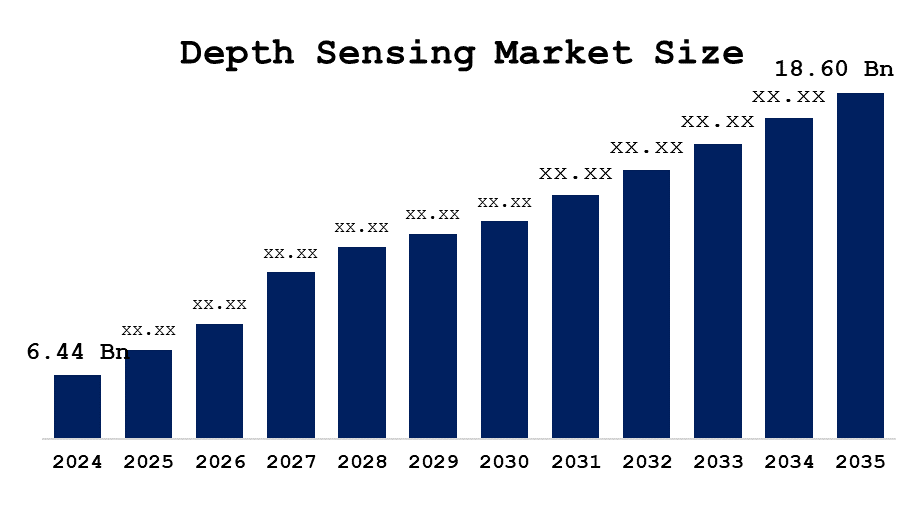
- The Market Size for Depth Sensing Market Was Estimated to be worth USD 6.44 billion in 2024.
- The Market Size is Going to Expand at a CAGR of 10.12% between 2025 and 2035.
- The Global Depth Sensing Market Size is anticipated to reach USD 18.60 billion by 2035.
- North America is estimated to generate the highest demand during the forecast period in the Global Depth Sensing Market.
- Asia Pacific is projected to grow the fastest during the forecast period in The Global Depth Sensing Market.
Market Segmentation
Global Depth Sensing Market Size, Share, By Component (Camera/Lens Module, Sensors, and Illuminator), By Technology (Stereo Vision, Structured Light, and Time-Of-Flight), By Type(Active Depth Sensing, and Passive Depth Sensing), By Virtical(Automotive, Industrial, Consumer Electronics, Medical, and Others), and By Region (North America, Europe, Asia-Pacific, Latin America, Middle East, and Africa), Analysis and Forecast 2024 - 2035
Regional growth and demand
Asia‑Pacific is expected to grow the fastest during the forecast period in the depth sensing market. It is due to the established consumer electronics manufacturing industry, especially in countries like China, Japan, South Korea, and India. The region is also benefiting from growing consumer demand for smartphones, AR/VR devices, as well as advanced driver-assistance systems. Moreover, growing investments in automation, robotics, as well as AI-driven technologies, with supportive government policies and growing industry infrastructure, are also significantly boosting market growth.
North America is anticipated to generate the highest demand during the forecast period in the depth sensing market. It is Due to the dominance of leading tech companies, advanced research and development facilities, and early adoption of latest technologies such as facial recognition, augmented reality, and 3D imaging. In addition, significant investments in autonomous vehicles, robots, and artificial intelligence-based applications, as well as high consumer purchasing power, are also boosting market demand in this region.
Ready to lead the Depth Sensing Market ?
Discover the regional trends and growth factors shaping the industry. We’re here to assist with expert, personalized data.
Call +1 303 800 4326 or Send us a message for a personalized consultation.
Top 10 trends in the depth sensing market
- Dominance of Time-of-Flight (ToF) Technology
- Automotive ADAS and Autonomous Vehicle Growth
- Expansion in AR/VR Headsets and Metaverse Applications
- AI-Enabled Edge Depth Processing
- Miniaturization of VCSEL Emitters
- Growth of 3D Sensing in Robotics and Warehouse Automation
- Transition to Software-Defined Sensing
- Rising Demand for 3D Face Authentication
- Integration of Security and Retail Analytics
- Focus on High-Performance Imaging in Adverse Conditions
1. Dominance of Time-of-Flight (ToF) Technology
Due in significant part to its use in smartphones for autofocus and 3D scanning, Time-of-Flight had the highest revenue share 45% in 2024–2025. Direct ToF (dToF) is quickly gaining traction in the industry because to its superior accuracy and reduced battery consumption, especially in mobile and augmented reality applications.
2. Automotive ADAS and Autonomous Vehicle Growth
The fastest-growing industry is automotive, where depth sensors are utilized for automated driving systems, collision avoidance, and in-cabin occupant monitoring. Adoption is being fueled by regulatory requirements for in-cabin monitoring (such as driver-monitoring systems), and flash LiDAR is becoming more and more popular in this field.
3. Expansion in AR/VR Headsets and Metaverse Applications
Demand for low-power, high-accuracy depth sensors to detect user movements and map the surroundings, like those found in the Meta Quest 3 and Apple Vision Pro, is being driven by the widespread use of AR/VR headsets.
4. AI-Enabled Edge Depth Processing
Moving AI processing from the cloud to the device itself is a major trend (Edge AI). Increased privacy, reduced latency, and quicker real-time 3D data interpretation are all made possible by this, which is essential for robots and intelligent surveillance.
5. Miniaturization of VCSEL Emitters
Manufacturers are shrinking VCSELs (Vertical-Cavity Surface-Emitting Lasers) while increasing their output power and power efficiency to integrate depth sensors behind displays and into small consumer products (smartphones, wearables)
.
Top 20 Companies Leading the depth sensing market
- Sony Group Corporation
- STMicroelectronics N.V.
- Infineon Technologies AG
- Texas Instruments Incorporated
- ams-OSRAM AG
- Qualcomm Incorporated
- Samsung Electronics Co., Ltd.
- OMNIVISION Technologies Inc.
- NXP Semiconductors N.V.
- Microchip Technology Inc.
- Intel Corporation (RealSense division)
- Lumentum Holdings Inc.
- Teledyne Technologies Incorporated
- Lattice Semiconductor Corporation
- pmdtechnologies ag
- Ouster, Inc.
- Aeva, Inc.
- Stereolabs Inc.
- Nerian Vision Technologies
- Occipital, Inc.
1. Sony Group Corporation
Headquarters: Tokyo, Japan
The Sony Group Corporation, which was founded in 1946 and employs about 113,000 worldwide, reported an estimated revenue of over USD 85 billion in 2025. Sony plays an important role in the global depth sensing market with its innovative CMOS image sensors and 3D sensing technology used in smartphones, automotive technology, and industrial applications, which improves its competitive position in the depth sensing technology market.
2. STMicroelectronics N.V.
Headquarters: Geneva, Switzerland
The STMicroelectronics N.V., and incorporated in 1987, has about 50,000 employees worldwide. The firm recorded an estimated revenue of about USD 17 billion in 2025. In the global depth sensing market, STMicroelectronics plays an important role with the help of Time-of-Flight (ToF) sensors, image sensors, and MEMS technologies used in smartphones, automotive applications, and industrial automation, thus contributing to the firm's role in advanced sensing and semiconductor development.
3. Infineon Technologies AG
Headquarters: Neubiberg, Germany
Infineon Technologies AG, founded in 1999, currently has approximately 58,000 employees worldwide. The firm achieved an estimated revenue of about USD 18 billion in 2025. In the global depth sensing market, Infineon plays a key role with its advanced 3D Time-of-Flight (ToF) sensors and REAL3 technologies, used in smartphones, automotive safety, and industrial automation applications, thus securing a strong footprint in high-performance sensing technologies.
4. Texas Instruments Incorporated
Headquarters: Dallas, Texas, United States
Texas Instruments Incorporated, which was founded in 1930, has around 34,000 employees worldwide. It has an estimated revenue of around 20 billion USD in 2025. Texas Instruments contributes to the global depth sensing market through its DLP technology, embedded processors, and analog chips for 3D imaging, industrial sensing, and automotive applications, thus strengthening its presence in the field of advanced semiconductor-based sensing solutions.
5. ams-OSRAM AG
Headquarters: Premstätten, Austria
The ams-OSRAM AG, established in 1981, has around 22,000 employees worldwide. The company has an estimated revenue of around 4.5 billion USD for 2025. In the global depth sensing market, ams-OSRAM plays an important role through their optical sensing solutions, including VCSEL laser and photodetector products used for 3D sensing, facial recognition, automotive LiDAR, and other applications, further enhancing their position in photonics-related technologies.
Are you ready to discover more about the depth sensing market?
The report provides an in-depth analysis of the leading companies operating in the global depth sensing market. It includes a comparative assessment based on their product portfolios, business overviews, geographical footprint, strategic initiatives, market segment share, and SWOT analysis. Each company is profiled using a standardized format that includes:
Company Profiles
- Sony Group Corporation
- Business Overview
- Company Snapshot
- Products Overview
- Company Market Share Analysis
- Company Coverage Portfolio
- Financial Analysis
- Recent Developments
- Merger and Acquisitions
- SWOT Analysis
- STMicroelectronics N.V.
- Infineon Technologies AG
- Texas Instruments Incorporated
- ams-OSRAM AG
- Qualcomm Incorporated
- Samsung Electronics Co., Ltd.
- OMNIVISION Technologies Inc.
- NXP Semiconductors N.V.
- Microchip Technology Inc.
- Intel Corporation (RealSense division)
- Lumentum Holdings Inc.
- Teledyne Technologies Incorporated
- Lattice Semiconductor Corporation
- pmdtechnologies ag
- Ouster, Inc.
- Aeva, Inc.
- Stereolabs Inc.
- Nerian Vision Technologies
- Occipital, Inc.
- Others.
Conclusion
The global depth sensing market is poised for robust expansion, projected to grow from USD 6.44 billion in 2024 to USD 18.60 billion by 2035, at a CAGR of 10.12%. This growth is driven by increasing demand across consumer electronics, automotive, and industrial sectors, particularly with the proliferation of smartphones, AR/VR devices, and ADAS-enabled vehicles. North America is expected to generate the highest demand due to strong technological infrastructure and high R&D investments, while Asia-Pacific is anticipated to witness the fastest growth, supported by large-scale manufacturing and rising digital adoption. Technological advancements such as AI-powered 3D sensing, Time-of-Flight dominance, and solid-state LiDAR are enhancing efficiency and application scope. Additionally, government-led Industry 4.0 initiatives, including India’s Make in India and Digital India programs, are accelerating automation and robotics adoption. Collectively, these factors are fostering innovation, strengthening competitive dynamics, and creating significant long-term value across the global depth sensing ecosystem.
About the Spherical Insights & Consulting
Spherical Insights & Consulting is a market research and consulting firm which provides actionable market research study, quantitative forecasting and trends analysis provides forward-looking insight especially designed for decision makers and aids ROI. Which is catering to different industry such as financial sectors, industrial sectors, government organizations, universities, non-profits and corporations. The company's mission is to work with businesses to achieve business objectives and maintain strategic improvements.
CONTACT US:
For More Information on Your Target Market, Please Contact Us Below:
Phone: +1 303 800 4326 (the U.S.)
Phone: +91 90289 24100 (APAC)
Email: inquiry@sphericalinsights.com, sales@sphericalinsights.com
Contact Us: https://www.sphericalinsights.com/contact-us
Need help to buy this report?