Top 20 Companies in Global Air and Missile Defense Radar (AMDR) Market (2025–2035): Competitive Analysis & Forecast
RELEASE DATE: Mar 2026 Author: Spherical InsightsRequest Free Sample Speak to Analyst
Description
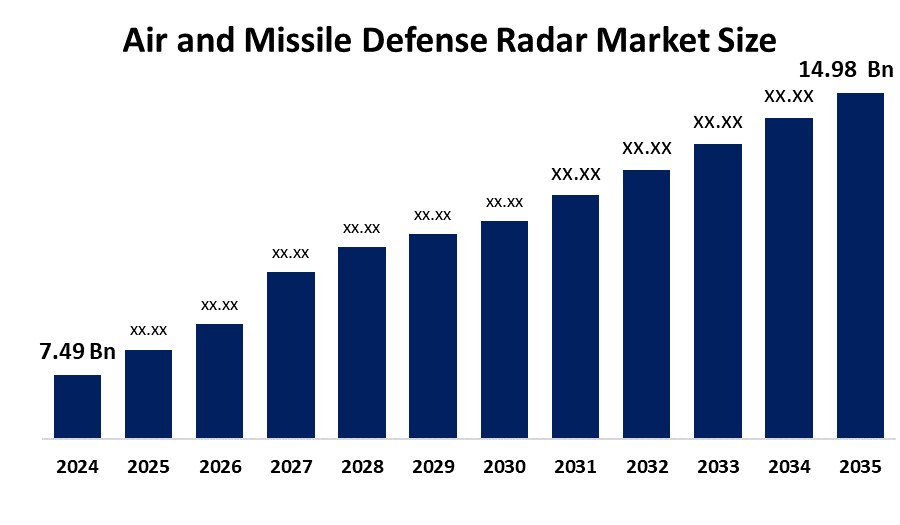
According to a research report published by Spherical Insights & Consulting, the Global Air and Missile Defense Radar AMDR Market Size is projected to grow from USD 7.49 Billion in 2024 to USD 14.98 Billion by 2035, at a CAGR of 6.5% during the forecast period 2025–2035. The Global Air and Missile Defense Radar AMDR Market is driven by increasing defense modernization programs, rising geopolitical tensions, advancements in radar technologies, and the growing demand for early threat detection and integrated missile defense systems worldwide.
Introduction
The Air and Missile Defense Radar AMDRmarket encompasses all activities involved in creating and implementing sophisticated radar systems that have the ability to identify and monitor as well as eliminate aerial and missile threats, which serve as essential defense systems for military organizations. The primary raw materials for AMDR systems include high frequency electronic components, semiconductors, phased array antennas, signal processors, and advanced software algorithms that enable accurate threat detection and real time response. AMDR systems operate in multiple environments including air defense systems, naval ships, missile early warning networks, and border protection systems to support military activities and strategic defense operations and national security efforts. The market experiences its main growth through the adoption of artificial intelligence and machine learning and multifunctional radar technologies, which improve detection performance and target tracking ability and automated threat handling systems. The defense industry presents growth potential through development of advanced radar systems which include mobile and shipborne systems and affordable compact solutions for new military forces. The implementation of AMDR systems in national security efforts progresses through international government programs which include defense modernization initiatives and military budget expansions and strategic partnerships and research and development funding.
Navigate Future Markets with Confidence: Insights from Spherical Insights LLP
The insights presented in this blog are derived from comprehensive market research conducted by Spherical Insights LLP a trusted advisory partner to leading global enterprises. Backed by in depth data analysis, expert forecasting, and industry-specific intelligence, our reports empower decision-makers to identify strategic growth opportunities in fast-evolving sectors. Clients seeking detailed market segmentation, competitive landscapes, regional outlooks, and future investment trends will find immense value in the full report. By leveraging our research, businesses can make informed decisions, gain a competitive edge, and stay ahead in the transition toward sustainable and profitable solutions.
Unlock exclusive market insights—Download the Brochure now and dive deeper into the future of the Air and Missile Defense Radar (AMDR) Market.
Air and Missile Defense Radar (AMDR) Market Size & Statistics
- The Market Size for Air and Missile Defense Radar (AMDR) Was Estimated to be worth USD 7.49 Billion in 2024.
- The Market is Going to Expand at a CAGR of 6.5% between 2025 and 2035.
- The Global Air and Missile Defense Radar AMDR Market Size is anticipated to reach USD 14.98 Billion by 2035.
- North America is expected to generate the highest demand during the forecast period in the Air and Missile Defense Radar (AMDR) Market
- Asia Pacific is xpected to grow the fastest during the forecast period in the Air and Missile Defense Radar AMDR Market.
Regional growth and demand
Asia Pacific is expected to grow the fastest during the forecast period in the Air and Missile Defense Radar (AMDR) market. Asia Pacific is expected to grow fastest due to by increasing defense budgets, modernization of air and missile defense systems, rising geopolitical tensions, and adoption of advanced radar technologies by countries like China, India, Japan, and South Korea.
North America is expected to generate the highest demand during the forecast period in the Air and Missile Defense Radar (AMDR) market. North America is expected to generate the highest demand driven by significant defense spending, modernization of military radar systems, increasing focus on missile defense, advanced technological capabilities, and strategic initiatives by the U.S. and Canada to enhance national and allied security.
Top 10 Trends in the Air and Missile Defense Radar (AMDR) Market
- Integration of Multi-Function Radar Systems
- Active Electronically Scanned Array (AESA) Technology
- AI and Machine Learning for Threat Detection
- Network-Centric Warfare Capabilities
- Mobile and Transportable Radar Solutions
- Enhanced Detection of Hypersonic and Ballistic Missiles
- Space-Based and Over-the-Horizon Radar Deployment
- Cybersecurity and Electronic Warfare Resilience
- Miniaturization and Lightweight Radar Systems
- Increased Defense Modernization and Procurement Programs
- Integration of Multi-Function Radar Systems
Modern AMDR systems combine surveillance, tracking, and targeting in a single platform, improving operational efficiency, reducing response times, and enabling simultaneous detection of multiple aerial and missile threats for enhanced defense capabilities.
- Active Electronically Scanned Array (AESA) Technology
AESA radars provide faster beam steering, higher resolution, and greater reliability compared to traditional systems, allowing accurate tracking of multiple targets, improved jamming resistance, and enhanced situational awareness in complex combat scenarios.
- AI and Machine Learning for Threat Detection
Artificial intelligence and machine learning algorithms analyze vast radar data in real time, enabling predictive threat assessment, automated target recognition, and faster decision-making for defense operators.
- Network-Centric Warfare Capabilities
AMDR systems are increasingly integrated into networked defense architectures, allowing seamless data sharing between land, air, and naval units, improving coordination, response efficiency, and multi-domain operational effectiveness.
Mobile and Transportable Radar Solutions
Demand for mobile and rapidly deployable radar systems is rising, enabling flexible defense coverage, rapid relocation, and protection of critical assets in dynamic battlefield environments.
Empower your strategic planning:
Stay informed with the latest industry insights and market trends to identify new opportunities and drive growth in the Air and Missile Defense Radar (AMDR) market. To explore more in-depth trends, insights, and forecasts, please refer to our detailed report.
Top 20 Companies Leading the Air and Missile Defense Radar (AMDR) Market
- Raytheon
- Lockheed
- Northrop
- Thales
- Leonardo
- BAE
- Saab
- Israel
- Hensoldt
- Rheinmetall
- Terma
- Airbus
- Mitsubishi
- General
- Alma
- Elbit S
- Aselsan
- Rafael
- Telephonics
Headquarters: Arlington, Virginia, USA
RTX is a global aerospace and defense giant supplying advanced radar systems such as AN TPY 2 LTAMD and SPY 6 for air and missile defense.
- Lockheed Martin Corporation
Headquarters: Bethesda, Maryland, USA
Lockheed Martin is a leading aerospace and defense manufacturer known for its 3D Expeditionary Long Range Radar ELRR air defense systems
- Northrop Grumman Corporation
Headquarters: Falls Church, Virginia, USA
Northrop Grumman specializes in advanced radar and aerospace systems, including the AN TPS 80 Ground Air Task Oriented Radar
- Thales Group
Headquarters: Paris, France
Thales is a French multinational aerospace and defense company providing radar solutions for ground naval and air applications cybersecurity and avionics. It operates in more than 68 countries with a broad military and civil portfolio. In 2024
- Leonardo S.p.A.
Headquarters: Rome, Italy
Leonardo is an Italian state controlled aerospace and defense firm offering radar electronic warfare, and air defense systems integrated into NATO and allied platforms
Are you ready to discover more about the Air and Missile Defense Radar (AMDR) market?
The report provides an in-depth analysis of the leading companies operating in the global Air and Missile Defense Radar (AMDR) market. It includes a comparative assessment based on their product portfolios, business overviews, geographical footprint, strategic initiatives, market segment share, and SWOT analysis. Each company is profiled using a standardized format that includes:
Company Profiles
- Business Overview
- Company Snapshot
- Products Overview
- Company Market Share Analysis
- Company Coverage Portfolio
- Financial Analysis
- Recent Developments
- Merger and Acquisitions
- SWOT Analysis
- Lockheed Martin Corporation
- Northrop Grumman Corporation
- Thales Group
- Leonardo S.p.A.
- BAE Systems plc
- Saab AB
- Israel Aerospace Industries Ltd.
- Hensoldt AG
- Others.
Conclusion
The global Air and Missile Defense Radar (AMDR) market will grow steadily from 2025 until 2035 because defense modernization programs and geopolitical conflicts and radar system technology progress will drive market expansion. North America will create the highest market demand according to forecasts while Asia Pacific will experience the fastest growth because defense budgets increase and radar modernization projects begin. Major companies, including Raytheon Technologies and Lockheed Martin and Northrop Grumman and Thales and Leonardo, develop AI-based multifunctional mobile radar systems for naval use, which enhance national defense capabilities and enable worldwide missile detection and threat tracking and air defense system integration.
Need help to buy this report?