Top 15 Companies in the Global Automotive Leather Fabric Market (2024–2035): Spherical Insights Analysis
RELEASE DATE: Mar 2026 Author: Spherical InsightsRequest Free Sample Speak to Analyst
Introduction
The global automotive leather fabric market is currently undergoing a structural transformation, evolving from a traditional upholstery segment into a high-tech component of the modern mobile living room. Defined by the integration of premium aesthetics with functional durability, this sector now relies on advanced bio-synthetic engineering and sustainable tanning technologies—such as chrome-free processing and plant-based polymers—to meet the rigorous environmental demands of the electric vehicle (EV) era. In practice, these materials serve as critical use cases for temperature-regulating surfaces and antimicrobial coatings in shared mobility, where interior surfaces must withstand high wear while maintaining a luxury feel. This shift is being further catalysed by recent government initiatives, including the EU’s Green Claims Directive and India’s 2025 focus on sustainable textile manufacturing, which mandate transparency in leather sourcing and carbon-neutral production cycles. The resulting impact is a market where circular economy principles and material innovation are the primary drivers of value, effectively redefining automotive luxury as a blend of ethical responsibility and sophisticated chemical engineering.
Navigate Future Markets with Confidence: Insights from Spherical Insights LLP
The insights presented in this blog are derived from comprehensive market research conducted by Spherical Insights LLP, a trusted advisory partner to leading global enterprises. Backed by in-depth data analysis, expert forecasting, and industry-specific intelligence, our reports empower decision-makers to identify strategic growth opportunities in fast-evolving sectors. Clients seeking detailed market segmentation, competitive landscapes, regional outlooks, and future investment trends will find immense value in the full report. By leveraging our research, businesses can make informed decisions, gain a competitive edge, and stay ahead in the transition toward sustainable and profitable solutions.
Global Automotive Leather Fabric Market Size & Statistics
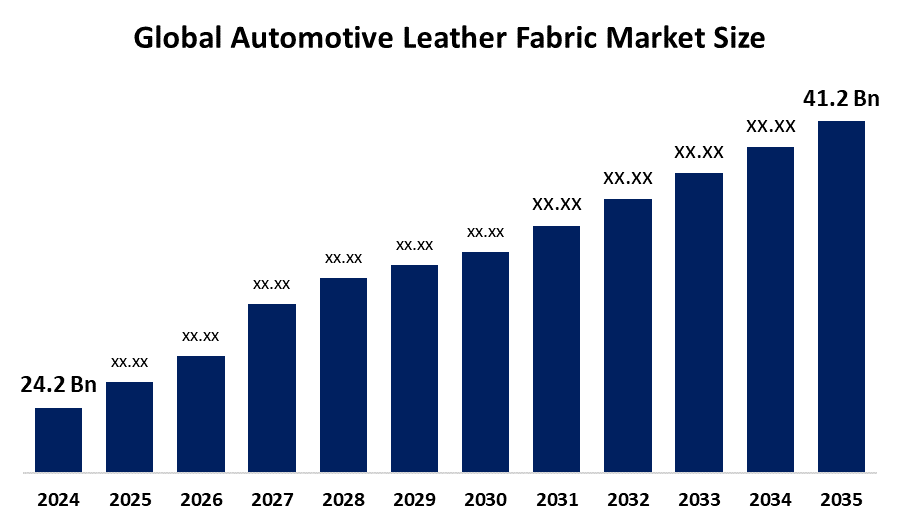
- The Global Automotive Leather Fabric Market was estimated to be worth USD 24.2 billion in 2024.
- The market is projected to expand at a steady CAGR of 4.96% between 2024 and 2035.
- The Global Automotive Leather Fabric Market Size is anticipated to reach USD 41.2 billion by 2035
- North America is identified as the region with the highest revenue demand for premium leather. This is primarily fuelled by a rapid consumer shift toward high-end SUVs and luxury EVs, where premium, sustainable leather is a core brand differentiator for manufacturers like Tesla, Rivian, and Lucid.
- Asia-Pacific is identified as the fastest-growing region, growth is spearheaded by China’s dominance in the EV market and India’s burgeoning luxury vehicle segment.
Unlock exclusive market insights—Download the Brochure now and dive deeper into the future of the Automotive Leather Fabric Market.
Regional Growth & Demand Analysis
North America is the Highest Revenue region through 2035, maintaining its lead through a sophisticated transition toward sustainable luxury. Growth is centred on the U.S. market, where the rapid electrification of SUVs and pickup trucks is redefining interior standards. With major Detroit and Silicon Valley automakers shifting toward ESG-compliant materials, the region is seeing a massive uptick in vegan and bio-based leather procurement to achieve weight reduction and carbon-neutral targets. The region's dominance is sustained by high consumer demand for animal-free premium cabins and the integration of smart, antimicrobial surfaces in the luxury EV segment.
Asia-Pacific is the fastest-growing region in this sector, driven by China’s position as the global leader in EV production and India’s burgeoning luxury vehicle market. The surge is fuelled by China’s 2025 New Energy Vehicle mandates, which prioritise lightweight, high-tech interiors, and India’s Make in India initiative, which is boosting local high-end synthetic leather manufacturing. As regional brands like BYD and Tata integrate premium-grade technical fabrics into mass-market models, the Asia-Pacific becomes the world's primary hub for high-volume, cost-effective upholstery innovation, effectively bridging the gap between affordability and premium aesthetics.
Global Automotive Leather Fabric Market Segmentation
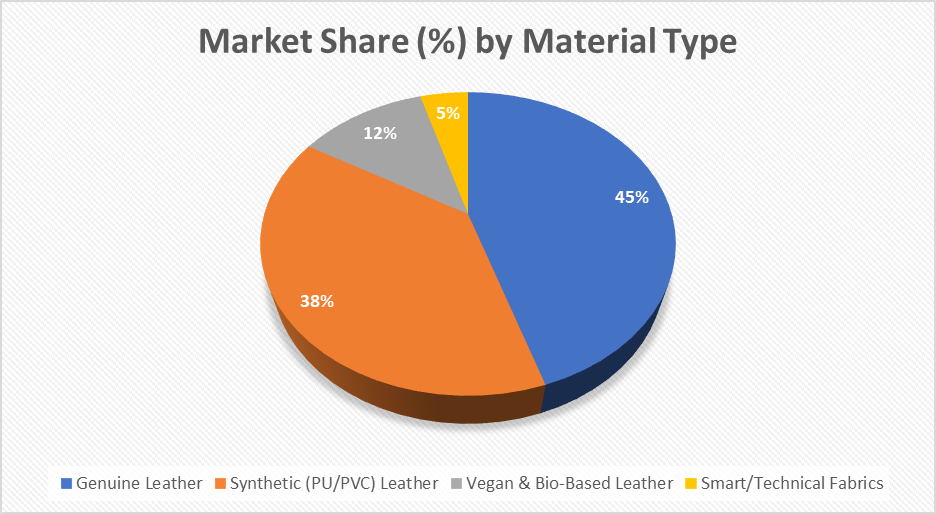
The Global Automotive Leather Fabric Market is segmented by Material Type (Genuine Leather, Synthetic PU Leather, PVC Leather, and Vegan/Bio-based Leather), Application (Seats & Upholstery, Dashboards, Door Panels, Steering Wheels, and Others), and Car Class (Economy, Mid-segment, and Luxury Cars), with a focus across Vehicle Type (Passenger Cars, Light Commercial Vehicles, and Heavy Commercial Vehicles & Buses). The analysis also provides a geographic breakdown across regions (North America, Europe, Asia-Pacific, Latin America, and the Middle East & Africa), offering a detailed forecast for the 2024–2035 period.
Ready to lead the Automotive Leather Fabric Market ?
Discover the regional trends and growth factors shaping the industry. We’re here to assist with expert, personalized data.
Call +1 303 800 4326 or Send us a message for a personalized consultation.
Top 10 Trends in the Global Automotive Leather Fabric Market
- Transition to Animal-Free Luxury Cabins
- The Rise of Bio-Fabricated Mycelium Leather
- Integration of Haptic & Smart Touch Surfaces
- Adoption of Chrome-Free & Sustainable Tanning
- Development of Antimicrobial & Self-Cleaning Coatings
- Shift Toward Circular Economy & Recyclable Polymers
- Lightweighting Fabrics for Enhanced EV Range
- Expansion of 3D-Knitted & Seamless Upholstery
- Personalisation through Digital Laser Perforation
- Growth of AI-Driven Material Durability Testing
- Transition to Animal-Free Luxury Cabins
The industry is moving away from traditional livestock-dependent sourcing toward high-end synthetic and plant-based alternatives that redefine premium. While luxury was once synonymous with genuine cowhide, leading automakers are now responding to consumer demand for ethical interiors by adopting high-performance vegan leathers. These materials, such as premium Polyurethane (PU) and recycled microfiber, offer a tactile experience indistinguishable from natural leather while providing superior resistance to UV rays and temperature fluctuations, effectively decoupling the concept of luxury from animal products.
- The Rise of Bio-Fabricated Mycelium Leather
Beyond standard synthetics, the market is witnessing a breakthrough in lab-grown materials derived from the root structure of mushrooms, known as mycelium. This technology allows manufacturers to grow leather in a matter of weeks rather than years, producing a biodegradable material that shares the cellular density and breathability of animal skin. By utilising agricultural waste as a growth medium, brands like BMW and Hyundai are exploring these bio-fabricated surfaces to significantly lower the carbon footprint of their cabins while maintaining a unique, organic aesthetic that appeals to the eco-conscious elite.
- Integration of Haptic & Smart Touch Surfaces
Modern vehicle interiors are evolving into active digital interfaces where the leather itself acts as a control panel. By embedding conductive yarns and capacitive sensors directly into the fabric or leather backing, designers are replacing physical buttons with smart surfaces. This technology enables a seamless, hidden-until-lit dashboard where a passenger can adjust climate or volume simply by touching the upholstered armrest or door panel. This shift not only streamlines interior design but also reduces vehicle weight by eliminating complex wiring and plastic switchgear.
- Adoption of Chrome-Free & Sustainable Tanning
For the remaining genuine leather segment, the focus shifted toward Green Chemistry to eliminate the environmental hazards of traditional processing. The industry is rapidly phasing out heavy metal-based chrome tanning in favour of vegetable-based or aldehyde-free alternatives, such as tanning agents derived from olive leaves or rhubarb. These sustainable tanning methods ensure that the leather is not only safer for the workers and the environment but also results in a hypoallergenic final product that meets the increasingly strict indoor air quality (VOC) standards of modern vehicle cabins.
- Development of Antimicrobial & Self-Cleaning Coatings
In the era of shared mobility and autonomous fleets, the hygiene of interior surface become a critical performance metric. Manufacturers are now integrating silver-ion technology and photocatalytic coatings directly into the leather finishing process to create surfaces that actively repel bacteria and break down organic pollutants. These self-cleaning materials are engineered to withstand over 60,000 abrasion cycles and repeated chemical cleaning without losing their protective properties, ensuring that high-traffic vehicle interiors remain sterile and odor-free throughout their operational life.
Empower your strategic planning:
Stay informed with the latest industry insights and market trends to identify new opportunities and drive growth in the automotive leather fabric market. To explore more in-depth trends, insights, and forecasts, please refer to our detailed report.
Top 15 Companies shaping the Global Automotive Leather Fabric Market
- Lear Corporation
- Adient plc
- Bader GmbH & Co. KG
- Forvia SE
- GST AutoLeather Inc.
- Toyota Boshoku Corporation
- Magna International Inc.
- Continental AG
- Seiren Co., Ltd.
- Sage Automotive Interiors
- Boxmark Leather GmbH & Co. KG
- Wollsdorf Leder
- Scottish Leather Group Limited
- Kyowa Leather Cloth Co., Ltd.
- Alcantara S.p.A.
- Lear Corporation
Headquarters: Southfield, Michigan, USA
The global powerhouse in high-performance automotive interiors, Lear Corporation through its subsidiary Eagle Ottawa sets the gold standard for luxury hide craftsmanship. As the industry pivots toward sustainability, Lear is redefining the premium experience by moving beyond traditional tanning to a circular manufacturing model. Their current focus lies in the development of BioTech leather, which significantly increases bio-based content while maintaining the tactile richness required by elite OEMs. By integrating their ZeoTech mineral-tanning technology, Lear effectively removed heavy metals from the production cycle, ensuring that the leather in a modern cockpit is as environmentally responsible as the electric powertrain driving it.
- Adient plc
Headquarters: Dublin, Ireland
Recognized as a global leader in automotive seating, Adient operates at the intersection of ergonomic engineering and material science. The company is currently spearheading the Pure Ergonomics movement, which aims to reduce the physical footprint of seating while maximizing interior space. To support this, Adient is aggressively expanding its portfolio of sustainable leather alternatives, such as bio-attributed PU and high-recycled-content faux leathers. In 2025, they advanced their sustainability roadmap by implementing a comprehensive supply chain mapping tool for leather, ensuring 100% transparency in sourcing to combat deforestation and meet the rigorous ESG (Environmental, Social, and Governance) demands of modern vehicle manufacturers.
- Bader GmbH & Co. KG
Headquarters: Göppingen, Germany
Bader is the definitive specialist for the premium European automotive segment, blending 150 years of German tanning tradition with futuristic bio-chemistry. The company’s Zero Waste Journey led to the creation of B-Green leather, a revolutionary product tanned using Cascara powder an upcycled byproduct of the coffee industry. This innovation allows Bader to offer a chrome-free, low-carbon natural material that meets the stringent durability tests of brands like Lucid and Mercedes-Benz. Furthermore, their Circutex line provides a vegan alternative that harmonizes perfectly with genuine leather in a hybrid cabin, allowing designers to mix materials without compromising on color consistency or haptic quality.
- Forvia SE
Headquarters: Nanterre, France
Forvia is the primary architect of the Software-Defined Interior, focusing on how sustainable surfaces can enhance digital cabin experiences. Through its dedicated cutting-edge materials brand, MATERI'ACT, the company is developing ultra-low-footprint alternatives to traditional animal hides. Their flagship material, Ecorium, utilizes a blend of recycled PET and hemp to achieve a 90% reduction in CO2 emissions compared to conventional leather. By collaborating with startups like Ananas Anam to commercialize Piñatex Advanced (a pineapple-fiber leather), Forvia is providing a scalable, bio-based solution that meets the weight-reduction and carbon-neutrality targets of the next generation of global EVs.
- GST AutoLeather Inc.
Headquarters: Southfield, Michigan, USA
Specializing in high-volume, customized leather solutions, GST AutoLeather is a critical partner for mainstream and luxury OEMs alike. The company is currently focusing on a Total Surface strategy, responding to the rise of shared mobility with the development of advanced antimicrobial and low-VOC (Volatile Organic Compound) finishes. These specialized coatings are engineered to stay sterile and odor-free under heavy use, making them ideal for autonomous shuttle fleets. In late 2024 and 2025, GST significantly expanded its capacity for high-performance synthetic leathers in Asia-Pacific, positioning itself as a leader in providing cost-effective, eco-certified materials for the rapidly growing mass-market electric vehicle sector.
Unlock exclusive market insights—Download the Brochure now and dive deeper into the future of the Automotive Leather Fabric Market.
Are you ready to discover more about the Automotive Leather Fabric Market?
The report provides an in-depth analysis of the leading companies operating in the global automotive leather fabric market. It includes a comparative assessment based on their product portfolios, business overviews, geographical footprint, strategic initiatives, market segment share, and SWOT analysis. Each company is profiled using a standardised format that includes:
Company Profiles
- Lear Corporation
- Business Overview
- Company Snapshot
- Products Overview
- Company Market Share Analysis
- Company Coverage Portfolio
- Financial Analysis
- Recent Developments
- Merger and Acquisitions
- SWOT Analysis
- Adient plc
- Bader GmbH & Co. KG
- Forvia SE
- GST AutoLeather Inc.
- Toyota Boshoku Corporation
- Magna International Inc.
- Continental AG
- Seiren Co., Ltd.
- Sage Automotive Interiors
- Boxmark Leather GmbH & Co. KG
- Wollsdorf Leder
- Scottish Leather Group Limited
- Kyowa Leather Cloth Co., Ltd.
- Alcantara S.p.A.
Conclusion
The global automotive leather fabric market is witnessing a profound shift as luxury and sustainability finally converge through a material-first philosophy. This transition is defined by bio-based engineering and smart, touch-integrated surfaces that transform static cabins into interactive, sensory environments. As manufacturers pivot toward carbon-neutral production, the modern interior is being redefined as an ethical, high-tech sanctuary for the next generation of drivers. With synchronized efforts from global regulators and material innovators to develop antimicrobial and sustainable solutions, the market is set for rapid evolution. This shift offers a unique opportunity for brands to redefine their identity through interior textures that are as technologically sophisticated as the electric powertrains they accompany.
About the Spherical Insights & Consulting
Spherical Insights & Consulting is a market research and consulting firm which provides actionable market research study, quantitative forecasting and trends analysis provides forward-looking insight especially designed for decision makers and aids ROI.
Which is catering to different industry such as financial sectors, industrial sectors, government organizations, universities, non-profits and corporations. The company's mission is to work with businesses to achieve business objectives and maintain strategic improvements.
CONTACT US:
For More Information on Your Target Market, Please Contact Us Below:
Phone: +1 303 800 4326 (the U.S.)
Phone: +91 90289 24100 (APAC)
Email: inquiry@sphericalinsights.com, sales@sphericalinsights.com
Contact Us: https://www.sphericalinsights.com/contact-us
Need help to buy this report?