Top 15 Companies in Global Augmented and Virtual Reality in Education Market: Statistics Report Till 2035
RELEASE DATE: Apr 2026 Author: Spherical InsightsRequest Free Sample Speak to Analyst
Description
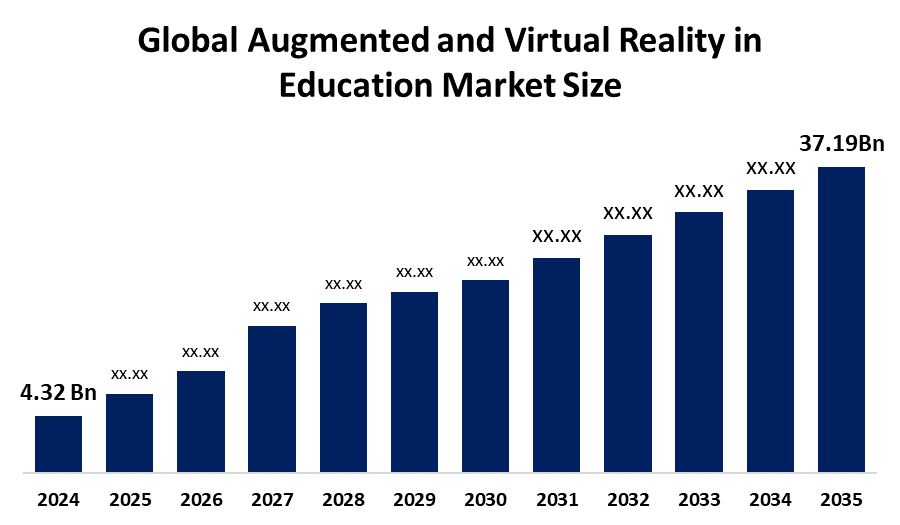
According to a research report published by Spherical Insights & Consulting, The Global Augmented And Virtual Reality In Education Market Size Is Projected To Grow From USD 4.32 Billion In 2024 To USD 37.19 Billion By 2035, At A CAGR Of 21.62% During The Forecast Period 2024–2035. The global augmented and virtual reality in education market is driven by increasing demand for immersive learning, improved student engagement, and enhanced knowledge retention. Advancements in hardware affordability, growing e-learning adoption, and integration of AR/VR with AI support personalized education. Additionally, government initiatives and rising investments in digital education infrastructure further accelerate market growth.
Introduction
The global augmented and virtual reality in education market refers to the use of immersive technologies that create interactive and simulated learning environments, enabling learners to better understand complex concepts through visualization and experience. These solutions are increasingly adopted across K–12, higher education, and corporate training to enhance learning efficiency and engagement. Market growth is driven by the rising demand for interactive and student-centric learning methods, increasing digital transformation in education, and continuous advancements in AR/VR technologies. According to UNESCO, digital technologies demonstrate measurable positive impacts on learning outcomes, supporting their integration into modern education systems. Additionally, OECD reports indicate that more than 19 national strategies globally now include immersive technologies, reflecting strong government support. Significant opportunities exist in remote education, virtual laboratories, and skill-based training, particularly in emerging economies investing in digital infrastructure. Furthermore, OECD highlights that digital education ecosystems are becoming central to national policies. Recent developments include increased investments by governments and technology providers, along with the expansion of immersive and metaverse-based learning platforms in virtual reality. In January 2024, Apple Inc. launched its mixed reality headset, Vision Pro, enabling advanced spatial computing applications in education and training environments. In March 2024, Meta Platforms, Inc. expanded its educational content ecosystem for Quest devices, focusing on immersive learning experiences. Additionally, in June 2024, Google LLC enhanced its AR Core platform to support improved educational applications, strengthening AR integration across mobile-based learning solutions
Navigate Future Markets with Confidence: Insights from Spherical Insights LLP
The insights presented in this blog are derived from comprehensive market research conducted by Spherical Insights LLP, a trusted advisory partner to leading global enterprises. Backed by in-depth data analysis, expert forecasting, and industry-specific intelligence, our reports empower decision-makers to identify strategic growth opportunities in fast-evolving sectors. Clients seeking detailed market segmentation, competitive landscapes, regional outlooks, and future investment trends will find immense value in the full report. By leveraging our research, businesses can make informed decisions, gain a competitive edge, and stay ahead in the transition toward sustainable and profitable solutions.
Unlock exclusive market insights—Download the Brochure now and dive deeper into the future of the global Augmented and Virtual Reality in Education Market.
Market Segmentation
Global Augmented and Virtual Reality in Education Market Size, Share, and, By Component (Hardware, Software, Content, and Services), By Technology (Augmented Reality and Virtual Reality), By Deployment (Cloud and On-Premise), By Application (E-learning, Simulation and Training, Virtual Field Trips, Skill Development, and Others), By End User (K-12 Education, Higher Education, Vocational Training, and Corporate Training), By Region (North America, Europe, Asia-Pacific, Latin America, and Middle East & Africa), Analysis and Forecast 2024 – 2035.
Global Augmented and Virtual Reality in Education Market Size & Statistics
- The market size for Global Augmented and Virtual Reality in Education was estimated to be worth USD 4.32 billion in 2024.
- The market is going to expand at a CAGR of 21.62% between 2024 and 2035.
- The Global Augmented and Virtual Reality in Education market size is anticipated to reach USD 37.19 billion by 2035.
- North America is expected to generate the largest revenue during the forecast period in the Global Augmented and Virtual Reality in Education market
- Asia Pacific is expected to grow at the fastest rate during the forecast period in the Global Augmented and Virtual Reality in Education market.
Regional growth and demand
Asia Pacific is expected to grow at the fastest rate during the forecast period in the global augmented and virtual reality in education market. Asia Pacific is expected to grow at the fastest rate due to rapid digital transformation across education systems in countries such as China, India, and Japan. Increasing government investments in digital infrastructure, expanding internet penetration, and rising adoption of e-learning platforms are key growth drivers. Additionally, large student populations and growing demand for skill-based and remote learning solutions accelerate AR/VR adoption. The presence of emerging edtech startups and supportive policy frameworks further contributes to strong regional expansion.
North America is expected to generate the largest revenue during the forecast period in the global augmented and virtual reality in education market. North America is expected to generate the highest revenue, led by the United States and Canada, due to early adoption of advanced technologies and strong digital infrastructure. The region benefits from significant investments in educational technology and the presence of leading AR/VR solution providers. High awareness among institutions, integration of immersive learning in curricula, and continuous innovation in content development support market leadership. Furthermore, collaborations between technology companies and academic institutions strengthen the region’s established position.
Ready to lead the Augmented And Virtual Reality In Education Market?
Discover the regional trends and growth factors shaping the industry. We’re here to assist with expert, personalized data.
Call +1 303 800 4326 or Send us a message for a personalized consultation.
Top 10 Trends in The Global Augmented and Virtual Reality in Education Market
- Integration of AR/VR With Artificial Intelligence
- Expansion of Immersive Remote Learning Environments
- Increasing Adoption of Virtual Laboratories and Simulations
- Growth of Metaverse-Based Education Platforms
- Rising Demand for Skill-Based and Vocational Training Solutions
- Declining Cost of AR/VR Hardware Devices
- Development of Personalized and Adaptive Learning Content
- Growing Partnerships Between Edtech Firms and Institutions
- Increased Government Funding for Digital Education Initiatives
- Adoption of Cloud-Based AR/VR Deployment Models
- Integration of AR/VR with Artificial Intelligence
The convergence of augmented and virtual reality with artificial intelligence is transforming educational delivery by enabling adaptive and personalized learning experiences. AI-driven analytics can assess student behavior, learning pace, and comprehension levels, allowing AR/VR platforms to dynamically adjust content in real time. This integration enhances engagement by tailoring immersive environments to individual learner needs. Furthermore, intelligent tutoring systems embedded within AR/VR applications provide instant feedback and guidance, improving knowledge retention. As institutions increasingly prioritize outcome-based education, the combination of AI with immersive technologies is expected to play a critical role in optimizing learning efficiency and academic performance.
- Expansion of Immersive Remote Learning Environments
The shift toward remote and hybrid education models has accelerated the adoption of immersive learning environments powered by AR/VR technologies. These platforms enable students to participate in interactive classrooms, virtual campuses, and collaborative simulations regardless of geographic constraints. By replicating physical learning experiences in a digital format, AR/VR enhances student engagement and reduces the limitations associated with traditional online education. Institutions are increasingly leveraging these solutions to deliver practical and experiential learning remotely. As connectivity improves globally, immersive remote learning is expected to become a fundamental component of modern education systems, particularly in higher education and professional training.
- Increasing Adoption of Virtual Laboratories and Simulations
Virtual laboratories and simulation-based learning are gaining traction as cost-effective and safe alternatives to physical lab infrastructure. AR/VR technologies allow students to conduct experiments, practice procedures, and explore complex scientific concepts in controlled virtual environments. This approach minimizes risks associated with hazardous materials and reduces operational costs for educational institutions. Additionally, virtual simulations enable repeated practice, enhancing skill acquisition and conceptual understanding. The growing emphasis on STEM education and practical training is further driving the demand for these solutions. As technological capabilities advance, virtual laboratories are expected to become an integral part of science and technical education.
- Growth of Metaverse-Based Education Platforms
The emergence of metaverse-based platforms is redefining the educational landscape by creating persistent, shared virtual spaces for learning and collaboration. These platforms enable students and educators to interact through avatars in immersive environments that simulate real-world or fictional settings. Metaverse-driven education supports experiential learning, cross-border collaboration, and enhanced social interaction among learners. Educational institutions and technology providers are increasingly investing in the development of such ecosystems to deliver engaging and scalable learning experiences. As digital ecosystems evolve, the metaverse is anticipated to become a key enabler of next-generation education models and institutional transformation.
- Rising Demand for Skill-Based and Vocational Training Solutions
The growing emphasis on employability and practical skills is driving demand for AR/VR-based vocational training solutions. These technologies enable learners to acquire hands-on experience in fields such as healthcare, engineering, and manufacturing without the need for physical infrastructure. Immersive training environments simulate real-world scenarios, allowing users to practice tasks and develop competencies in a risk-free setting. This is particularly valuable in industries requiring precision and safety. Governments and organizations are increasingly adopting AR/VR solutions to bridge the skills gap and enhance workforce readiness. Consequently, skill-based training is emerging as a significant growth segment within the market.
Empower your strategic planning:
Stay informed with the latest industry insights and market trends to identify new opportunities and drive growth in the global augmented and virtual reality in education market. To explore more in-depth trends, insights, and forecasts, please refer to our detailed report.
Top 15 Companies Leading the Global Augmented and Virtual Reality in Education Market
- Meta Platforms, Inc.
- Microsoft Corporation
- HTC Corporation
- EON Reality, Inc.
- zSpace, Inc.
- Labster ApS
- VictoryXR, Inc.
- Veative Labs Pvt. Ltd.
- Avantis Systems Ltd.
- Strivr
- Mursion
- Virti
- Talespin
- Nearpod, Inc.
- Engage XR Holdings plc
- Meta Platforms, Inc.
Headquarters: Menlo Park, California, USA
Meta Platforms, Inc., active in over 20 countries, is a leading provider of virtual reality solutions through its Oculus ecosystem, widely used in education and training environments. The company develops immersive hardware and software platforms that enable interactive learning experiences, including virtual classrooms and simulation-based training. Its strong global presence supports institutions in delivering scalable and engaging educational content. Meta’s continuous investment in immersive technologies and ecosystem development strengthens its position in the global market, particularly in enhancing remote learning and experiential education across academic and enterprise segments.
- Microsoft Corporation
Headquarters: Redmond, Washington, USA
Microsoft Corporation, active in more than 190 countries, plays a significant role in the AR/VR education market through its HoloLens and Mesh platforms. The company enables immersive mixed reality experiences that support collaborative learning and advanced training simulations. Its solutions are widely adopted across educational institutions and enterprises for practical skill development and remote collaboration. Microsoft’s strong global infrastructure and integration capabilities with cloud and AI technologies enhance the scalability of immersive education. The company continues to expand its influence by supporting digital transformation initiatives and fostering innovation in experiential learning environments worldwide.
- HTC Corporation
Headquarters: New Taipei City, Taiwan
HTC Corporation, active in over 60 countries, is a key player in the virtual reality education market through its Vive product line. The company provides high-performance VR hardware and platforms designed for immersive training, simulations, and classroom applications. Its solutions are widely used in higher education and enterprise training to deliver realistic and interactive learning experiences. HTC’s focus on innovation and content ecosystem development supports diverse educational use cases globally. By enabling advanced visualization and experiential learning, the company strengthens its position as a major contributor to the expansion of immersive education technologies.
- EON Reality, Inc.
Headquarters: Irvine, California, USA
EON Reality, Inc., active in over 40 countries, specializes in augmented and virtual reality solutions for education and knowledge transfer. The company focuses on creating virtual campuses, immersive learning modules, and skill development platforms tailored for academic institutions and workforce training. Its global operations emphasize accessibility and scalability, enabling institutions to adopt immersive technologies efficiently. EON Reality’s solutions support interactive and experiential learning across multiple disciplines, enhancing knowledge retention and engagement. Through continuous innovation and strategic partnerships, the company plays a vital role in advancing AR/VR adoption in the global education ecosystem.
- zSpace, Inc.
Headquarters: San Jose, California, USA
zSpace, Inc., active in over 50 countries, is a prominent provider of augmented and virtual reality solutions designed specifically for STEM education. The company offers interactive learning platforms that combine hardware and software to deliver hands-on, immersive educational experiences. Its technology enables students to explore complex scientific and technical concepts through visualization and simulation. zSpace’s solutions are widely implemented in schools and training centers, supporting practical learning and skill development. By focusing on curriculum-aligned content and user-friendly systems, the company contributes significantly to the global expansion of immersive learning technologies.
Are you ready to discover more about the global augmented and virtual reality in education market?
The report provides an in-depth analysis of the leading companies operating in the global augmented and virtual reality in education market. It includes a comparative assessment based on their product portfolios, business overviews, geographical footprint, strategic initiatives, market segment share, and SWOT analysis. Each company is profiled using a standardized format that includes:
Unlock exclusive market insights—Download the Brochure now and dive deeper into the future of the global Augmented and Virtual Reality in Education Market.
Company Profiles
- Meta Platforms, Inc.
- Business Overview
- Company Snapshot
- Products Overview
- Company Market Share Analysis
- Company Coverage Portfolio
- Financial Analysis
- Recent Developments
- Merger and Acquisitions
- SWOT Analysis
- Microsoft Corporation
- HTC Corporation
- EON Reality, Inc.
- zSpace, Inc.
- Labster ApS
- VictoryXR, Inc.
- Veative Labs Pvt. Ltd.
- Avantis Systems Ltd.
- Others.
Conclusion
The global augmented and virtual reality in education market is witnessing significant growth, driven by increasing demand for immersive learning experiences, continuous technological advancements, and strong government support for digital education. AR and VR technologies provide interactive and engaging solutions across academic and training environments, enhancing knowledge retention and experiential learning. Innovations in artificial intelligence integration, cloud deployment, and simulation-based platforms further improve scalability and effectiveness. Leading companies such as Meta Platforms, Inc., Microsoft Corporation, HTC Corporation, EON Reality, Inc., and zSpace, Inc. are expanding their global presence, contributing to market development. Overall, augmented and virtual reality technologies play a vital role in transforming modern education systems and advancing digital learning worldwide.
About the Spherical Insights & Consulting
Spherical Insights & Consulting is a market research and consulting firm which provides actionable market research study, quantitative forecasting and trends analysis provides forward-looking insight especially designed for decision makers and aids ROI.
Which is catering to different industry such as financial sectors, industrial sectors, government organizations, universities, non-profits and corporations. The company's mission is to work with businesses to achieve business objectives and maintain strategic improvements.
CONTACT US:
For More Information on Your Target Market, Please Contact Us Below:
Phone: +1 303 800 4326 (the U.S.)
Phone: +91 90289 24100 (APAC)
Email: inquiry@sphericalinsights.com, sales@sphericalinsights.com
Contact Us: https://www.sphericalinsights.com/contact-us
Need help to buy this report?