Iran - US, Israel War - Demonstration Of The Military Underground Infrastructure - Importance of Infrastructure, Technology Assignment, Future Scope and Top Key Players - Market Analysis By 2026
RELEASE DATE: Mar 2026 Author: Spherical InsightsRequest Free Sample Speak to Analyst
Article Summary
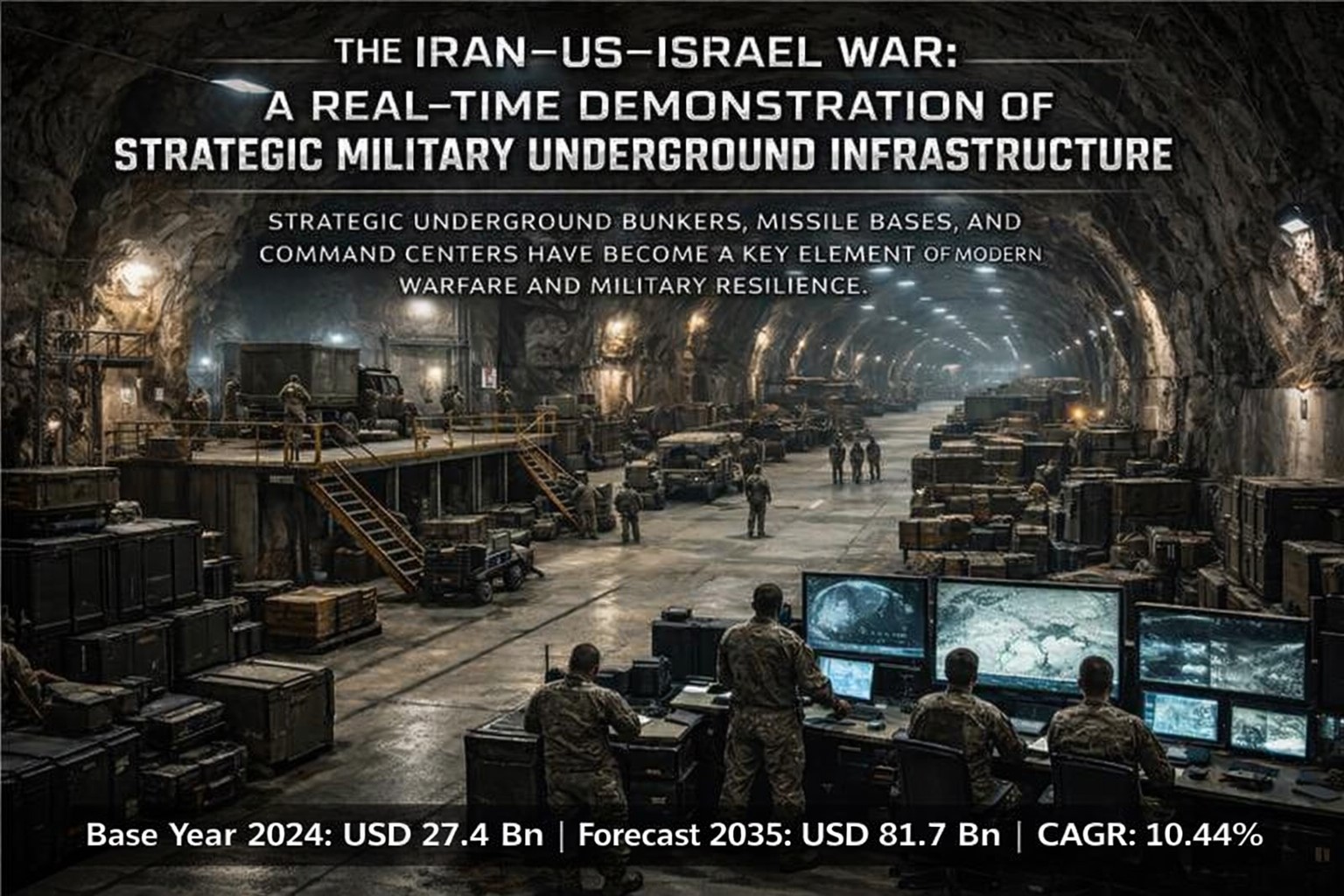
The ongoing Iran-US-Israel war has drawn the significant global attention to the strategic role of the underground military infrastructure in the modern warfare. This dynamic is expected to accelerate investment in advanced tunneling technologies, fortified bunker systems, and resilient underground command networks, thereby shaping the future trajectory of the global defense and military infrastructure market. The Global Military Underground Infrastructure Market Size is expected to reach at USD 81.7 Billion in 2035. Over the years the Iran has developed an extensive network of the subterranean facilities, often it is referred to as a “missiles cities,” constructed the mountains terrain and fortified tunnel system to store the ballistic missiles, command, and critical defense assets. These underground installations are designed to ensure the operational continuity and safeguard the strategic capabilities from the aerial surveillance and the precision airstrike. The recent military development suggest that the United States and Israel have increasingly directed their operations towards identifying and targeting these concealed facilitates, which is marking a tactical shift from conventional surface-level engagement to the neutralization of hardened underground assists. The use of advanced satellite intelligence, precision guided munition, and bunker penetration weapon systems has highlighted both the defensive advantages and the potential vulnerabilities of such infrastructure.
Navigate Future Markets with Confidence: Insights from Spherical Insights LLP
The insights presented in this blog are derived from comprehensive market research conducted by Spherical Insights LLP, a trusted advisory partner to leading global enterprises. Backed by in-depth data analysis, expert forecasting, and industry-specific intelligence, our reports empower decision-makers to identify strategic growth opportunities in fast-evolving sectors. Clients seeking detailed market segmentation, competitive landscapes, regional outlooks, and future investment trends will find immense value in the full report. By leveraging our research, businesses can make informed decisions, gain a competitive edge, and stay ahead in the transition toward sustainable and profitable solutions.
Unlock exclusive market insights-Download the Brochure now and dive deeper into the future of Military Underground Infrastructure Market
Recent Statistics and Global Market Growth
The global market for the military underground infrastructure are poised to be shaped in the coming years by intensifying geopolitical tensions and the increasing strategic emphasis on the resilient defense architecture. The government across the major economics are steadily expanding the investments in the fortified underground bunkers, missile storage complexes, and the subterranean command and the facilities to safeguard the critical military assets from the precision strikes, surveillance technologies and the emerging asymmetric threats. There is conflict between the United States and Iran, also the strategic rivalry between Russia and Europe and the regional strain between India and Pakistan are now reinforcing the strategic value of concealed and hardened military installation.
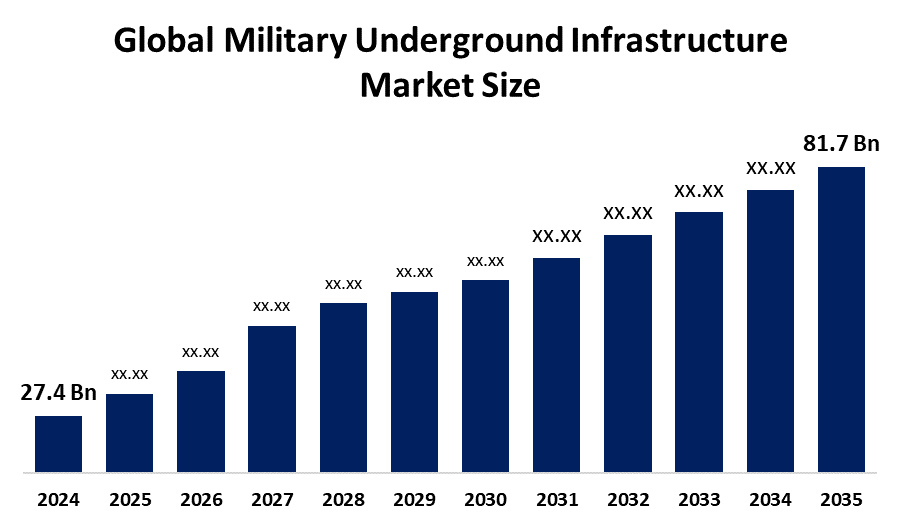
- The Global Military Underground Infrastructure Market Size is projected to Grow USD 27.4 Billion in 2024.
- The Military Underground Infrastructure Market Size is expected to reach at USD 81.7 Billion in 2035.
- The Military Underground Infrastructure Market is expected to grow at a CAGR of 10.44% during the forecast period 2025–2035.
- North America is anticipated to generate the highest demand during the forecast period in the Military Underground Infrastructure.
- Asia-Pacific is predicted to grow the fastest during the forecast period in the Military Underground Infrastructure.
How is the growing importance of underground military infrastructure reshaping Iran–US–Israel defense strategies?
The underground military infrastructure is becoming a central element in the evolving defense strategies of Iran, United States, and Israel as the modern conflicts increasingly prioritize the protection and targeting of the hardened strategic assets. The Iran–US–Israel conflict underscores the future of subterranean warfare, as 230+ munitions targeted underground facilities, accelerating global investment in fortified tunnels, AI-enabled command centers, and resilient infrastructure. The United Stated and Israel have expanded the investment investments in advanced reconnaissance systems, satellite surveillance, and the bunker penetrating munition to locate and neutralize concealed facilities. Iran has constructed extensive subterranean tunnel networks and the fortified missiles bases capable of storing hundreds of ballistic missiles and sustaining launch operations even during the aerial bombardment, thereby it is strengthening its strategic deterrence. Iran built dozens of underground missile bases over decades to protect an arsenal estimated at 2,500–3,000 missiles, but during conflict with Israel and the United States, airstrikes and drones targeted launchers and bombed entrances, trapping weapons underground.
Operational Continuity and Strategic Deterrence: Leveraging Underground Military Facilities in High-Intensity Conflicts
In the ongoing Iran-US-Israel conflict, military underground infrastructure has emerged as a critical enabler of strategic resilience and the operational continuity. The Iran has invested heavily in the extensive subterranean facilities, including fortified missile storage bunkers, production complexes, also designed to shield the ballistic missile arsenal. These underground network allows Iran to launch the missiles while maintaining command operations in a protected environment thereby reinforcing strategic deterrence. This conflict underscores the dual significance of underground infrastructure as both a shield for critical assets and a potential, shaping contemporary military doctrines and defense investment strategies across the region.
For instance, North Korea has developed tunnels up to 100 m deep, capable of transporting an estimated 8,000 troops per hour with heavy vehicles, raising strategic concerns along the DMZ. These tunnels and bunkers are designed to enable a massive surprise attack. Troops and vehicles could be moved undetected below the DMZ or emerge from concealed bunkers, bypassing the front line defenses.
Unlock exclusive market insights-Download the Brochure now and dive deeper into the future of Military Underground Infrastructure Market
Competitive Analysis: Military Underground Infrastructure
• US
The United States built some of the most well-known hardened underground military facilities during the Cold War and beyond, primarily focused on command, control, continuity of government, and strategic communication rather than the weapon storage in tunnels. The Cheyenne Mountain Complex, a NORAD and aerospace defense hub designed to survive nuclear attack, and the Raven Rock Mountain Complex which is an underground pentagon for continuity of government and secure communications. The Us also possesses the GBU-57/B Massive Ordnance Penetrator, which is capable of penetrating up to 60m of earth or the concrete, and employs the long range platforms like B-2 Spirit bombers to degrade enemy hardened sites emphasizing the strategic defensive and operational roles over tactical underground deployment.
• Israel
Israel does not maintain deep, nationwide underground missile cities comparable to those attributed to the Iran, instead it has its strategic forces particularly air and missile assets which remains largely above the ground but widely disappeared and is protected by the layered air defense system such as the Iron Dome and Arrow Missile Defense System. The Israel Defense Forces has accumulated the significant operational experience through counter –in surgery campaigns against Hamas tunnel system in Gaza commonly termed as the GAZA Metro, which Israeli and US military assessment estimate to span roughly 350 to 450 miles with approximately 5700 access shafts across the enclave. Some of the individual tunnels uncovered by the Israeli forces extend over 7Km in length around 25 m in depth.
• Iran
Iran has invested for decades in extensive underground military infrastructure designed to safeguard strategic assets including the ballistic missiles, drone fleets, and the sensitive nuclear installations. Many of these facilities are constructed deep within the mountains or hardened rock formations with some tunnel reportedly reaching the depth of up to 500m according to the Iranian commentary. This networks are described as the missile cities consist of the interconnected tunnels with the storage depot, launch ramps, and segmented cavern complexes spread across multiple provinces such as the Kermanshah, Alborz, and Bushehr. Their primary objective is to enhance the survivability against the airstrike while sustaining strategic deterrence by protecting missile forces and nuclear facilities including the Natanz and Fordow. In 2026, joint U.S.–Israeli operations targeted tunnel entrances, surface infrastructure, and missile-launcher emergence points, constraining Iran’s ability to rapidly deploy stored systems.
Strategic Trends Shaping the Future of the Military Underground Infrastructure Market
The military underground infrastructure market is set to witness the robust growth over the coming decade which is driven by the escalating the geopolitical tension and rising the defense modernization budgets. This infrastructure is also evolving to serve not only as storage and protective shelters but as the secure command hubs and missile launch nodes, ensuring operational continuity and the strategic deterrence during high intensity conflicts. The conflicts have elevated subterranean warfare as central to defense, with NATO highlighting to 1,250 delegates from over 50 nations that underground facilities safeguard personnel and assets efficiently, driving a global shift toward resilient, cost-effective military infrastructure. There is a strong adoption of Ai enabled monitoring, robotics, and automated maintenance system will enhance the efficiency, reduce the human risk and allow the real time management of the underground networks.
Unlock exclusive market insights-Download the Brochure now and dive deeper into the future of Military Underground Infrastructure Market
Recent Developments according to global analysis:
In March 2026, India advanced its military capabilities by developing a bunker-buster variant of the Agni-5 missile, capable of hypersonic speeds (Mach 8–20) to target hardened subterranean command centers and missile silos, highlighting the strategic value of underground infrastructure.
In March 2026, Iran leveraged its mountainous terrain, including the Zagros and Alborz ranges, to develop underground “missile cities” with hidden entrances and deep-rock storage, ensuring survivability of ballistic missiles and strategic assets against aerial attacks.
In February 2026, the IRGC unveiled underwater missile tunnels near the Strait of Hormuz, reportedly housing cruise missiles with ranges over 1,000 km, enhancing Iran’s ability to threaten naval forces and secure strategic control of regional waterways.
In October 2023, Israel intensified operations against the “Gaza Metro,” Hamas’s extensive tunnel network, while also targeting subterranean infrastructure linked to Hezbollah in southern Lebanon, aiming to disrupt troop movements, weapons storage, and cross-border attack capabilities.
In August 2023, satellite imagery showed China building reinforced bunkers and at least three underground facilities within ~15 sq km of Aksai Chin, roughly 70 km from the Line of Actual Control, to protect troops and assets from potential strikes. These hardened structure are intended to protect troops, equipment, and the logistics assets from potential air or missile strikes.
Top 10 Companies Major the Military Underground Infrastructure Market
- AECOM
- KBR
- Fluor Corporation
- Lockheed Martin
- Northrop Grumman
- Parsons
- General Dynamics
- Jacobs Engineering
- Huntington Ingalls
- Bechtel
1. AECOM
The company’s headquarters are located in Dallas, Texas, United States at 13355 Noel Rd #400, Dallas, TX 75240. The company was founded in 1990 about 36 years ago, the revenue generated by the company in 2025 was about USD 16.1 Billion. The AECOM is a global infrastructure and the engineering firm serving clients in more than the 150 countries. AECOM secured three U.S. Army Corps of Engineers contracts worth over $400 million, focusing on infrastructure modernization across the Pacific region, enhancing military and strategic facilities with advanced engineering solutions.
2. KBR
The KBR headquarters are located in 601 Jefferson Street, Houston, Texas 77002, United States. The company is a Houston based American engineering, procurement and construction company which is providing, science, technology and the engineering solutions globally especially in defense, intelligence, and the infrastructure. It supports governments, militaries, and commercial clients with the system engineering. In February 2026, KBR’s Mission Technology Solutions announced expansion of digital engineering capabilities for the U.S. military to modernize defense systems and simulations. KBR also maintains substantial defense and government service contract, including the test infrastructure and the resilience training agreements.
3. Flour Corporation
The Flour Corporation is a major American engineering, procurement, and construction (EPC) company which is headquartered in Irving, Texas, United States. The company has generated the revenue of USD 15.5 Billion in 2025. The company is providing global services in infrastructure, industrial, energy and government sector with about 23000 employees working with it. In September 2025, Fluor was awarded a position on the U.S. Defense Threat Reduction Agency’s CTRIC IV contract, enabling access to task orders worth up to $3.5 billion over 10 years for CBRN threat reduction services. Flour operates in more than 100 countries, delivering the project in oil gas, chemical, mining’s, infrastructure, its government and defense division provides secure facility construction, mission-critical infrastructure, and consulting for military operations.
4. Lockheed Martin
Lockheed Martin is a leading American aerospace, defense, security, and technology company which has its headquarter in Bethesda, Maryland, United States, the company was founded in 1995 through the merger of Lockheed Corporation and Martin Marietta and now operates with about 1,21,000 employees and also provides 350+ facilities. The company generates most of its revenue from U.S. federal defense contracts and specializes in advanced military systems including fighters (e.g., F-35), missiles, space technologies, and integrated defense solutions, with a robust backlog and long-term programs. In December 2025, Lockheed Martin secured a Tracking Layer space contract from the U.S. Space Development Agency worth over $1 billion to build 18 missile-tracking satellites for advanced space-based defense.
5. Northrop Grumman
Northrop Grumman is a major American aerospace and the defense technology company headquartered in West Falls Church, Virginia, United States. The company has generated the revenue of USD 41.9 Billion in the year 2025. It designs and manufactures the advanced military systems in aeronautics, defense, mission systems, and the space, with approximately 95,000 employees and global operations. The company expanded production of its Integrated Battle Command System (IBCS) amid growing international demand, with over 20 countries expressing interest, boosting its global defense footprint. Northrop Grumman is known for producing strategic bombers like the B-21 Raider, airborne radar and sensor systems, missile defense technologies, unmanned vehicles, and space systems, serving the U.S. government and allies worldwide.
Unlock exclusive market insights-Download the Brochure now and dive deeper into the future of Military Underground Infrastructure Market
Conclusion:
The ongoing confrontation involving Iran, Israel and the United States underscores how underground military infrastructure is becoming a defining feature of modern warfare. Increasing global conflicts and the need to protect critical military assets are significantly accelerating investments in underground military infrastructure worldwide. As precision airstrikes, satellite surveillance, and advanced bunker-penetrating weapons evolve, nations are simultaneously investing in deeper, more resilient subterranean facilities to protect strategic assets and maintain the operational continuity. For the global defense industry, this dynamic is accelerating demand for advanced tunneling technologies, fortified bunkers, and AI-enabled monitoring systems. Consequently, underground military infrastructure is poised to remain a critical pillar of defense modernization and strategic deterrence in an increasingly volatile geopolitical landscape.
About the Spherical Insights & Consulting
Spherical Insights & Consulting is a market research and consulting firm which provides actionable market research study, quantitative forecasting and trends analysis provides forward-looking insight especially designed for decision makers and aids ROI.
Which is catering to different industry such as financial sectors, industrial sectors, government organizations, universities, non-profits and corporations. The company's mission is to work with businesses to achieve business objectives and maintain strategic improvements.
CONTACT US:
For More Information on Your Target Market, Please Contact Us Below:
Phone: +1 303 800 4326 (the U.S.)
Phone: +91 90289 24100 (APAC)
Email: inquiry@sphericalinsights.com, sales@sphericalinsights.com
Contact Us: https://www.sphericalinsights.com/contact-us
Need help to buy this report?