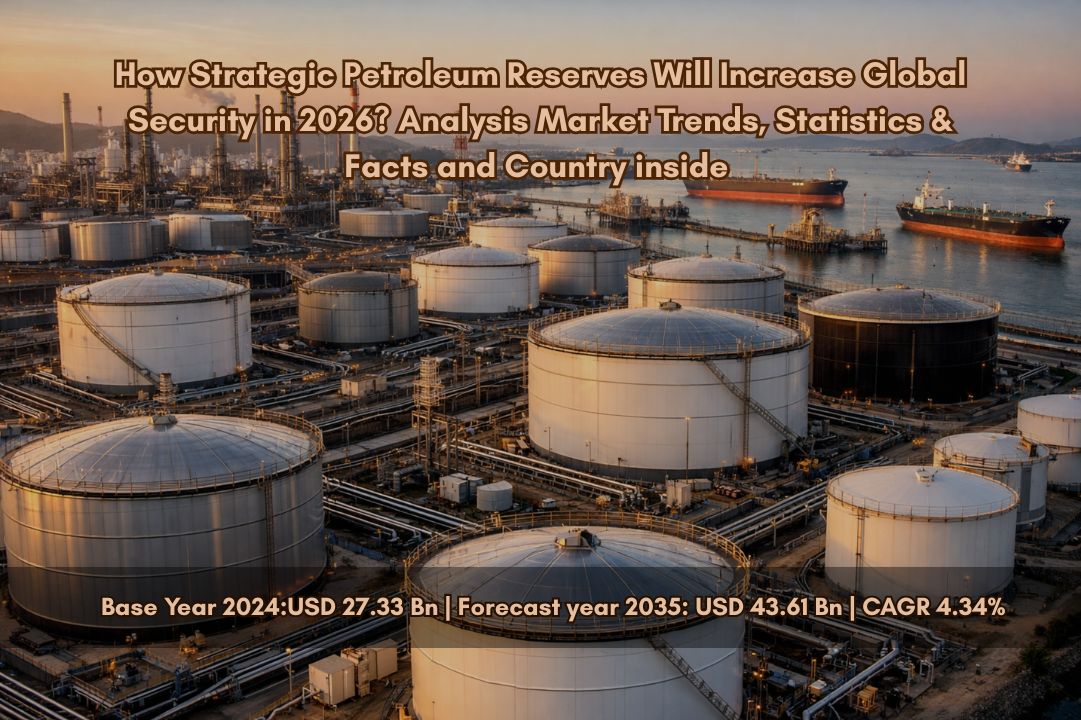
How Strategic Petroleum Reserves Will Increase Global Security in 2026? Analysis Market Trends, Statistics & Facts and Country inside
RELEASE DATE: Mar 2026 Author: Spherical InsightsRequest Free Sample Speak to Analyst
Introduction
Strategic Petroleum Reserves are becoming a key component of global energy security in 2026, giving countries a crucial safety net against supply interruptions and geopolitical shocks. The ongoing dispute between Iran and Israel highlights how vulnerable Middle Eastern oil shipments are, which raises questions about price volatility and instability in the region. While nations with low capacity, like India, are still susceptible to unexpected shortages, countries with strong reserves, like South Korea, Japan, and the United States, are better positioned to stabilise markets and reassure customers. In a world where oil is still essential despite the accelerated energy shift, nations may promote collective security, increase resilience against energy crises, and reduce the risks of conflict-driven supply disruptions by developing and coordinating an SPR strategy.
Navigate Future Markets with Confidence: Insights from Spherical Insights LLP
The insights presented in this blog are derived from comprehensive market research conducted by Spherical Insights LLP, a trusted advisory partner to leading global enterprises. Backed by in-depth data analysis, expert forecasting, and industry-specific intelligence, our reports empower decision-makers to identify strategic growth opportunities in fast-evolving sectors. Clients seeking detailed market segmentation, competitive landscapes, regional outlooks, and future investment trends will find immense value in the full report. By leveraging our research, businesses can make informed decisions, gain a competitive edge, and stay ahead in the transition toward sustainable and profitable solutions.
Unlock exclusive market insights-Download the Brochure now and dive deeper into the future of the Global Oil Storage Market
What is meant by Strategic Petroleum Reserves (SPRs)?
Strategic Petroleum Reserves (SPRs) are emergency crude oil stocks under government control that were established to safeguard international stability and shield countries against energy crises. By supplying a backup supply, averting fuel shortages, and reducing price volatility, they act as a vital defence during conflicts, supply outages, or natural catastrophes. Additionally, SPRs increase economic resilience and provide nations with clout in international energy diplomacy. Coordinated releases of over 300 million barrels by the G7 and the International Energy Agency in 2026 have highlighted their significance in mitigating supply shocks associated with geopolitical tensions and OPEC+ production limits. Even if the use of renewable energy is growing, oil is still necessary for transportation and petrochemicals, which makes SPRs crucial for ensuring global energy security in today's unstable environment.
Industry insights
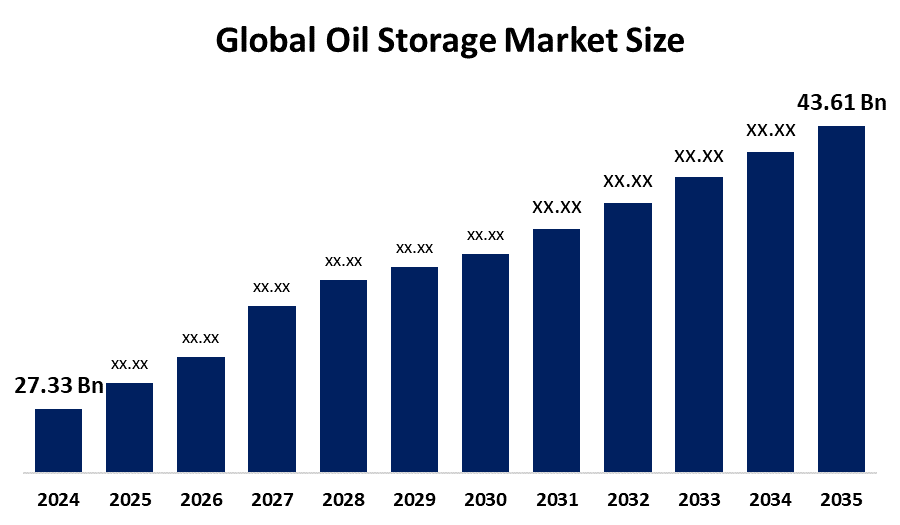
- The Global Oil Storage Market Size was valued at USD 27.33 Billion in 2024.
- The Market is Growing at a CAGR of 4.34% from 2024 to 2035.
- The Worldwide Oil Storage Market Size is expected to reach USD 43.61 Billion by 2035.
- Asia Pacific is expected to grow with the highest market share during the forecast period.
- North America is expected to grow the fastest CAGR during the forecast period.
Key Market statistics that upscale the energy and power industry
- Global crude oil output fell by 0.77 mb/d (1.0%), marking the first decline after three years of growth, averaging 72.58 mb/d.
- OPEC and DoC nations saw sharp drops—0.57 mb/d (2.1%) and 0.78 mb/d (5.2%)—while non-DoC producers grew output by 0.58 mb/d (1.8%).
- Global oil consumption rose by 1.49 mb/d (1.5%), reaching 103.84 mb/d, led by non-OECD Asia, especially China and India.
- Refining capacity expanded by 1.04 mb/d, with growth in Asia and the Middle East offsetting closures in OECD Europe and Asia Pacific.
- Saudi Arabia dominated OPEC earnings, securing about $179 billion, nearly one-third of the group’s crude export revenues.
- Crude prices have risen above $115 a barrel due to shipping interruptions and Middle East conflicts, highlighting the vulnerability of supply systems.
- Stricter carbon rules in the EU and the US are also driving up investments in renewable energy, with solar and wind power growing by 15% and 9% annually, respectively, to provide 32% of the world's electricity.
- Petrochemicals account for more than half of the incremental rise in oil consumption, which is still high at 103 million barrels per day on average.
Outlook for Strategic Petroleum Reserves between the current conflict participants' countries
Strategic Petroleum Reserves are becoming a key component of global energy security in 2026, giving countries a crucial safety net against supply interruptions and geopolitical shocks. The ongoing dispute between Iran and Israel highlights how vulnerable Middle Eastern oil shipments are, which raises questions about price volatility and instability in the region.
USA
The U.S. Strategic Petroleum Reserve (SPR) is still the world's greatest emergency oil reserve in 2026. With four Gulf Coast locations, the current inventory is 411 million barrels, or roughly 58% of its allowed 714 million barrel capacity. The SPR, which is valued at around $27 billion at about $65 per barrel, offers approximately 100 days of import coverage to ensure resilience against natural catastrophes, conflicts, and supply shocks. The government promised to replenish reserves following significant drawdowns in 2022–2023 to lower petroleum prices, and President Trump promised in 2025 to "fill it back to the top." The Iran-Israel crisis, which drove Brent crude to $119 per barrel before coordinated G7/IEA releases stabilised prices near $100, highlights the significance of the SPR in U.S. energy.
Iseral
Israel's energy profile for 2026 emphasises how vulnerable it is because of its small oil supplies and lack of an official Strategic Petroleum Reserve (SPR). Only 12.7 million barrels of proven reserves remain, and daily output of roughly 23,674 barrels falls well short of 219,757 barrels/day of consumption, resulting in a deficit of almost 196,000 barrels. More than 120% of demand is met by imports, highlighting reliance on outside supply. Israel uses commercial storage and strategic alliances to control risks in the absence of a large-scale SPR. Concerns over supply security have grown as a result of the ongoing Iran-Israel conflict, especially in light of possible interruptions to Middle Eastern shipping lines. In order to ensure resilience against future crises, this circumstance highlights Israel's need for increased international collaboration and energy source diversity.
Iran
Iran has substantial crude oil reserves and has been building infrastructure for storage that works similarly to a Strategic Petroleum Reserve (SPR) to support both internal energy security and exports. With an estimated 157 billion barrels of oil reserves, the nation is one of the top producers in the world. In order to improve supply flexibility and export logistics, Iran recently increased the amount of oil storage capacity at its Kharg Island export terminal by 2 million barrels in 2025. There are also plans to raise capacity by roughly 18 million barrels. Furthermore, Iran has been strategically accumulating throughout sanctions and geopolitical tensions by deploying floating storage on tankers, which reached approximately 166–170 million barrels in early 2026. Iran maintains its oil supply due to these reserves and storage facilities.
Unlock exclusive market insights-Download the Brochure now and dive deeper into the future of the Global Oil Storage Market
Major countries in the Strategic Petroleum Reserves pipeline network
India
India's Strategic Petroleum Reserve (SPR), which is built with subterranean rock caverns that decrease evaporation and cut costs, is an essential defence against supply disruptions. Its economic benefit was shown by the government saving around Rs 5000 crore from the initial filling in 2020 at 19 dollars per barrel. Engineers India Limited is in charge of maintenance, with Rs 408 crore allotted for FY 2024 to 2025 to guarantee operational dependability. Although development plans seek to increase this to 67 million barrels by 2027, current capacity is approximately 39 million barrels, which covers about 10 days of net imports. Even for leased oil like ADNOC's, security is given top attention through government priority access and underground storage. India's SPR is still essential for resilience in the unstable energy environment of 2026, but its small scale emphasises the need for growth.
United Kingdom
The United Kingdom's strategy for Strategic Petroleum Reserves (SPR) in 2026 is different from that of countries with substantial government controlled stockpiles because it mainly depends on commercial infrastructure to fulfil its International Energy Agency (IEA) requirement to maintain reserves equivalent to 90 days of net imports. Facilities are kept up to EU standards, guaranteeing efficiency and cost effectiveness, and oil is cycled on a regular basis to prevent deterioration. There are currently 300 million barrels of emergency supplies in the UK, dispersed between refineries and commercial storage facilities. Underground storage offers intrinsic safety, and private companies are in charge of security under government supervision. The UK's reliance on commercial reserves emphasises both its flexibility and susceptibility in the face of persistent geopolitical tensions and unpredictable oil prices, underscoring the significance of coordinated IEA releases for market stability.
China
China's need for energy security in the face of unstable international markets is reflected in its Strategic Petroleum Reserve (SPR), which is among the fastest growing in the world. With current development projects like Phase III adding 204 million barrels, China's SPR capacity is projected to reach 500 to 600 million barrels by 2026. Oil is rotated to maintain quality in a combination of aboveground tanks and subsurface tunnels. Specific procedures are not publicly known. Strict security measures are in place, with state troops stationed at key locations to prevent outside attacks. Minimal public disclosure of reserve operations is ensured by China's secrecy. China's SPR is essential for stabilising domestic markets, lowering import vulnerability, and bolstering its position in global oil security amid Middle East crises and OPEC Plus supply adjustments.
Germany
Germany's decentralised Strategic Petroleum Reserve (SPR) relies on required stockholding commitments under the International Energy Agency (IEA). Around 250 to 270 million barrels are thought to be in current reserves, which are mostly owned by government regulated oil firms. In accordance with strict EU regulations, stocks are kept in commercial facilities throughout the nation and rotated to avoid deterioration. The Federal Ministry for Economic Affairs and Energy is in charge of security, and private operators make sure the facility is safe. Germany participated in the coordinated G7 and IEA release of 300 million barrels globally in early 2026, which helped stabilise Brent crude prices from 119 dollars to 100 dollars per barrel, highlighting the significance of the SPR for the energy security of all of Europe.
Canada
In 2026, Canada's Strategic Petroleum Reserve (SPR) system is different from centralised versions such as that in the United States. Instead, Canada uses a combination of commercial inventories and government oversight to meet its International Energy Agency (IEA) requirement to hold 90 days of net imports. With proven oil reserves of approximately 4.5 billion barrels and output of 4.6 million barrels per day, Canada is a significant exporter rather than an importer. Because of this, its SPR capacity is relatively small, estimated at 170 to 190 million barrels, focused on the storage of refined products rather than crude. In commercial facilities, maintenance is based on rotation to guarantee oil quality and adherence to EU and IEA regulations. Federal regulators and private operators collaborate to manage security. Canada took part in the coordinated IEA and G7 release of 300 million barrels globally.
Unlock exclusive market insights-Download the Brochure now and dive deeper into the future of the Global Oil Storage Market
Alliance for current industry expansion
In March 2026, the United Kingdom confirmed that Britain is ready to support a coordinated release of global oil reserves following the Iranian war, warning that the conflict could drive inflation higher. The UK also backed potential emergency stockpile releases coordinated by the International Energy Agency (IEA) if required.
In October 2025, China accelerated its Strategic Petroleum Reserve (SPR) expansion with 11 new sites planned between 2025 and 2026, adding about 169 million barrels of capacity, equal to roughly two weeks of crude imports. These facilities were strategically located inland in Shaanxi and Yunnan provinces, as well as along the east and south coasts near refineries and ports.
In September 2025, India launched a major expansion under SPR Phase II, including the country's first private sector strategic oil reserve project at Padur, Karnataka, built by Megha Engineering and Infrastructures Ltd with an investment of about Rs 5700 crore or 687 million dollars. This expansion under SPR Phase II enhances India's energy security, supplementing existing reserves of about 39 million barrels. While MEIL manages operations, the government retains priority access during emergencies, ensuring national control.
Unlock exclusive market insights-Download the Brochure now and dive deeper into the future of the Global Oil Storage Market
Final Sum up
Strategic petroleum reserves (SPRs), which provide as a buffer against supply shocks and geopolitical crises, have emerged as a key component of global energy security. Before coordinated G7/IEA releases steadied markets, the Iran-Israel crisis highlighted weaknesses in Middle Eastern oil shipments, propelling prices above $115 per barrel. While countries with smaller reserves, like Israel and India, are still vulnerable, those with larger reserves, like the United States, China, Japan, and South Korea, are better able to handle volatility. China's eleven additional sites, India's Padur initiative, and the UK's willingness to enable coordinated releases are examples of recent expansions. All things considered, in a time of ongoing reliance on energy, SPRs improve resilience, stabilise markets, and fortify collective security.
About the Spherical Insights & Consulting
Spherical Insights & Consulting is a market research and consulting firm which provides actionable market research study, quantitative forecasting and trends analysis provides forward-looking insight especially designed for decision makers and aids ROI.
Which is catering to different industry such as financial sectors, industrial sectors, government organizations, universities, non-profits and corporations. The company's mission is to work with businesses to achieve business objectives and maintain strategic improvements.
CONTACT US:
For More Information on Your Target Market, Please Contact Us Below:
Phone: +1 303 800 4326 (the U.S.)
Phone: +91 90289 24100 (APAC)
Email: inquiry@sphericalinsights.com, sales@sphericalinsights.com
Contact Us: https://www.sphericalinsights.com/contact-us
Need help to buy this report?