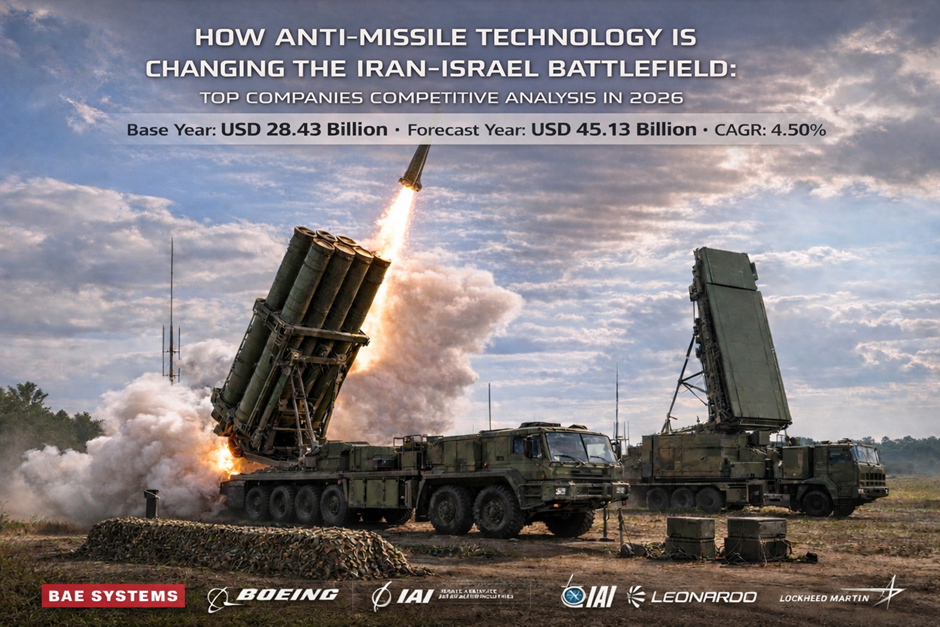
How Anti-Missile Technology is Changing the Iran–Israel Battlefield: Top Companies Competitive Analysis in 2026 - Published Report by Spherical Insights & Consulting
RELEASE DATE: Mar 2026 Author: Spherical InsightsRequest Free Sample Speak to Analyst
Introduction
This escalated situation has brought attention to how crucial cutting-edge military technologies and anti-missile systems are. Cities, military installations, and essential infrastructure are protected from ballistic missiles and drone strikes by modern missile defence systems such as multi-layer interception networks, radar monitoring, and space-based surveillance. Currently, systems are expanded and demonstrate how missile defence is now a strategic requirement that decides survival and deterrence in today's conflicts. Iran and Israel are growing in influence in the Middle East market, with high notice of their nuclear aspirations, and their employment of proxy groups equipped with drones and missiles.
Navigate Future Markets with Confidence: Insights from Spherical Insights LLP
The insights presented in this blog are derived from comprehensive market research conducted by Spherical Insights LLP, a trusted advisory partner to leading global enterprises. Backed by in-depth data analysis, expert forecasting, and industry-specific intelligence, our reports empower decision-makers to identify strategic growth opportunities in fast-evolving sectors. Clients seeking detailed market segmentation, competitive landscapes, regional outlooks, and future investment trends will find immense value in the full report. By leveraging our research, businesses can make informed decisions, gain a competitive edge, and stay ahead in the transition toward sustainable and profitable solutions.
Unlock exclusive market insights-Download the Brochure now and dive deeper into the future of Drone Market
How this system uphold high importance in the current scenario at Middle East territory?
Defence technologies known as anti-missile systems are made to identify, follow, and stop incoming missiles before they can hit their objectives. They offer multilayer defence against ballistic and short-range threats through the use of kinetic interceptors, satellite guidance, and radar tracking. These demonstrations are important in the Iran-US-Israel conflict: Iran builds its own systems, Israel uses Iron Dome and Arrow, and the US displays THAAD and Patriot. They are crucial for maintaining the balance of power in the area, protecting civilians, and deterring. These displays are more than just technical drills; they reassure allies, strengthen deterrence, and show adversaries that you are prepared. In order to maintain a balance of power and assert its sovereignty, Iran must develop its own missile and defence capabilities.
Industry market statistics for Anti-Missile System & Technology
The market for missiles and missile defence systems is expanding significantly worldwide as a result of rising defence spending and geopolitical tensions. Moreover, to improve capabilities and satisfy the demands of contemporary warfare, key parties are investing in cutting-edge technologies like hypersonic and precision-guided missiles. The requirement for strong missile defence systems to combat a variety of threats, such as ballistic and cruise missiles, is another factor driving the market.
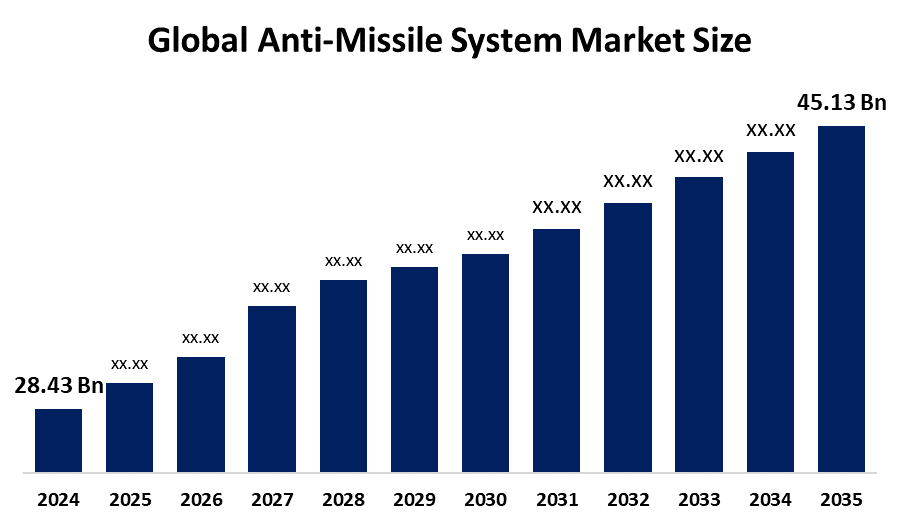
- The Global Anti-Missile System Market Size was valued at USD 28.43 Billion in 2024.
- The Market is Growing at a CAGR of 4.50% from 2024 to 2035
- The Worldwide Anti-Missile System Market Size is expected to reach USD 45.13 Billion by 2035
- Asia Pacific is expected to grow the fastest during the forecast period.
- North America is anticipated to grow at the highest market share during the forecast period
Compatible Score in Anti-Missile Strength Between the Current Conflict Countries
USA
In recent conflicts, American anti-missile technology, such as Patriot PAC-3, THAAD, and Aegis systems, has been crucial. Integrated U.S., Israeli, and Gulf defences stopped waves of missiles and drones during the 2026 conflict with Iran, averting catastrophic destruction and proving the value of layered defence. In a similar vein, NATO resistance to Russian strikes was bolstered by U.S. assistance in Ukraine. By lowering opponents' confidence in successful assaults, these technologies not only strengthen deterrence but also safeguard vital infrastructure and populations. However, the extensive employment of interceptors has put a strain on stockpiles, highlighting the necessity of ongoing modernisation and investment. All things considered, alliance credibility and the global security architecture continue to depend heavily on U.S. missile defence.
Unlock exclusive market insights-Download the Brochure now and dive deeper into the future of Drone Market
Israel
Israel's anti-missile technology, which combines Iron Dome, David's Sling, Arrow, and the upcoming Iron Beam laser system, has proved crucial to its survival in recent battles. Thousands of short-range rockets from Hezbollah and Hamas were intercepted by Iron Dome, and longer-range missiles, including those from Iran, were stopped by Arrow and David's Sling. Iron Beam may have been tested against Hezbollah missiles in 2026, according to reports, which would have been a breakthrough in affordable laser defence. Israel's deterrence stance was strengthened by this multi-layered shield, which protected vital infrastructure and avoided mass deaths. Israel has built one of the most sophisticated missile defence networks in the world by fusing conventional interceptors with state-of-the-art lasers, guaranteeing resilience against changing threats and serving as a blueprint for future international defence tactics.
Iran
Iran's anti-missile technology has been used defensively in recent battles, although being less sophisticated than its offensive arsenal. During the conflict with the United States and Israel in 2026, systems such as Bavar-373 and Khordad-15 were used to protect important locations, with the addition of Russian and Chinese HQ-16 batteries. Iran's military strategy, however, places more emphasis on offence than interception, using drones and mass missile strikes to overwhelm enemy defences. Iran was able to threaten Middle Eastern bases, ports, and oil infrastructure by using this anti-access/area denial tactic. Although some retaliation strikes were stopped by its defences, their efficacy was restricted. Iran's power ultimately comes from its offensive missile-centric strategy, which is bolstered by foreign technology and continues to upset the balance of regional security.
Top Companies that extended industrial growth opportunities
- BAE Systems
- Boeing Defense
- Israel Aerospace Industries (IAI)
- Leonardo
- Lockheed Martin
- MBDA
- Northrop Grumman
- Rafael Advanced Defence Systems
- Raytheon (RTX Corporation)
- Saab AB
1. Leonardo (Italy)
Europe's missile defence capabilities have been drastically improved by Leonardo, Italy's top defence corporation. The Spada 2000 and Skyguard systems, which offer medium-range defence against drones, planes, and precision-guided threats, are among its most recent releases. Additionally, Leonardo contributes technology to the Aster and CAMM missile families, which serve as the foundation of NATO's integrated air defence, as part of the multinational MBDA consortium. In addition to missiles, Leonardo is an expert in cutting-edge radar systems that guarantee efficient aerial threat identification and tracking. NATO's multi-layered defence policy has been strengthened by recent contracts that have increased its delivery to Italy, Poland, and other European partners. Leonardo increases Europe's ability to withstand changing drone and missile threats by fusing radar integration with missile interceptors.
2. Lockheed Martin (USA)
In 2026, Lockheed Martin will lead the United States' missile defence buildup. In order to satisfy growing worldwide demand, Lockheed Martin is increasing PAC-3 MSE output and quadrupling THAAD interceptor production under new Pentagon contracts. These systems, which intercept tactical and ballistic missiles at different ranges, are the foundation of the U.S. layered defence. Due to its involvement in improved radar integration and next-generation deterrence, Northrop Grumman has revealed a record $91 billion backlog. To supplement Lockheed's interceptors, the business is making significant investments in missile defence sensors and command systems. Together, they offer the United States and its allies complete defence against changing aerial threats, highlighting their strategic significance in contemporary defence.
Unlock exclusive market insights-Download the Brochure now and dive deeper into the future of Drone Market
3. Rafael Advanced Defence Systems (Israel)
Rafael Advanced Defence Systems, Israel's top defence corporation, has increased its budget with record revenues reaching $4 billion. Iron Dome, which offers short-range defence against rockets and drones, and David's Sling, which is intended to intercept medium-to-long range cruise and ballistic missiles, are among its current launches. Additionally, Rafael manufactures the mobile short-to-medium range defensive platform known as SPYDER, which was just shipped to Kenya. These systems combine quick detection, tracking, and interception capabilities to create a multi-layered defence network. Rafael continues to solidify its position as a world leader in missile defence, guaranteeing efficient defence against changing aerial and missile threats, with expanding contracts across Europe, Asia, and NATO allies.
4. Saab (Sweden)
Saab's strategy focus on scalable, reasonably priced defences against new threats like drone swarms and loitering bombs is reflected in this breakthrough. Saab continues to field its RBS 70 portable air-defence system and cutting-edge radar technology alongside Nimbrix, strengthening NATO's multi-layered defence architecture. Saab is positioned as a key actor in contemporary missile defence due to its concentration on low-cost, fast-responding interceptors, which are in high demand throughout Europe and beyond. The Nimbrix missile, which was revealed in 2025 and is scheduled for delivery in 2026, is the latest addition to the missile defence portfolio of Saab AB, the leading defence corporation in Sweden. Nimbrix is a lightweight, fire-and-forget counter-drone technology that can intercept unmanned aerial systems up to five kilometres away.
5. BAE Systems (UK)
The top military business in the UK, BAE Systems, began 2026 with record orders totalling £36.8 billion and revenues above £30 billion, indicating a spike in defence spending worldwide. With a focus on radar integration, naval missile defence, and electronic warfare systems, the business plays a significant role in NATO's missile defence architecture. The Pentagon's $25 billion Golden Dome project, which aims to fortify America's missile shield, heavily relies on its U.S. subsidiary. While investments in AI and cyber technologies improve resistance against UAV and missile threats, current launches include naval defence systems and sophisticated radar platforms. BAE establishes itself as a key participant in contemporary missile defence by supplementing interceptors from Lockheed Martin and MBDA to maintain NATO's multi-layered defence.
Recent Alliance with regional expansion for this market growth
North America
In February 2026, Canada launched Canada’s first Defence Industrial Strategy, framing it as a landmark initiative to strengthen national security, create economic prosperity, and reinforce strategic autonomy. The strategy outlined measures to modernise Canada’s defence industry, enhance domestic production capacity, and reduce reliance on foreign suppliers. Officials emphasised that the plan would not only bolster Canada’s military readiness but also generate new opportunities for innovation and job creation across the country.
In October 2024, the United States deployed a THAAD (Terminal High Altitude Area Defence) anti-missile system and about 100 troops to Israel following Iran’s missile attacks. This marked a rare direct U.S. military deployment to Israel outside of joint drills and underscored Washington’s intent to bolster Israel’s defences while deterring further escalation in the Middle East.
Unlock exclusive market insights-Download the Brochure now and dive deeper into the future of Drone Market
Europe
In December 2025, Russia activated its first S-500 air and missile defence regiment, marking a significant step in strengthening its strategic defence capabilities. The deployment underscored Moscow’s intent to modernise its military infrastructure and enhance protection against advanced aerial and missile threats.
In November 2025, the armed forces received a major boost as a new laser weapon successfully took down high-speed drones during trials. The breakthrough demonstrated the system’s ability to neutralise aerial threats with precision, marking a significant advancement in defence technology and strengthening military readiness against evolving drone warfare.
Asia Pacific
In February 2026, the Defence Research and Development Organisation (DRDO) conducted successful flight trials of its Very Short-Range Air Defence System (VSHORADS), demonstrating the weapon’s capability to intercept aerial threats at close range. The trials marked a significant milestone in India’s efforts to strengthen indigenous air defence and enhance battlefield readiness.
In December 2025, China carried out a successful ballistic missile defence test amid related regional developments, reinforcing its strategic deterrence capabilities. The test demonstrated China’s growing investment in advanced missile interception technologies and highlighted Beijing’s intent to strengthen national defence while signalling its readiness to counter evolving security challenges in the Asia-Pacific.
Middle East and Africa
In February 2026, Saudi Arabia embraced new air defence options as part of its broader effort to strengthen national security and counter evolving regional threats. The move reflected Riyadh’s intent to diversify its defence capabilities, enhance protection against missile and drone attacks, and reinforce its strategic partnerships in advanced military technology.
In December 2025, Kenya received the Israeli SPYDER anti-air missile system, marking a significant step in strengthening its national defence capabilities. The delivery underscored Nairobi’s intent to modernise its air defence infrastructure and enhance protection against aerial threats, while also deepening its strategic security ties with Israel.
Unlock exclusive market insights-Download the Brochure now and dive deeper into the future of Drone Market
Just a quick review
The article highlights how the Iran-Israel battlefield is changing due to anti-missile technologies. Modern defences against drones and ballistic missiles, such as THAAD, Iron Dome, and Bavar-373, are essential for survival and deterrence. The anti-missile market is expected to increase at a 4.5% CAGR from its 2024 valuation of USD 28.43 billion to USD 45.13 billion by 2035. Iran develops domestic platforms like Bavar-373 and drones, Israel uses Iron Dome, Arrow, and David's Sling, and the United States leads with layered systems (Patriot, THAAD, and Aegis). Lockheed Martin, Northrop Grumman, MBDA, Leonardo, Rafael, Raytheon, BAE Systems, Boeing, IAI, and Saab are some of the major businesses propelling expansion.
About the Spherical Insights & Consulting
Spherical Insights & Consulting is a market research and consulting firm which provides actionable market research study, quantitative forecasting and trends analysis provides forward-looking insight especially designed for decision makers and aids ROI.
Which is catering to different industry such as financial sectors, industrial sectors, government organizations, universities, non-profits and corporations. The company's mission is to work with businesses to achieve business objectives and maintain strategic improvements.
CONTACT US:
For More Information on Your Target Market, Please Contact Us Below:
Phone: +1 303 800 4326 (the U.S.)
Phone: +91 90289 24100 (APAC)
Email: inquiry@sphericalinsights.com, sales@sphericalinsights.com
Contact Us: https://www.sphericalinsights.com/contact-us
Need help to buy this report?