Global AI Visual Inspection System Market Size, Share, and COVID-19 Impact Analysis, By Component (Hardware, Software, and Services), By Type (Deep Learning Model, Pre-trained Model, and Others), By Industry Vertical (Manufacturing, Semiconductors & Electronics, Healthcare, Retail, and Others), and By Region (North America, Europe, Asia-Pacific, Latin America, Middle East, and Africa), Analysis and Forecast 2025 - 2035
Industry: Information & Technology
Global AI Visual Inspection System Market Size Insights Forecasts to 2035
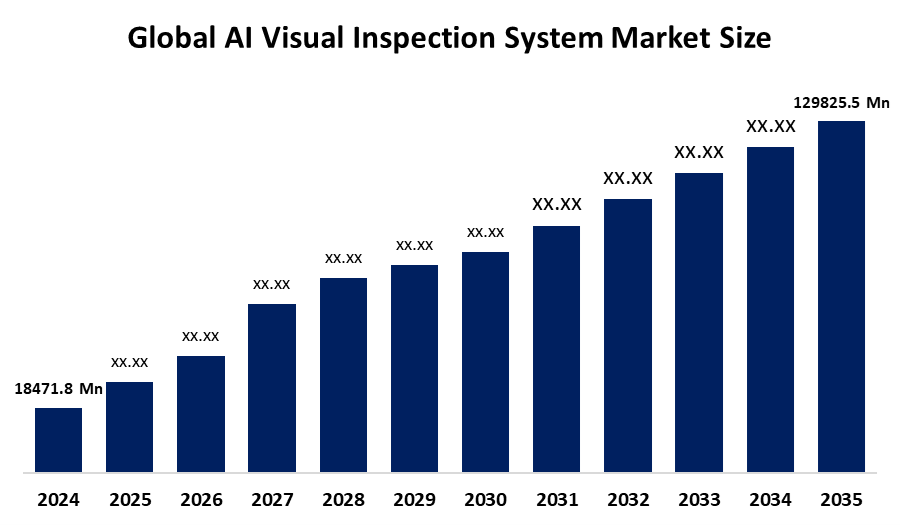
- The Global AI Visual Inspection System Market Size Was Estimated at USD 18471.8 Million in 2024
- The Market Size is Expected to Grow at a CAGR of around 19.4% from 2025 to 2035
- The Worldwide AI Visual Inspection System Market Size is Expected to Reach USD 129825.5 Million by 2035
- Asia Pacific is expected to grow the fastest during the forecast period.
Get more details on this report -
According to a Research Report Published by Spherical Insights and Consulting, The Global AI Visual Inspection System Market Size was worth around USD 18471.8 Million in 2024 and is predicted to grow to around USD 129825.5 Million by 2035 with a compound annual growth rate (CAGR) of 19.4% from 2025 to 2035. The AI visual inspection market is growing because companies need hyper-automation and better quality control methods. The main forces driving this trend are organizations' need to reduce defects and labour costs as they implement Industry 4.0 and employ edge AI for accurate, real-time analysis.
Market Overview
The Global AI Visual Inspection System Market Size utilises artificial intelligence and computer vision technologies, together with high-resolution cameras and sensors, and deep learning algorithms to detect defects, dimensional errors, surface anomalies, and quality-control issues in production processes. The systems are used in manufacturing, semiconductor manufacturing, electronics, automotive, pharmaceutical, healthcare and aerospace sectors to perform real-time defect identification and assembly verification, packaging examination and regulatory compliance testing. The Industry 4.0 movement and zero-defect manufacturing requirements serve as primary forces driving industrial sector adoption of AI technology, while quality control represents the most common AI application in manufacturing, which accounts for 45% of all AI implementations. The technology provides solutions to increasing labor costs and the decreasing number of skilled inspectors because manufacturers buy 71% of machine vision equipment.
The company provides deep learning solutions that enable data training in robotics and edge artificial intelligence, and Internet of Things systems, while expanding their operations in Asia-Pacific and electric vehicle markets, which allows them to achieve 25% better inspection results and 30% less equipment downtime. The Australian government awarded $3.47 million in grants to eight SMEs through its Defence Global Competitiveness program in April 2024. Sentient Vision Systems received $108,000 to enhance its AI reconnaissance and surveillance systems. The project supports domestic defense production capabilities while creating skilled employment opportunities through technical innovation, and Sentient Vision Systems announced that Shield AI will acquire them.
Report Coverage
This research report categorizes the AI visual inspection system market based on various segments and regions, forecasts revenue growth, and analyzes trends in each submarket. The report analyses the key growth drivers, opportunities, and challenges influencing the AI visual inspection system market. Recent market developments and competitive strategies, such as expansion, type launch, development, partnership, merger, and acquisition, have been included to draw the competitive landscape in the market. The report strategically identifies and profiles the key market players and analyses their core competencies in each sub-segment of the AI visual inspection system market.
AI Visual Inspection System Market Report Coverage
| Report Coverage | Details |
|---|---|
| Base Year: | 2024 |
| Market Size in 2024: | USD 18471.8 Million |
| Forecast Period: | 2025-2035 |
| Forecast Period CAGR 2025-2035 : | CAGR of 19.4% |
| 2035 Value Projection: | USD 129825.5 Million |
| Historical Data for: | 2020-2023 |
| No. of Pages: | 220 |
| Tables, Charts & Figures: | 120 |
| Segments covered: | By Component, By Type |
| Companies covered:: | OMRON Corporation, IBM Corporation, SICK AG, Alphabet Inc., ISRA VISION AG, Amazon.com Inc., Siemens AG, Cognex Corporation, Keyence Corporation, Fujitsu Limited, ViTrox Corporation Berhad, NEC Corporation, Ombrulla, Basler AG, Teledyne Technologies Incorporated, and other key players |
| Pitfalls & Challenges: | COVID-19 Empact, Challenge, Future, Growth, & Analysis |
Get more details on this report -
Driving Factors
The worldwide market for AI visual inspection systems experiences rapid growth because manufacturing sectors need both automation and quality assessment solutions. The primary forces driving this trend stem from Industry 4.0 and smart factories becoming more popular while companies seek to achieve defect-free production through advancements in computer vision and deep learning technologies, which enhance inspection accuracy. AI inspection systems enable organizations to decrease their need for manual inspection work by 40% while they achieve their defect detection goals 30% faster, which leads to increased operational efficiency. The market experiences accelerated expansion because the automotive, electronics, semiconductor, and healthcare sectors increasingly adopt the technology.
Restraining Factors
High implementation and integration costs, which include the necessary expenses for cameras and sensors, GPUs and AI software, create barriers to market entry for small and medium enterprises. The integration process for legacy manufacturing systems proves to be both expensive and complicated, while AI talent shortages, data security concerns, and regulatory compliance needs create obstacles that prevent market expansion. About 45% of companies face integration challenges, 62% cite a lack of standardization, and 95% report AI talent shortages, which slow down deployment.
Market Segmentation
The AI visual inspection system market share is classified into component, type, and industry vertical.
- The hardware segment dominated the market in 2024, approximately 47% and is projected to grow at a substantial CAGR during the forecast period.
Based on the component, the AI visual inspection system market is divided into hardware, software, and services. Among these, the hardware segment dominated the market in 2024 and is projected to grow at a substantial CAGR during the forecast period. The hardware segment maintains a major market position in the AI visual inspection system market because it provides essential equipment that enables high-quality image acquisition and processing through cameras, processors and sensors. The automotive industry, electronics industry, and pharmaceutical industry show increased demand for automated quality inspection, which drives market expansion, while imaging technology developments and electronic device downsizing improve inspection results, operational productivity and accuracy.
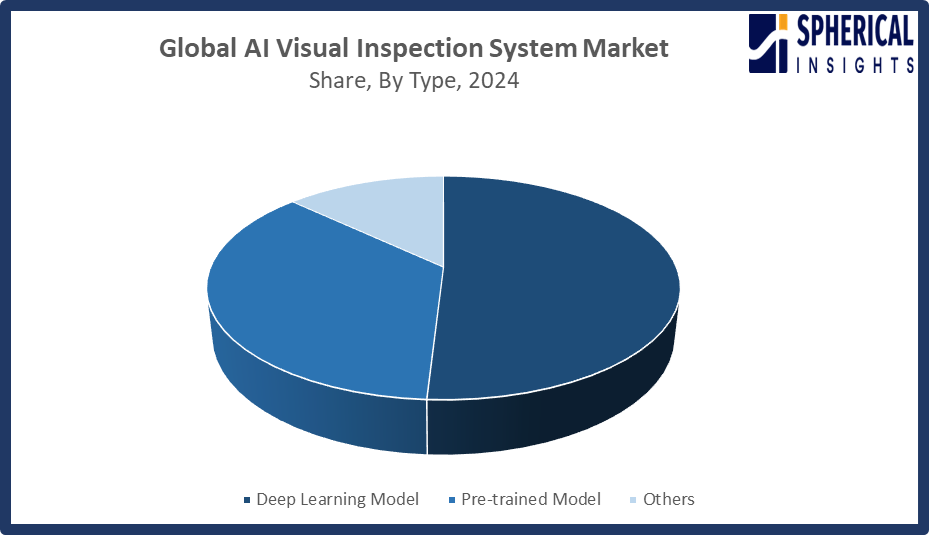
- The deep learning model segment accounted for the largest share in 2024, approximately 51% and is anticipated to grow at a significant CAGR during the forecast period.
Based on the type, the AI visual inspection system market is divided into deep learning model, pre-trained model, and others. Among these, the deep learning model segment accounted for the largest share in 2024 and is anticipated to grow at a significant CAGR during the forecast period. Deep learning leads the market because it can process complicated visual content to identify hidden imperfections with exceptional precision. The models use extensive training data to enhance their performance, which leads to quicker and more accurate examination results. The automotive industry, semiconductor industry, and packaging sector all use deep learning systems to boost their quality control processes while decreasing waste production and increasing their operational effectiveness.
Get more details on this report -
- The manufacturing segment accounted for the highest market revenue in 2024, approximately 43% and is anticipated to grow at a significant CAGR during the forecast period.
Based on the industry vertical, the AI visual inspection system market is divided into manufacturing, semiconductors & electronics, healthcare, retail, and others. Among these, the manufacturing segment accounted for the highest market revenue in 2024 and is anticipated to grow at a significant CAGR during the forecast period. The market shows manufacturing sector dominance because businesses require accurate and efficient quality control solutions. The systems identify defects with greater speed and accuracy than human inspection methods, which helps businesses minimize waste and boost their operational output. The Industry 4.0 framework, combined with automotive and electronics production requirements and operational advantages of decreased equipment downtime and lower rework expenses, drives technology implementation.
Regional Segment Analysis of the AI Visual Inspection System Market
- North America (U.S., Canada, Mexico)
- Europe (Germany, France, U.K., Italy, Spain, Rest of Europe)
- Asia-Pacific (China, Japan, India, Rest of APAC)
- South America (Brazil and the Rest of South America)
- The Middle East and Africa (UAE, South Africa, Rest of MEA)
North America is anticipated to hold the largest share of the AI visual inspection system market over the predicted timeframe.

Get more details on this report -
North America is anticipated to hold the largest share of the AI visual inspection system market over the predicted timeframe. The AI visual inspection system market is dominated by North America with approximately 34% share because advanced manufacturing technologies are widely adopted, AI spending is high and major tech companies operate in the region. The United States dominates the regional market with AI investment exceeding USD 60 billion in 2024. The automotive, semiconductor, and electronics industries drive demand for AI inspection systems through their widespread adoption of Industry 4.0 and smart factory solutions. Canada is also expanding AI adoption through national AI strategies and research funding. The Government of Canada allocated USD 98.6 million to 23 AI projects in July 2025 to support industrial AI implementation. The funding supports AI machine vision solutions, which enhance production efficiency, quality control and real-time inspection functions.
Asia Pacific is expected to grow at a rapid CAGR in the AI visual inspection system market during the forecast period. The AI visual inspection system market in the Asia Pacific is experiencing a 27% share of rapid growth due to expanding industrial automation, electronics manufacturing, and strong government support for AI technologies. China leads with over 30% of global electronics production, increasing demand for automated inspection systems. Japan and South Korea contribute through advanced robotics and semiconductor industries. India’s manufacturing sector, projected to reach USD 1 trillion by 2030, further drives adoption. The Seoul Metropolitan Government allocated KRW 27.1 billion (approximately USD 20 million) in February 2026 to enhance AI monitoring systems, which increased detection accuracy from 36% to 81%. The city is transitioning to context-aware AI functions that assess risk situations by using comprehensive analysis methods that extend beyond basic object detection.
The AI visual inspection system market in Europe continues to expand because of industrial automation and advanced manufacturing capabilities, and supportive AI regulations that enable its development. Germany leads with Industry 4.0 initiatives and a large automotive sector, while France and the United Kingdom are increasing AI investments. The European Union has invested over €1 billion in AI research, and industrial automation adoption has grown by over 15%. The government of Rhineland-Palatinate, Germany assigned €600,000 to Fraunhofer ITWM in January 2024 for Project eQuality, which will create datasets to train AI inspection systems.
Competitive Analysis:
The report offers the appropriate analysis of the key organizations/companies involved within the AI visual inspection system market, along with a comparative evaluation primarily based on their type of offering, business overviews, geographic presence, enterprise strategies, segment market share, and SWOT analysis. The report also provides an elaborative analysis focusing on the current news and developments of the companies, which includes type development, innovations, joint ventures, partnerships, mergers & acquisitions, strategic alliances, and others. This allows for the evaluation of the overall competition within the market.
List of Key Companies
- OMRON Corporation
- IBM Corporation
- SICK AG
- Alphabet Inc.
- ISRA VISION AG
- Amazon.com Inc.
- Siemens AG
- Cognex Corporation
- Keyence Corporation
- Fujitsu Limited
- ViTrox Corporation Berhad
- NEC Corporation
- Ombrulla
- Basler AG
- Teledyne Technologies Incorporated
- Others
Key Target Audience
- Market Players
- Investors
- End-users
- Government Authorities
- Consulting and Research Firm
- Venture capitalists
- Value-Added Resellers (VARs)
Recent Development
- In January 2026, the Ministry of Industry and Information Technology of China and seven government departments launched the AI+ Manufacturing Action Plan. The policy promotes machine vision and unmanned intelligent inspection for quality control, integrating AI into major equipment manufacturing, such as aircraft and ships, to enhance real-time monitoring and predictive maintenance.
- In October 2025, Omron Corporation introduced an update to its FH Vision System with enhanced AI defect detection. The upgrade reduces over-detection by automatically selecting optimal training images, enabling accurate inspection on reflective or textured surfaces. The system ensures 100% reproducible results and requires fewer images, simplifying setup for manufacturers.
- In September 2024, Teledyne DALSA, part of Teledyne Technologies, launched the AI-powered BOA 3 smart camera. Combining advanced sensors and AI inspection technologies, the compact, rugged system delivers flexible, high-performance machine vision solutions for complex industrial automation and inspection applications.
- In June 2024, SICK AG launched the Inspector83x 2D vision sensor, enabling out-of-the-box AI machine vision inspections for high-speed production. The system allows non-specialists to configure inspections using a few sample images, delivering accurate results within minutes and quickly adapting to product design or batch changes on the production line.
- In May 2024, KonnectAi partnered with Google Cloud to launch an AI-powered quality inspection platform. The system uses a simple image capture to optimize inspections, ensure traceability, and maintain high safety and quality standards, leveraging Cloud Run, BigQuery, and Google’s global network for scalable manufacturing solutions.
- In April 2024, Cognex Corporation launched the In-Sight L38 3D Vision System, combining AI, 2D, and 3D imaging for industrial inspections. The system simplifies training, detects variable features, and provides precise 3D measurements, enhancing automation, reliability, and quality in factory inspection and measurement applications.
Market Segment
This study forecasts revenue at global, regional, and country levels from 2020 to 2035. Spherical Insights has segmented the AI visual inspection system market based on the below-mentioned segments:
Global AI Visual Inspection System Market, By Component
- Hardware
- Software
- Services
Global AI Visual Inspection System Market, By Type
- Deep Learning Model
- Pre-trained Model
- Others
Global AI Visual Inspection System Market, By Industry Vertical
- Manufacturing
- Semiconductors & Electronics
- Healthcare
- Retail
- Others
Global AI Visual Inspection System Market, By Regional Analysis
- North America
- US
- Canada
- Mexico
- Europe
- Germany
- UK
- France
- Italy
- Spain
- Russia
- Rest of Europe
- Asia Pacific
- China
- Japan
- India
- South Korea
- Australia
- Rest of Asia Pacific
- South America
- Brazil
- Argentina
- Rest of South America
- Middle East & Africa
- UAE
- Saudi Arabia
- Qatar
- South Africa
- Rest of the Middle East & Africa
Frequently Asked Questions (FAQ)
-
1. What is driving the shift toward cloud-native AI platforms and hybrid deployment models in visual inspection systems?The shift toward cloud-native AI platforms and hybrid deployments in visual inspection is driven by scalability, flexibility, and data processing needs. About 85% of enterprises run AI workloads on cloud infrastructure, while 70% adopt hybrid cloud models to balance on-premise control with scalable cloud analytics.
-
2. How is AI visual inspection reducing defect rates and improving quality assurance across manufacturing industries?AI visual inspection improves manufacturing quality by detecting defects in real time with 98-99.5% accuracy, reducing defect rates by 30-40% and cutting customer-reported quality issues by 50-70%, significantly enhancing quality assurance and minimizing waste across production lines.
-
3. What measurable impact has AI visual inspection had on reducing waste and operational downtime in semiconductor manufacturing?AI visual inspection significantly improves semiconductor manufacturing efficiency by detecting micro-defects earlier and enabling predictive maintenance. Studies show up to 90% improvement in defect detection, 25% fewer mask defects, and up to 40% reduction in equipment downtime, helping fabs reduce waste and increase production yield.
-
4. How are advancements in deep learning algorithms and edge AI enhancing real-time defect detection capabilities?Advancements in deep learning and edge AI enable real-time defect detection with 96-99% accuracy, <10 ms inference latency, and 30-50% faster inspection cycles, allowing on-device processing and immediate identification of defects in high-speed manufacturing lines.
-
5. What role do AI-powered inspection systems play in reducing operational costs and improving productivity across industries?AI-powered inspection systems reduce operational costs by 20-30% and increase productivity by up to 25% by automating defect detection, minimizing human error, reducing rework and scrap, and enabling continuous high-speed quality monitoring.
-
6. How are generative AI and synthetic data being used to train inspection models for rare defect detection?Generative AI and synthetic data create realistic defect images to train inspection models when real samples are scarce. Studies show 40-60% improvement in rare-defect detection and up to 70% reduction in data collection costs.
-
7. What impact do government AI initiatives and funding programs have on the development and commercialization of AI visual inspection technologies?Government AI funding accelerates visual inspection innovation by supporting R&D and commercialization. Over 60% of government AI investments target operational innovation, while 36% of public organizations already deploy AI, driving faster industrial adoption.
-
8. How are emerging technologies such as 3D vision systems and real-time analytics transforming the AI visual inspection system market?Emerging technologies such as 3D vision and real-time analytics enhance AI inspection accuracy and speed. 3D vision improves spatial accuracy by 35%, while automated inspection detects 40-70% more defects and increases inspection speed by 15-30%, transforming industrial quality control.
Need help to buy this report?